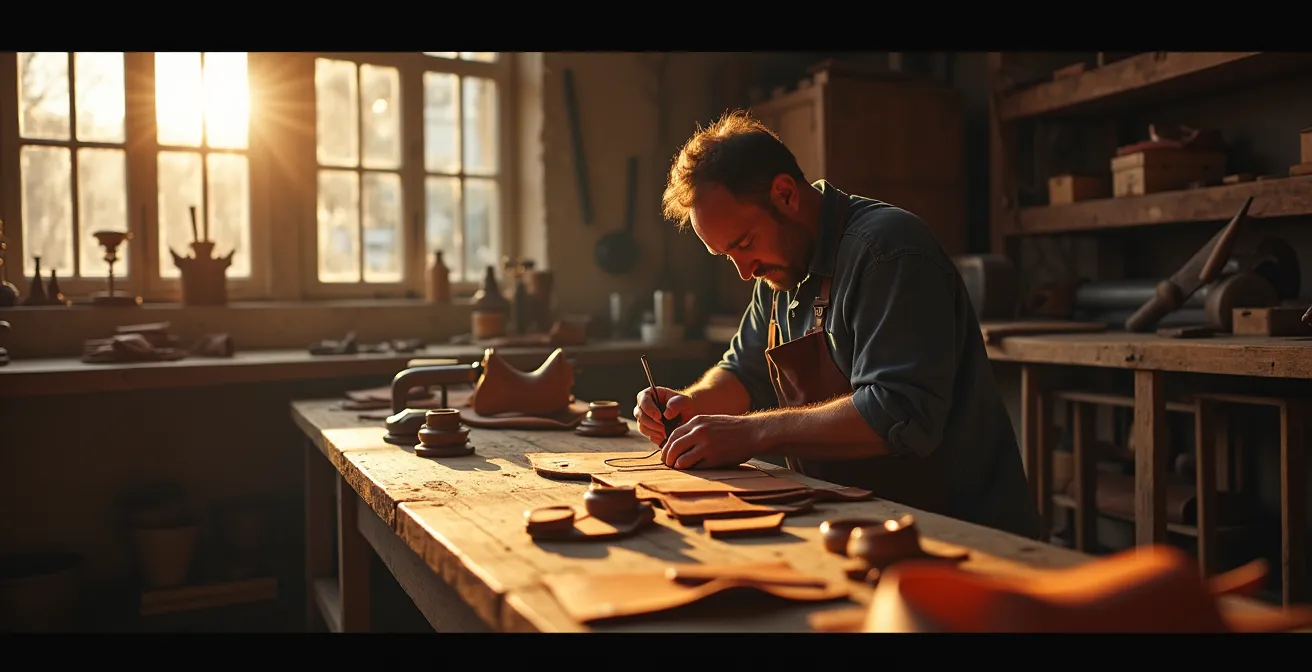
The high price of handmade goods is not about sentiment; it’s a direct measure of superior structural integrity and longevity.
- Hand-sewn saddle stitching is fundamentally more durable than machine sewing, preventing catastrophic failure.
- Authentic craft is identifiable through tangible details like hand-burnished edges and the quality of the materials, which are designed to age beautifully.
Recommendation: Instead of comparing price tags, learn to assess the object’s construction. A well-made artisan product is not an expense, but a long-term investment in an item built to last generations.
You’ve seen it before. You walk into a local market or an online boutique and spot a beautiful leather bag. It feels substantial, it smells incredible, and the details are impeccable. Then you see the price, and it’s five times what you’d pay for a similar-looking item at a department store. The immediate question is always the same: “Why is it so expensive?” For many, the default answers—”it takes more time,” or “you’re supporting an artist”—feel vague and sentimental, failing to justify the significant cost difference. This skepticism is understandable in a world dominated by mass production and fast fashion.
But what if the higher price wasn’t just about ethics or an artist’s time? What if it was a direct reflection of tangible, physical advantages that make the handmade object fundamentally superior? The conversation around handmade goods often misses the most crucial point: true craftsmanship is a form of engineering. It’s about building an object with techniques honed over centuries, designed not just to look good upon purchase, but to gain character and integrity over a lifetime of use. It’s the difference between an item designed for a season and an heirloom designed for a generation.
This guide moves beyond the platitudes. We will dissect the very structure of a handmade object, from the microscopic integrity of a single stitch to the economic realities of its creation. We will arm you with the knowledge to look at a product and see not a price tag, but a story of skill, material honesty, and generational durability. You will learn to identify the subtle but critical details that separate true craft from clever imitation, empowering you to understand, and even seek out, the profound value hidden in plain sight.
This exploration will equip you with a new lens through which to view the objects you own. We will cover the specific techniques, ethical considerations, and even the sensory clues that define quality, allowing you to make informed decisions and truly appreciate the legacy of craftsmanship.
Summary: Why Handmade Goods Justify Higher Price Points?
- Why Saddle Stitching Lasts Longer Than Machine Sewing?
- How to Identify Genuine Craftsmanship Details in Store?
- Mass Production vs Artisan Made: The Ethics of Scale
- The Maintenance Error That Ruins Natural Leather
- How to Support Local Artisans Without Breaking the Bank?
- Learning Forgotten Crafts: Why It Matters for Future Generations
- Chocolate Tasting: Spotting High Cocoa Butter vs Fillers?
- Why Documenting Family Oral History Is Urgent Right Now?
Why Saddle Stitching Lasts Longer Than Machine Sewing?
The single greatest, yet often invisible, indicator of a handmade leather good’s longevity is its stitching. A sewing machine and an artisan’s hands produce two fundamentally different types of seams, with dramatically different outcomes under stress. A machine uses a “lockstitch,” where two separate threads—one from the top and one from the bobbin below—interlock within the leather. While fast and uniform, its weakness is systemic. If one of these threads breaks, the locking mechanism is compromised, and the entire seam can quickly and catastrophically unravel.
In stark contrast, the traditional saddle stitch, performed with two needles on a single, long piece of waxed thread, creates a far more robust structure. The artisan passes both needles through each hole, creating two independent rows of stitches that lock around each other in the middle. As leather craftsmanship experts explain, each saddle stitch effectively creates its own knot. This means that if one stitch were to break from extreme abrasion, the stitches on either side would remain secure, preventing the seam from pulling apart. It is a simple, elegant, and incredibly resilient technique born from the need for equestrian gear that could not fail.
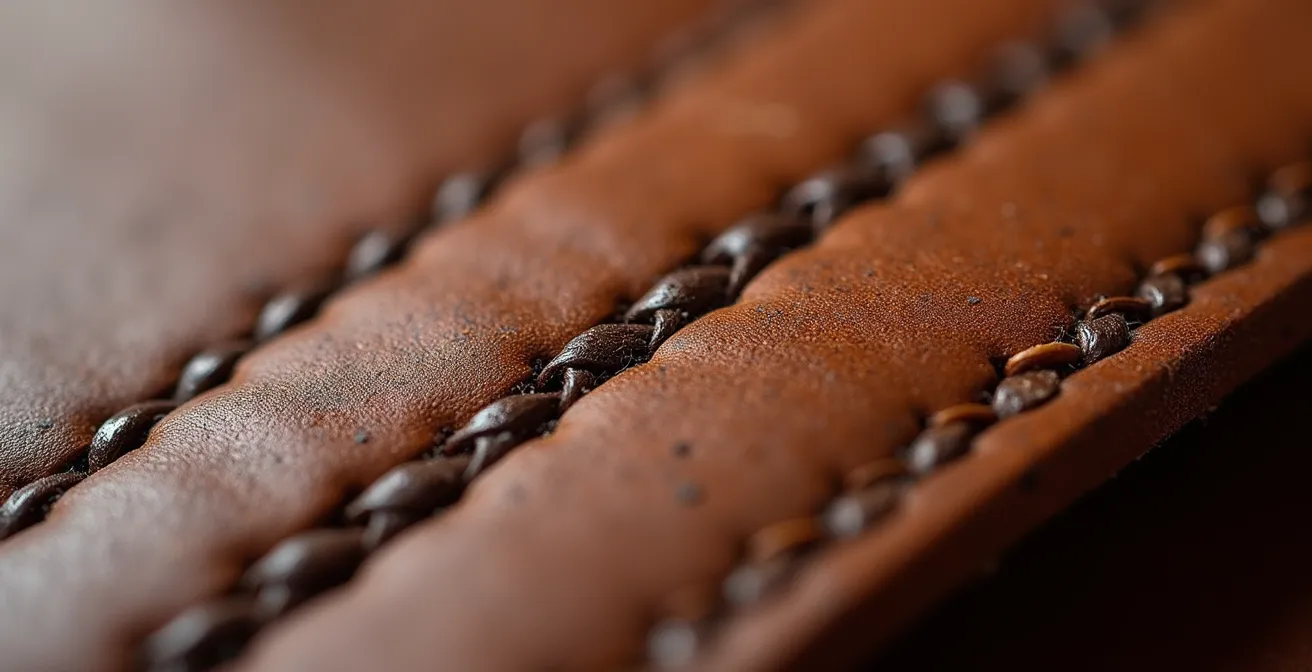
This micro-level detail has macro-level implications for the product’s lifespan. While a machine-sewn bag may look perfect, its seams are its weakest point. A saddle-stitched item has seams that are arguably stronger than the leather itself. This commitment to structural integrity is the first and most compelling reason for the higher price: you are paying for an object engineered to resist failure and endure for decades, not just seasons.
How to Identify Genuine Craftsmanship Details in Store?
Once you understand the superiority of the saddle stitch, your eyes can be trained to spot other tangible signs of authentic craftsmanship. Mass-produced items are designed for speed and uniformity; artisan goods are defined by the deliberate, time-consuming details that enhance both beauty and durability. The work of makers like D&M Leather Studio, for instance, highlights a process where every step is intentional, from hand-cutting leather to respect its grain to punching each hole manually for perfect spacing. When you’re in a store, you’re not just a consumer; you’re an inspector. You can learn to read the story of how an object was made.
The most obvious tells are in the stitching and the edges. Look closely at the stitch line. A saddle stitch will often be slightly angled and may have subtle, human variations, unlike the perfectly straight and flat appearance of a machine lockstitch. The edges of the leather are another dead giveaway. Factory-made goods often have their edges sealed with a rubbery paint or plastic coating, which can crack and peel over time. A true artisan will take the time to burnish the edges—a laborious process of sanding, wetting, and rubbing the leather edge until the fibers compress into a smooth, glossy, and incredibly durable finish. This “perfect imperfection” is a hallmark of the human hand.
This following comparison, based on an analysis of traditional leatherwork, breaks down the key differences to look for.
| Aspect | Machine-Made | Handmade |
|---|---|---|
| Stitching Pattern | Uniform lockstitch | Saddle stitch with slight variations |
| Thread Type | Thin, single thread | Thick, waxed double thread |
| Edges | Painted or sealed | Burnished by hand |
| Repairability | Entire seam must be redone | Individual stitches can be repaired |
| Character | Sterile uniformity | Perfect imperfections |
By learning to spot these details, you shift from a passive buyer to an active participant in the appreciation of craft. You begin to recognize that the value is not just in the final product, but in the hundreds of small, expert decisions made during its creation.
Mass Production vs Artisan Made: The Ethics of Scale
The visual and structural differences between handmade and mass-produced goods are rooted in a fundamental divergence in their economic and ethical models. A large brand’s primary goal is maximizing profit through scale, which involves minimizing the cost of materials and labor. An artisan’s goal, on the other hand, is to create the best possible object, with cost being a consequence of that commitment. This is not a judgment, but a simple statement of different values leading to different products.
The cost structure for an artisan is inverted compared to a large corporation. As the Artisans Cooperative points out in their analysis of handmade pricing, big brands operate on a completely different playing field. As they explain in their guide, “The Cost of Handmade”:
That’s because the big brands purchase their materials in wholesale quantities for much less money, pay their workers much lower wages, and produce goods at scale using automated processes.
– Artisans Cooperative, The Cost of Handmade: How Artisans Price Their Work
Furthermore, an independent maker often sits at the end of a long supply chain. An industry analysis reveals that materials can be marked up at least three times before they even reach the artisan’s workshop. Add to this the artisan’s own labor—which is not a factory wage but a reflection of years of skill acquisition—and the overhead of running a small studio. The final price reflects a transparent sum of high-quality materials, skilled labor, and the simple cost of business, with a much smaller profit margin than you might think.

Choosing a handmade item is an economic vote for a different kind of system: one built on material honesty and fair compensation for skill, rather than the efficiencies of automation and low-cost labor. The price reflects not just the object, but the entire ecosystem of its creation.
The Maintenance Error That Ruins Natural Leather
Investing in a handmade leather item is only the first step. The promise of generational durability can only be fulfilled if the owner becomes a custodian of the material. Natural leather is not a static, inert substance like plastic; it is a skin that needs to breathe, moisturize, and be protected from harsh chemicals. The single biggest maintenance error is treating it like an indestructible material and using common household cleaners on it, which can cause irreparable damage.
Many people, in an attempt to clean or “protect” their leather, reach for the most convenient products: baby wipes, all-purpose sprays, or silicone-based waterproofing products. This is a critical mistake. As FinWatchStraps explains in their care protocols, leather needs to breathe. Sealing its pores with silicone traps moisture inside, leading to rot from within. Similarly, the alcohol and chemicals in many wipes and cleaners strip the leather of its natural oils, causing it to dry out, become brittle, and crack. Petroleum-based products are equally destructive, as they can break down the fibrous structure of the leather itself.
Proper care is simple and requires only a few dedicated products. A gentle cleaner like saddle soap for occasional deep cleans, a high-quality conditioner with natural ingredients like lanolin or beeswax to replenish oils, and a soft microfiber cloth are all that’s needed. The goal is not to mummify the leather, but to work with its nature, allowing it to develop a rich patina—the beautiful darkening and sheen that comes with age and use. This aging process is a feature, not a flaw, of high-quality leather.
Your Leather Care Audit: The Do’s and Don’ts
- SAFE: Natural leather conditioners with lanolin or beeswax. These replenish the essential fats that keep leather supple.
- SAFE: Saddle soap for gentle cleaning. Use sparingly and only when necessary to remove dirt buildup.
- SAFE: Microfiber cloths for wiping. They are gentle and won’t scratch the surface.
- DESTRUCTIVE: Baby wipes with alcohol content. The alcohol will severely dry out and damage the leather fibers.
- DESTRUCTIVE: Silicone-based waterproofing sprays that seal pores. This traps moisture and prevents the leather from breathing, leading to internal rot.
By avoiding these common errors, you are not just cleaning an object; you are actively participating in its journey. You are ensuring that the artisan’s initial work is honored and that the item can live up to its full, long-lasting potential.
How to Support Local Artisans Without Breaking the Bank?
Appreciating the value of handmade goods doesn’t mean you have to immediately purchase the most expensive item in a maker’s collection. The ecosystem of craft thrives on all levels of support, and there are numerous meaningful and affordable ways to champion the work of local artisans. Often, the most impactful support goes beyond the initial transaction and helps build the artisan’s reputation and reach, which is invaluable for a small business.
A powerful, no-cost way to help is by becoming a digital advocate. Following makers on social media, sharing their posts, and leaving detailed, thoughtful reviews on their products can significantly boost their visibility. A genuine review that speaks to the quality and your experience is far more valuable than a simple star rating. Another strategy is to start with “gateway items.” Most artisans offer a range of products, including smaller, more accessible pieces like keychains, wallets, or notebooks. These items are made with the same care and quality materials as their larger counterparts and offer a perfect entry point into the world of that maker.
Furthermore, buying directly from the artisan whenever possible is a huge help. When you purchase from a large online marketplace, a significant portion of the price goes to platform fees. For example, some marketplace analysis shows that platforms can take transaction fees of 6.5% or more, which either cuts into the maker’s slim profit margin or gets passed on to the consumer. Buying directly at a craft fair or from their personal website ensures that the maximum amount of your money goes to the person who made the item. Here are some simple, budget-friendly ways to show your support:
- Follow artisans on social media and share their work regularly.
- Leave detailed, thoughtful reviews on their platforms.
- Start with gateway items like keychains or small accessories.
- Join pre-order campaigns for new designs.
- Buy directly from makers to avoid marketplace fees.
- Attend local craft fairs for better prices than online.
- Sign up for newsletters to catch sales and promotions.
Supporting craft is not an exclusive club for the wealthy. It’s a community built on appreciation, and every act of support, big or small, helps keep the legacy of these skills alive and thriving.
Learning Forgotten Crafts: Why It Matters for Future Generations
The conversation around handmade goods ultimately transcends the individual object. Each artisan is a living library, a custodian of skills and knowledge passed down through generations. When an artisan stops practicing their craft due to a lack of support, it’s not just a small business that closes; it’s a chapter of our shared human history that is lost. Supporting craftsmanship is an act of cultural preservation.
This sense of urgency is palpable within the craft community. As the leather goods maker Waskerd passionately states:
Artisans are becoming extinct. For the person who appreciates the blood, sweat, and tears that go into handcrafted goods, you understand why it is worth paying a little more for artisanal goods made to last.
– Waskerd, Hand Stitching Leather Basics
This is why institutions dedicated to teaching these skills are so vital. They serve as a bridge between the past and the future, ensuring that this embodied knowledge doesn’t vanish. They transform tacit, hands-on skill into a teachable curriculum, keeping the flame of tradition alive for a new generation of makers.
Case Study: The Walsall Leather Skills Centre
A prime example of this preservation in action is the Walsall Leather Skills Centre in the UK. By becoming an official test centre for prestigious City & Guilds Saddlery Qualifications, they have formalized the transmission of heritage skills. Their workshops teach foundational techniques like saddle stitching to a wide range of students, from complete beginners to experienced craftspeople. This ensures that the knowledge is not only preserved but also disseminated, creating a new generation of artisans who understand both the mechanics and the philosophy of traditional craftsmanship.
When you buy from an artisan, you are indirectly funding this chain of knowledge. You are providing the economic incentive for a master to teach an apprentice, for a school to run a workshop, and for a forgotten technique to find new hands. It’s an investment in a future where craft as knowledge remains a vibrant and essential part of our culture.
Chocolate Tasting: Spotting High Cocoa Butter vs Fillers?
Developing an appreciation for craftsmanship is akin to developing a palate. At first, things might just seem “good” or “bad,” but with practice, you learn to detect nuance, quality, and authenticity. We can draw a powerful analogy from the world of artisan chocolate. Just as a fine leather good is defined by its material and technique, a high-quality chocolate bar is defined by its cocoa butter content and the skill of the chocolatier, as opposed to cheap fillers and industrial processing.
You can train your senses to identify quality in chocolate using simple tests, and the same principles apply to other crafts. A high-quality chocolate bar, rich in cocoa butter, will have a clean, sharp “snap” when you break it. A lower-quality bar with vegetable fat fillers will have a dull thud or crumble. Similarly, real cocoa butter melts cleanly at body temperature, leaving no waxy residue on the tongue, unlike hydrogenated fats. These sensory clues are direct indicators of material quality. Learning to perform these tests trains your brain to look for similar signs of quality elsewhere.
- The Snap Test: Break the chocolate. A sharp, clear snap indicates high cocoa butter content and proper tempering. A dull thud suggests fillers.
- The Melt Test: Place a piece on your tongue. Real cocoa butter will melt smoothly and cleanly. A waxy or greasy coating is a sign of cheaper hydrogenated fats.
- Visual & Aroma: A glossy sheen indicates good tempering, and the aroma should be complex and nuanced, not just vaguely “sweet.”
Just as there are legal standards for what can be called “dark chocolate” in different regions, there are unwritten but deeply understood standards of quality in every traditional craft. The table below shows how even a common product has defined quality markers—a useful parallel for understanding the implicit standards in crafts like leatherworking.
| Chocolate Type | EU Standards | US Standards |
|---|---|---|
| Dark Chocolate Min. Cocoa | 35% total, 14% non-fat, 18% butter | 35% total (no butter minimum) |
| Milk Chocolate | 25% total cocoa, 12-14% milk solids | 10% chocolate liquor, 12% milk solids |
| White Chocolate | 20% cocoa butter minimum | 20% cocoa butter, 55% sugar max |
| Artisan Standards | 45-68% cacao typical | 35%+ cocoa butter typical |
This exercise in sensory education is not trivial. It’s about developing “quality literacy”—the ability to recognize and value genuine substance over superficial appearance, whether in a piece of chocolate or a hand-stitched wallet.
Key takeaways
- Handmade goods are not just ethically superior; they are often structurally stronger due to techniques like saddle stitching.
- You can learn to identify genuine craftsmanship by looking for tangible details like hand-burnished edges and the quality of the thread.
- The price of an artisan product reflects transparent costs of high-quality materials and skilled labor, not the scaled-down costs of mass production.
Why Documenting Family Oral History Is Urgent Right Now?
In the end, the justification for a handmade object’s price transcends its physical properties and economic realities. It touches upon something deeper: its connection to a human story. A handmade item is a piece of tangible history, an artifact imbued with the knowledge, intention, and signature of a specific person. In an age of anonymous, disposable goods, this connection is a rare and profound form of value. It is, in essence, a form of oral history you can hold in your hands.
This idea of documenting stories is more urgent than ever. Just as we are encouraged to record the stories of our elders before they are lost, we should also recognize that an artisan’s skill is a form of living history. The way a woodworker shapes a joint, a weaver works a loom, or a leatherworker stitches a seam is a story being told through action. Each object they create is a document of that story. As the Artisans Cooperative beautifully states, the difference is one of fundamental values:
While the price tags on authentically handmade goods might seem different from major retailers and brands, that’s because they are different products, created by different people with different values. Every cent is considered and justified, and every purchase is appreciated.
– Artisans Cooperative, The Cost of Handmade
When you buy a handmade bag, you are not just acquiring a possession. You are becoming the custodian of a story—the story of its maker, of the traditions behind their skill, and of a more conscious approach to consumption. The object ceases to be a simple commodity and becomes a connection. It holds the “oral history” of its creation in its very fibers. The higher price, then, is not just for a thing, but for the privilege of owning a piece of that story, a tangible connection to a human legacy in a world of impersonal objects.
The next time you encounter a beautifully crafted handmade item with a price tag that gives you pause, take a moment. Look closer at the stitches, feel the burnished edges, and consider the story it holds. The most valuable things in our lives are rarely the cheapest, and investing in true craftsmanship is an investment in objects with integrity, history, and a soul.