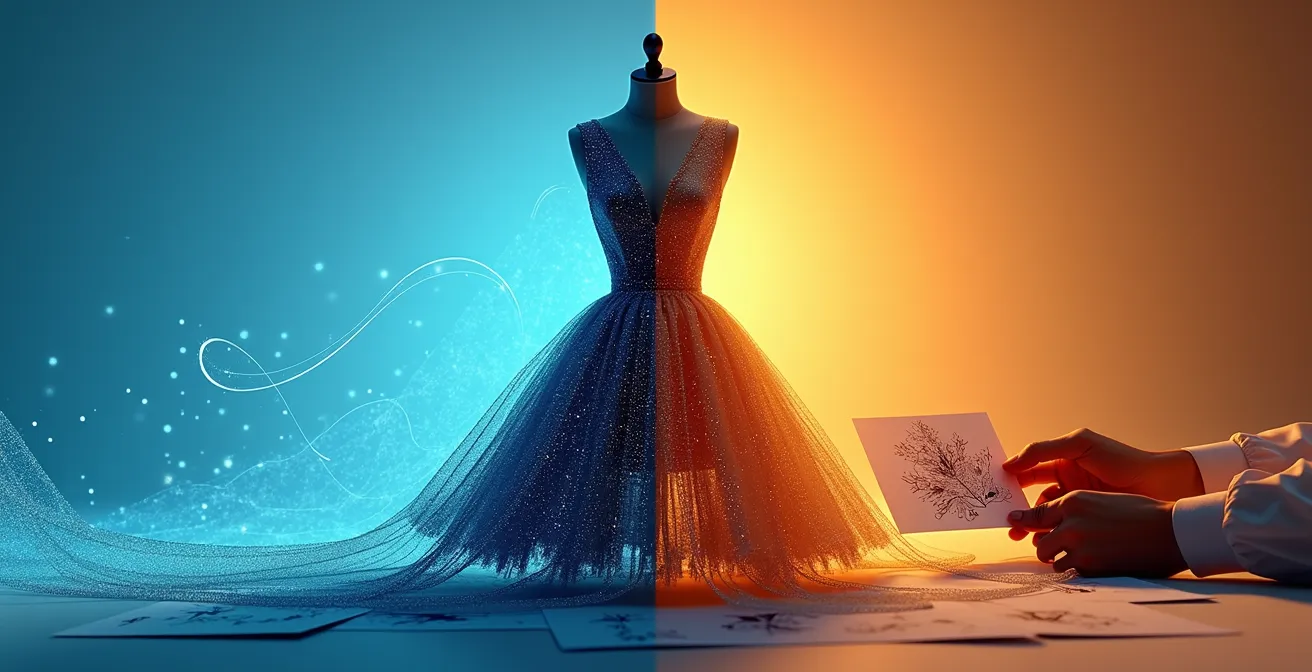
The debate isn’t about AI replacing human stylists; it’s about shifting the user’s role from a passive consumer to an active data translator.
- An AI’s ability to understand your taste is limited by its initial focus on object recognition, not personal context.
- Success depends on your ability to provide structured, nuanced feedback—a skill that requires learning and practice.
Recommendation: Treat your AI stylist like a powerful intern. You must invest time in training it with specific data and contextual prompts to offload the cognitive burden of daily styling decisions effectively.
For any busy professional, the daily question of “what to wear” represents a recurring drain on cognitive energy. It’s a series of small but compounding decisions that chip away at your focus before the workday even begins. The promise of an AI-powered stylist—a digital assistant that curates perfect outfits from your own wardrobe—seems like the ultimate life hack. Subscription boxes and styling apps are flooding the market, all claiming to solve this exact problem with the power of machine learning.
The common discourse pits the cold efficiency of algorithms against the warm, empathetic touch of a human stylist. We’re told that AI saves time, while humans understand feeling. But this binary view misses the point entirely and overlooks the fundamental shift in how we must now interact with technology. The real challenge isn’t choosing between a bot and a person. It’s about understanding that an AI stylist’s success is not magical; it’s a direct reflection of a new, crucial skill: your ability to translate the abstract art of personal taste into the hard science of data.
This article moves beyond that simplistic debate. We will dissect the cognitive architecture behind personal style, explore why early AI failed to grasp it, and provide a clear framework for training your digital assistant. We will investigate the “empathy gap” in handling complex body issues and look toward a future where the lines between digital and physical wardrobes blur, ultimately answering whether an algorithm can truly dress you better—or if it simply equips you to dress yourself better.
text
This guide breaks down the core components of the human-AI styling partnership, from the technology’s limitations to the practical skills needed to master it. The following sections will provide a complete picture of this evolving relationship.
Summary: The New Rules of Algorithmic Style
- Why AI Struggled to Understand Personal Taste Until Now?
- How to Train Your Styling App to Learn Your Preferences?
- Human Stylist or AI Bot: Who Solving Complex Body Issues?
- The Hassle of Cataloging Your Wardrobe for AI Apps
- Future of Shopping: The End of Standard Sizing?
- Why Your AI Prompts Are Generating Generic Results?
- App Integration: Getting Personalized Discounts In-Store?
- Using LLMs to Automate Mundane Office Tasks Safely
Why AI Struggled to Understand Personal Taste Until Now?
The initial promise of AI in fashion was built on a fundamental misunderstanding of style. Early systems, powerful in their own right, were designed for object recognition, not contextual understanding. As a developer’s experiment with Google Cloud Vision API showed, an AI could identify an item as ‘Fashion’ with 90% confidence, but it had no concept of *why* someone would wear it. It could see a floral dress, but it couldn’t differentiate between a dress for a beach vacation and one for a funeral. This is the core reason for AI’s historical struggle: it was mastering classification, not curation. It lacked the ability to process the thousands of micro-variables—mood, weather, occasion, social codes, self-perception—that constitute personal taste.
This gap is precisely what a personal stylist once articulated in frustration: “The problem with you people in tech is that you’re always looking for some kind of theory or strategy or formula for fashion.” True style is often illogical and emotionally driven. However, the technology is rapidly evolving. The AI-based personalized stylist market is no longer a niche experiment; it’s an industry experiencing explosive growth. Valued at a significant sum, projections show the market is set to expand with a compound annual growth rate of over 36.5% between 2025 and 2034. This financial injection is fueling a new generation of algorithms that move beyond simple tagging toward understanding the complex relationships between items, occasions, and user feelings.
The new frontier is not about identifying a ‘shirt’ but about building a cognitive architecture of your style. It involves creating a complex web of associations that mimics, and in some ways exceeds, human capacity for memory and combination. The struggle is shifting from the AI’s inability to see, to the user’s ability to teach it how to perceive.
How to Train Your Styling App to Learn Your Preferences?
Treating an AI stylist like a mind-reader is the fastest path to frustration. The key to unlocking its potential is to see yourself as its trainer. This process, which we can call preference calibration, requires a deliberate and structured approach to feedback. A simple “like” or “dislike” is low-quality data. The algorithm needs to know *why*. Was the fit wrong? The color unflattering? Was it perfect for a weekend brunch but completely inappropriate for the office? This is the high-quality data that accelerates its learning curve.
The effort invested in this initial phase pays significant dividends. According to industry data, modern AI stylists can achieve an impressive 85-92% satisfaction rate after just two to three weeks of consistent, detailed feedback. This demonstrates that the technology is capable; it just needs the right inputs. Your role is to become an expert in translating your intuitive feelings into structured feedback that the machine can process and learn from.
This learning process transforms a chaotic collection of clothes into an organized, functional system. The journey from a random assortment of items to a perfectly curated set of recommendations is a visual representation of machine learning in action. The AI begins to form connections you might have missed, pairing old forgotten pieces with new acquisitions in unexpected ways.

As you can see, the process is one of creating order from chaos. To actively guide this process, you need a clear plan of action. The following checklist outlines the essential steps to effectively train your AI stylist and make it a genuinely useful tool rather than a novelty.
Your action plan: Optimizing your AI’s learning curve
- Choose your tool: Select an AI stylist based on your primary goal (e.g., daily outfit creation, shopping assistance, or wardrobe organization).
- Provide the raw data: Methodically photograph your existing clothes so the AI can analyze what you already own and integrate it into its recommendations.
- Give contextual feedback: Go beyond simple likes. Add notes about why something worked or didn’t, specifying details about the occasion, fit, and feel.
- Experiment with mood boards: Create visual collections of styles you aspire to, even if they are outside your comfort zone, to push the algorithm’s boundaries.
- Use specific negative feedback: Instead of a generic “dislike,” use descriptive terms like “too boxy,” “color washes me out,” or “fabric feels cheap” to refine the AI’s understanding quickly.
Human Stylist or AI Bot: Who Solving Complex Body Issues?
While an algorithm can master color theory and pattern matching, it runs into a hard wall when faced with the deeply personal and emotional landscape of body image. This is where the distinction between a tool and a coach becomes stark. An AI operates on cold data—measurements, fit preferences, and past choices. A human stylist, however, works with the person inside the clothes, addressing insecurities and reframing perceived flaws. This critical distinction is what some in the industry call the “empathy gap.”
The Empathy Gap: A human stylist acts as a coach, reframing perceived flaws and celebrating unique features. An AI, working from cold data, can inadvertently reinforce insecurities.
– Fashion Technology Analysis, AI Fashion Stylist Technology Overview
An algorithm might notice you consistently reject tight-fitting clothing and simply stop recommending it, effectively building a digital wall around an insecurity. A human stylist would ask *why*, perhaps introducing a different cut or fabric that achieves a similar silhouette without triggering discomfort, helping the client to explore new possibilities. For a busy professional dealing with body changes or simply wanting to feel more confident, this empathetic guidance is something pure data processing cannot yet offer.
However, the most promising solutions aren’t a strict either/or. A new hybrid model, the “Cyborg Stylist,” is emerging, where AI and human expertise augment each other. The AI handles the laborious data analysis while the human provides the creative and emotional intelligence.
Case Study: The Style3D Hybrid Approach
The work of companies like Style3D exemplifies this hybrid model. Their platform combines AI-driven styling suggestions with advanced 3D design tools. This allows a designer or stylist to take a concept, convert it into a realistic 3D garment, and conduct virtual fittings on a client’s avatar instantly. Here, the AI manages the technical complexities of digital pattern-making and physics-based fabric simulation, freeing up the human stylist to focus entirely on the creative decisions, fit, and client feedback. It’s a partnership where each party does what it does best.
The Hassle of Cataloging Your Wardrobe for AI Apps
The biggest hurdle to entry for any AI styling app is the initial setup: the tedious task of cataloging your entire wardrobe. For a busy professional, the idea of spending a weekend photographing every shirt, pair of trousers, and accessory can feel more daunting than the problem it’s supposed to solve. This friction at the onboarding stage is a significant barrier. Why invest hours of manual labor for an unproven return? The answer lies in a simple cost-benefit analysis of your time.
The motivation to push through this initial “hassle” comes from the long-term payoff. Studies show that the average person spends a significant amount of time deciding what to wear each day. By automating this process, AI stylists can slash that time dramatically. Research from platform developers indicates that users can reduce their decision-making time from an average of 17 minutes daily to under 2 minutes once the system is operational. Over a year, this translates to over 100 hours of reclaimed time—a compelling incentive for enduring the initial setup.
Furthermore, the technology for cataloging is rapidly evolving away from manual labor. The future of wardrobe management will be largely automated, making the current hassle a temporary problem. The industry is moving towards a seamless, low-effort future.
| Method | Time Required | Availability |
|---|---|---|
| Manual Photo Upload | 4+ hours for full wardrobe | Current |
| AI-enriched metadata | 1-2 hours | 2024-2025 |
| E-receipt auto-population | Automatic | Testing phase |
| RFID smart hangers | Initial setup only | Future (2026+) |
Future of Shopping: The End of Standard Sizing?
The ultimate application of AI in fashion extends far beyond organizing your current wardrobe. It points toward a future where mass-produced, standard sizing becomes a relic of the past. By combining your detailed style preferences with precise body-scan data, AI can facilitate a new era of on-demand, perfectly fitted, custom-made clothing. This is the end-game: a ‘segment of one’ market where every garment is made for an individual, eliminating the frustrating and often demoralizing experience of trying to fit a unique body into a standardized mold.
This hyper-personalization is powered by the concept of a digital twin—a highly accurate 3D avatar of your body. Brands can use this avatar to conduct virtual fittings, ensuring a perfect fit before a single piece of fabric is cut. This not only promises better-fitting clothes but also represents a monumental shift towards sustainability by drastically reducing returns and the waste from overproduction. The innovation is happening at the material level, with smart fabrics integrating technology directly into the weave.

However, this utopian vision of fashion comes with a critical caveat: data privacy. The level of detail required for this revolution is immense and deeply personal. As one data privacy analysis notes, this convenience has a cost. The question is not just whether the technology works, but who controls the intimate data that fuels it.
As one market report on AI-driven virtual stylists warns, “To get custom-made clothes, you must surrender a precise 3D scan of your body. Who owns this data? How is it secured?” As we move toward this future, consumers will need to weigh the undeniable benefits of perfect-fit clothing against the significant privacy implications of surrendering their most personal physical data. The conversation will shift from style and fit to security and ownership.
Why Your AI Prompts Are Generating Generic Results?
If you’ve experimented with a ChatGPT-powered stylist and received bland, generic suggestions, the problem may not be the AI—it’s the prompt. Just as with training a styling app, the quality of the output is directly tied to the quality of the input. A vague request like “What should I wear for winter?” is the data equivalent of a shrug. It lacks the context necessary for a truly personalized recommendation. The AI defaults to the safest, most statistically common answer, resulting in a generic look.
To break free from this, you must master the art of narrative prompting. Instead of listing keywords, you describe a scenario. “I’m attending a creative industry networking event in a chilly, converted warehouse in the evening. I want to look approachable and professional, but not corporate. I’ll be standing for most of the night, so comfort is key.” This rich, contextual prompt gives the AI dozens of data points to work with: formality level, temperature, venue aesthetic, desired impression, and practical constraints.
The most advanced platforms are being built specifically to interpret this kind of natural language. A case study on YesPlz’s GPT Fashion Stylist highlights its use of advanced NLP and sentence transformers. This technology allows it to understand complex and even incomplete questions, like a human assistant would. It’s a move away from rigid command structures towards a more conversational interaction, making the data translation process feel more natural for the user.
To elevate your results, you must apply more sophisticated prompting techniques. This involves:
- Adding negative constraints to explicitly rule things out (e.g., ‘no stilettos,’ ‘avoid fast-fashion brands’).
- Including contextual layers that define the environment and your role in it (‘I will be speaking on a panel,’ ‘needs to be packable for a carry-on’).
- Applying persona prompting by assigning the AI a role (‘You are an expert stylist for a tech CEO’).
- Referencing style icons or specific aesthetic movements (‘channel a 1970s Lauren Hutton vibe’) for clearer visual direction.
App Integration: Getting Personalized Discounts In-Store?
The true power of an AI stylist is unleashed when it breaks free from the confines of your phone and integrates with the wider retail ecosystem. The next phase of this technology involves a seamless connection between your digital wardrobe, your style preferences, and the physical stores you visit. Imagine walking into a department store and receiving a notification on your phone: “The blue blazer on the second floor is a 95% match for your style profile, pairs perfectly with three pairs of trousers you already own, and is currently available with a 15% personalized discount.”
This is not a distant fantasy; it’s the direction the industry is heading. For retailers, the incentive is enormous. Companies that effectively use AI for personalization have seen significant revenue growth, with some reports showing as much as a 77% increase in sales from these initiatives. This creates a powerful win-win scenario: the consumer gets a highly relevant, curated shopping experience, and the retailer increases sales and customer loyalty.
Conversely, the risk of getting personalization wrong is equally high. A constant barrage of irrelevant suggestions can quickly turn a helpful tool into a nuisance, eroding trust and driving customers away. The stakes are high, as research from YesPlz AI found that 38% of US shoppers stated they would stop shopping at a retailer that consistently made poor product recommendations. Success hinges on the quality of the AI’s data and its ability to understand nuance, reinforcing the importance of the user’s role in the training process.
This integration bridges the gap between online discovery and offline purchasing, creating a truly omnichannel experience. Your AI stylist becomes not just a wardrobe organizer but a savvy shopping companion that knows your taste, your budget, and your existing inventory.
Key Takeaways
- The value of an AI stylist is not automatic; it is directly proportional to the quality and context of the feedback you provide.
- Algorithms excel at data processing and combination, but human stylists remain superior for navigating the emotional complexities of body image and confidence (the “empathy gap”).
- The future of fashion tech points towards hyper-personalization and the end of standard sizing, but this raises significant data privacy questions that users must consider.
Using LLMs to Automate Mundane Office Tasks Safely
For the busy professional, the ultimate goal of this technology is automation. It’s about delegating the “mundane tasks” of style management to an AI to free up mental bandwidth for more critical decisions. By leveraging Large Language Models (LLMs) and integrating them with other digital tools, your AI stylist can evolve from a reactive suggestion engine into a proactive strategic planner. This is where the initial investment in data entry and training delivers its highest return.
The most powerful application of this is calendar integration. An advanced AI can scan your work calendar, identify an event like “Board Meeting” or “Business Trip to Dubai,” and proactively assemble appropriate outfits. It can cross-reference the event type with your style history, the weather forecast for the location, and even check for cultural appropriateness. As demonstrated by platforms like Glance AI, the system can automatically suggest a specific outfit—like a velvet blazer and brogues for a winter event—based on your schedule, without you ever having to ask. This offloads the entire cognitive architecture of professional dressing.
Beyond daily outfits, you can use these tools for higher-level strategic planning. You can task an LLM with creating a seasonal capsule wardrobe aligned with your professional goals, such as “Generate a 12-piece fall capsule wardrobe for a creative director aiming for a minimalist but authoritative look.” It can function as your automated wardrobe planner, your personal brand consultant, and your cultural context checker, all in one. The key is to see it not just as a closet organizer, but as a system for managing your professional image efficiently and safely, with your data under your control.
Ultimately, the question is not whether an algorithm can dress you better than a stylist, but whether you are prepared to become the director of your own algorithmic styling team. Start today by viewing your wardrobe not as a collection of clothes, but as a dataset waiting to be optimized. Your next step is to choose a tool and begin the process of preference calibration, turning your abstract taste into actionable intelligence.