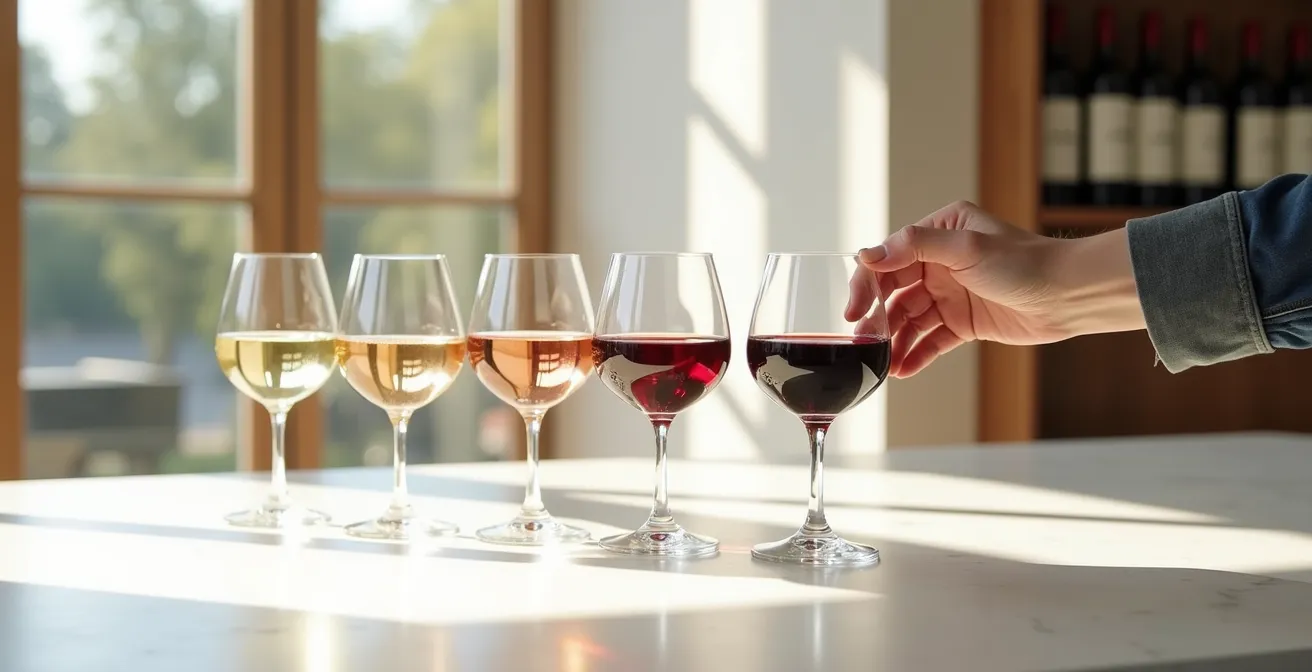
Tasting wine like a professional has less to do with the ‘five S’s’ and more with deconstructing every flavor you encounter in daily life.
- The texture of high-quality chocolate trains your palate to recognize the structure and tannins in red wine.
- Exploring global street food and spices builds a diverse mental “flavor library,” which is a sommelier’s most crucial tool.
Recommendation: Start actively cataloging tastes and textures in a journal—your wine palate will transform.
Picture the scene: a hushed room, a flight of gleaming glasses, and a sommelier speaking in a language of leather, lychee, and limestone. For many novice wine drinkers, this world can feel intimidating, a closed-off club with secret handshakes. You’ve likely been told the basics—to see, swirl, sniff, sip, and savor. This five-step ritual is a valid starting point, a mechanical framework for approaching what’s in your glass. It teaches you the “what” of tasting.
But it’s a well-kept secret that this process is only the final act. The real training, the work that separates a casual sipper from a true connoisseur, happens far away from the vineyard and the tasting room. It occurs at the breakfast table, in the spice aisle of a market, and at a bustling street food stall. The conventional advice focuses on the wine, but misses the fundamental truth of the craft.
What if the key to unlocking the complex world of wine wasn’t about memorizing more tasting notes, but about building a more sophisticated palate? The true skill of a sommelier lies in their vast internal flavor library—a mental database of tastes, textures, and aromas meticulously collected and cross-referenced over years of conscious sensory deconstruction. This is not about being born with a “good palate”; it’s about training your brain to pay attention.
This guide will not rehash the five S’s. Instead, it will reveal how to build your own flavor library. We will explore how tasting chocolate can teach you about tannins, why the science of salt and acid is crucial for understanding balance, and how your own childhood memories are your most powerful tool for identifying aromas. Prepare to see the world of flavor in a completely new way.
To guide you on this journey of sensory development, this article breaks down the essential, often overlooked, skills that form the foundation of a sommelier’s expertise. The following sections will provide a roadmap for training your palate using everyday experiences.
Summary: Develop a Sommelier’s Palate: The Secret Is Outside the Wine Glass
- Chocolate Tasting: Spotting High Cocoa Butter vs Fillers?
- Water or Bread: The Best Way to Reset Your Taste Buds?
- Street Food 101: How to Eat Locally Without Getting Sick?
- Salt and Acid: Why This Combo Makes Everything Taste Better?
- Tasting Menu Etiquette: Is Service Included in the Price?
- Why Certain Spices Trigger Instant Childhood Memories?
- Organic or Local: Which Matters More for Nutrient Density?
- The Legal Risks of Bringing Food Souvenirs Home
Chocolate Tasting: Spotting High Cocoa Butter vs Fillers?
Before you can identify the subtle notes in a Grand Cru Classé, you must first learn to perceive structure and texture. Wine isn’t just about flavor; it’s about how it feels in your mouth. This is where a simple square of chocolate becomes an invaluable training tool. The difference between high-quality chocolate and a cheap candy bar is a masterclass in texture that directly translates to wine. Quality chocolate is defined by its high percentage of cocoa butter, a fat that melts precisely at human body temperature, coating your mouth in a smooth, velvety layer.
In contrast, low-quality or compound chocolate often uses other vegetable fats as fillers. These fats have a different melting point, resulting in a texture that can feel waxy or greasy and dissolves too quickly, leaving little to no lingering sensation. This is the first lesson in sensory deconstruction. By paying close attention, you can learn to distinguish a silky, long finish from a grainy, abrupt one. This very same skill is what allows a sommelier to assess the quality of tannins in a red wine—are they fine-grained and velvety, or are they coarse and astringent? The coating sensation of melting cocoa butter is remarkably similar to the feeling of well-integrated polyphenols from a fine wine.
As Master Sommelier George Miliotes demonstrates in his professional training, identifying subtle texture variations is a core component of systematic evaluation. His blind tastings, formatted like the rigorous Master Sommelier examinations, force participants to move beyond simple flavor identification and into the critical analysis of a wine’s structural components. Learning to spot fillers in chocolate is, in essence, your first step into this more advanced world of texture analysis.
Your Action Plan for Sensory Deconstruction: Chocolate Edition
- Isolate the Subject: Choose two chocolates: one high-quality (70%+ cacao) and one common candy bar. Find a quiet space where you can focus without olfactory or auditory distractions.
- Document Initial Aromas: Before tasting, smell each chocolate. Note the differences. Does one smell rich and earthy, the other simply “sweet”? Write down your first impressions.
- Analyze the Texture: Place a small piece of the high-quality chocolate on your tongue. Do not chew. Close your mouth and let it melt. Note how it coats your palate. Is it silky, creamy, velvety? How long does the sensation last after it’s gone? Repeat with the other chocolate and document the contrast (waxy, grainy, fast-dissolving).
- Identify Core Tastes: Now, consciously taste for the five basic flavors in each: sweetness, bitterness, sourness, saltiness, and umami (savory). High-quality dark chocolate will have prominent bitterness and little sweetness, while the candy bar will be dominated by sweetness.
- Connect to Wine: The next time you drink a red wine, actively search for that same mouth-coating sensation. This is tannin. Is it a “high-cacao” or a “cheap-filler” tannin? This exercise builds a direct textural bridge in your flavor library.
Water or Bread: The Best Way to Reset Your Taste Buds?
As you move from one wine to the next, or from a piece of chocolate to a sip of wine, your palate can become overwhelmed. This phenomenon, known as palate fatigue, is a significant obstacle. In fact, research from sommelier training programs indicates a potential 73% decrease in aroma detection accuracy after tasting just six wines without a proper reset. This makes the choice of a palate cleanser not just a matter of tradition, but of scientific necessity. The question of water versus bread is not about preference; it’s about understanding the mechanism required for the job.
The two most common cleansers, still water and plain bread, work in fundamentally different ways. Still water is a simple solvent; it rinses away water-soluble compounds left in your mouth, making it effective for resetting between light, similar wines. However, it’s often insufficient when faced with the powerful, fatty, or astringent compounds found in heavy red wines. Tannins, for example, are polyphenols that bind to proteins in your saliva, creating that characteristic drying sensation. Water alone can’t effectively remove them.
This is where more advanced tools come into play. Plain, untoasted bread or crackers work mechanically, with the starch acting like a sponge to absorb tannins and fats. For an even more powerful reset, sommeliers often turn to sparkling water. The carbonation and slight acidity physically lift and scrub compounds from the tongue and taste buds, providing a more complete “reboot.” Understanding which tool to use is key to maintaining sensory acuity throughout a tasting.
The following table, based on professional tasting practices, breaks down the best uses for common palate-cleansing methods, moving from simple rinsing to more advanced techniques used for difficult transitions between wines.
| Method | Best For | Mechanism | Professional Usage |
|---|---|---|---|
| Still Water | Light whites, rosé | Rinses water-soluble compounds | Basic reset between similar wines |
| Sparkling Water | Heavy reds, tannic wines | Carbonation physically lifts compounds from tongue | Preferred by sommeliers for complete reset |
| Plain Bread | High-tannin wines | Starch absorbs tannins and fats mechanically | Traditional European tasting method |
| Green Apple Slice | Sweet or heavy wines | Malic acid shocks and resets taste buds | Advanced technique for difficult transitions |
| Coffee Grounds (sniff only) | Aromatic whites | Olfactory reset through contrast | Borrowed from perfume industry |
Street Food 101: How to Eat Locally Without Getting Sick?
A sommelier’s flavor library cannot be built on wine and chocolate alone. To truly develop a global palate, one must venture into the world’s most vibrant and authentic classrooms: its streets. Street food offers an uncurated, intense, and often complex tapestry of flavors that are essential for expanding your sensory vocabulary. It’s here you’ll find the specific smoky note of a particular chili, the unique funk of a fermented ingredient, or the precise herbal character of a local green. These are the very notes that might later appear in a glass of wine.
However, this exploration comes with an obvious risk. The key to safely building your flavor library through street food is to follow a few pragmatic rules. The most important principle is to choose vendors with high customer turnover. A long line of locals is the best indicator that the food is not only delicious but also fresh. Watching the food being cooked to order at high temperatures (ideally above 165°F/74°C) is another critical safety check, as this kills most harmful pathogens. It’s also wise to start with cooked items before graduating to raw preparations, allowing your system to acclimate.
This process of exploration is not just about tourism; it is a professional development tool. As highlighted by Alice Achayo, founder of The Wine Linguist, traditional wine language often feels exclusionary to those with different cultural backgrounds. Raised on the bold flavors of Ugandan cooking, she built a platform to connect wine to one’s own taste memories. Her work demonstrates how safely exploring global food traditions builds the essential sensory vocabulary needed to describe wine in a more personal and authentic way. The “gamey” note a European might find in a Syrah could be the “suya spice” note for someone familiar with Nigerian street food. Both are correct; the goal is to build the reference points in your own mind.
Salt and Acid: Why This Combo Makes Everything Taste Better?
While exploring exotic flavors expands your library, understanding the fundamental architecture of taste is what allows you to appreciate harmony and balance. At the core of all great food and wine are two pillars: salt and acid. This combination is a form of sensory magic, a biochemical reaction that elevates every other component. Salt, in small quantities, doesn’t just make food salty; it acts as a universal flavor enhancer by suppressing bitterness and making the aromas of other ingredients more prominent. Think of how a tiny pinch of salt makes a caramel sauce or a ripe melon taste more intensely of itself.
Acid, on the other hand, provides brightness, lift, and structure. It cuts through richness and fat, cleansing the palate and preventing a dish from feeling heavy or cloying. A squeeze of lemon on grilled fish or a dash of vinegar in a hearty stew brings all the flavors into sharp focus. When salt and acid are in balance, they create a mouthwatering effect, literally stimulating saliva production and making you want to take another bite—or another sip.
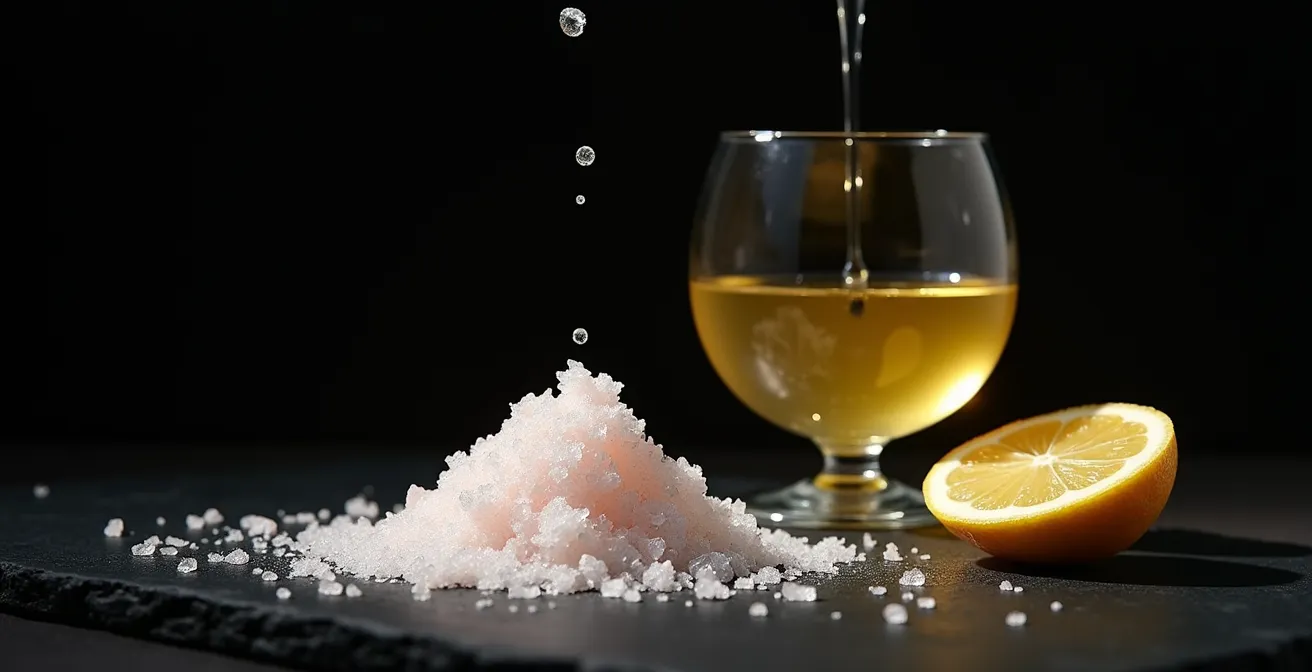
This principle is the absolute bedrock of wine pairing and evaluation. A wine with good acidity will feel fresh, vibrant, and cleansing, making it a perfect companion to food. A wine that lacks acid feels “flabby” and lifeless. Similarly, certain wines possess a saline or “mineral” quality that functions much like a sprinkle of salt. The best wines, like the best dishes, demonstrate an internal balance where the fruit, tannins, and other components are perfectly framed by this dynamic duo. As demonstrated in tastings of wines made from regenerative organic grapes, a wine’s internal balance between acidity and fruit is what creates an exceptional flavor profile that pairs harmoniously with food.
Tasting Menu Etiquette: Is Service Included in the Price?
A tasting menu with a professional wine pairing is the ultimate classroom for an aspiring connoisseur. It is a curated, real-time demonstration of all the principles we’ve discussed, from texture to balance. Here, your role shifts from active explorer to observant student. The price of the menu doesn’t just include the food and wine; it includes a guided lesson from a sommelier. Your mission is to extract as much of that knowledge as possible. This is not the time to be a passive recipient.
Engage with the sommelier. Ask direct, intelligent questions that go beyond “what is this?” Instead, try: “What specific element in this dish is this wine meant to complement?” This question reveals the pairing logic. Is the wine’s acidity cutting the fat of the protein? Is its sweetness balancing the spice? Also, don’t be afraid to request to taste the wine both before the dish arrives and with the food. This allows you to observe firsthand how the flavors transform and interact. Pay attention to the progression arc of the pairings—they are rarely random. A sommelier often crafts a journey, moving from light to heavy, simple to complex, or following a specific geographical or conceptual theme.
This is where all your training converges. The texture analysis you practiced with chocolate, the flavor vocabulary from street food, and your understanding of salt and acid will allow you to appreciate the sommelier’s artistry on a much deeper level. As Master Sommelier Emily Wines explains in her guide to wine:
A well-designed wine pairing for a tasting menu has a story—building in intensity, creating contrasts, or following a theme. Understanding this arc is a masterclass in appreciating how different wines interact and build upon one another.
– Master Sommelier Emily Wines, MasterClass – A Sommelier’s Snob-Free Guide to Wine
Why Certain Spices Trigger Instant Childhood Memories?
Perhaps the most powerful and personal tool in your tasting arsenal is your own memory. Have you ever smelled cinnamon and been instantly transported to your grandmother’s kitchen? Or caught a whiff of freshly cut grass and remembered a specific summer day? This is not mere nostalgia; it’s a neurological superpower. The sense of smell has a direct and privileged pathway to the brain’s centers for emotion and memory. In fact, neuroscience reveals the olfactory bulb has direct connections to the amygdala and hippocampus, which are strongly implicated in emotion and memory. This makes smell an estimated 10,000 times more sensitive than taste for triggering these deep-seated connections.
This is why wine tasting can be so subjective and, for beginners, so frustrating. When a sommelier detects “saddle leather” or “wet pavement,” they are not inventing it; they are accessing a specific scent memory from their personal library. Your library is different. You might not have a memory of saddle leather, but perhaps you recognize the scent of a specific brand of black tea, a particular flower from your garden, or the dusty aroma of an old bookstore. These are your unique, and equally valid, tasting notes.
The key is to build your aroma memory bank consciously. Spend time in spice shops, farmers’ markets, and gardens. Don’t just look; actively smell everything and try to connect it to an experience. By doing so, your mind becomes a rich library of flavors and scents. This transforms wine from a simple beverage into a time capsule. You begin to understand it as a liquid record of a place and time—capturing the sun, soil, weather, and the hands that crafted it, all filtered through the beautifully personal lens of your own life’s memories.
Organic or Local: Which Matters More for Nutrient Density?
As your palate becomes more refined, you’ll start to notice more than just broad flavors like “fruity” or “oaky.” You’ll begin to perceive a wine’s energy, its clarity, and the sheer concentration of its flavor. This is where the conversation shifts from the cellar to the vineyard. While both “organic” and “local” are often used as markers of quality, they impact a wine’s final taste profile in very different ways, particularly when it comes to the concentration of flavor compounds.
Farming methods have a direct and measurable effect on a wine’s phenolic concentration. Phenolics are the compounds responsible for a wine’s color, texture (tannins), and many of its aromatic complexities. Conventional farming, which may use synthetic treatments, can sometimes mute the full expression of the grapes. Organic farming, by eliminating these chemicals, allows for a more transparent expression of the fruit, often resulting in higher phenolic levels. Biodynamic farming takes this a step further, treating the vineyard as a holistic, self-sustaining ecosystem, which can lead to even greater complexity and what many tasters describe as more “energy” or vibrancy in the wine.
“Local,” on the other hand, is a geographic descriptor, not a farming one. Its primary benefit is freshness and the full expression of a specific terroir, or sense of place. The ideal scenario for maximum flavor concentration is often a wine that is both: grown using organic or biodynamic methods by a local producer who understands their specific environment. This combination allows for the clearest and most intense expression of the grape and its land.
The differences are not just theoretical; they can be clearly identified in a side-by-side tasting. The following table illustrates how these practices can influence the final product in your glass.
| Farming Method | Phenolic Concentration | Flavor Impact | Terroir Expression |
|---|---|---|---|
| Conventional | Standard baseline | Consistent but often muted | Limited – masked by interventions |
| Organic | 15-20% higher phenolics | More vibrant fruit expression | Moderate – less chemical interference |
| Biodynamic | 25-30% higher phenolics | Enhanced complexity and energy | High – full terroir expression |
| Local/Estate | Varies by practice | Depends on farming method | Maximum when combined with organic |
Key Takeaways
- A sommelier’s most critical skill is a mental “flavor library” built from consciously deconstructing everyday tastes and smells, not just wine.
- Understanding a wine’s structural components—texture, acid, and tannin—is more fundamental than simply naming fruit flavors.
- Your personal scent memories are your greatest and most authentic asset in identifying and describing aromas in wine.
The Legal Risks of Bringing Food Souvenirs Home
After a journey spent diligently building your flavor library, it can be tempting to bring physical pieces of it home—a special cheese, a unique sausage, or a rare spice. However, this desire often clashes with strict agricultural laws. Many countries, including the U.S. and those in the E.U., have stringent regulations on importing fresh produce, meats, and certain animal products to prevent the spread of pests and diseases. Attempting to bring back a prohibited item, even unknowingly, can result in confiscation and hefty fines. This practical barrier reinforces the central thesis of this guide: the most valuable souvenirs are not physical.
The true goal is to create a permanent sensory library within your own mind. The most effective way to do this is through meticulous documentation. Wine professionals follow a systematic approach for a reason: it forces detailed observation. By looking, sniffing, swirling, and sipping—and then immediately documenting every impression—you create a lasting record. A photograph of a local spice, a note in a journal describing its specific aroma (“Tuscan rosemary – more resinous than French”), or a quick voice memo capturing your initial reaction is far more valuable, and entirely legal, than the item itself.
This practice of creating a flavor travel journal transforms fleeting experiences into a permanent, searchable database. You can create “flavor maps” that connect a local ingredient to a wine descriptor, such as noting that the smoky character of Spanish pimentón is reminiscent of a Northern Rhône Syrah. This internal library is weightless, cannot be confiscated, and becomes more valuable with every new entry. It is the culmination of your training—the transition from tasting things to truly understanding flavor.
Start building your personal flavor library today. The next time you eat or drink anything—your morning coffee, a piece of fruit, or tonight’s dinner—take an extra 30 seconds. Deconstruct its taste, texture, and aroma, and write down one simple observation. This is the first, most crucial step on your path to tasting like a sommelier.