
The best bike for a beginner isn’t the most expensive one, but the one that provides the clearest feedback for skill development.
- A hardtail acts as an honest coach, forcing you to master fundamentals like line choice and body position through unfiltered trail feedback.
- A full suspension is a high-speed simulator that teaches control in rough terrain but can mask underlying bad habits if you’re not careful.
Recommendation: Frame your first bike purchase not as a final decision, but as the first step in a long-term skill curriculum where both platforms have a role to play.
Alright team, let’s talk about the big question every new mountain biker faces. You’re standing in the bike shop, or scrolling endlessly online, and the choice looms: hardtail or full suspension? It’s a debate as old as the sport itself. On one hand, you see pros floating over rock gardens on bikes with seemingly endless travel. On the other, you hear whispers from seasoned riders that “real skill is built on a hardtail.” It’s a confusing crossroads, especially when you’re just trying to figure out how to get better, faster.
The market doesn’t make it easier. While a full-suspension bike might seem like the “ultimate” goal, market data reveals that hardtails still dominate with 62.1% of the share, proving their enduring relevance. But the choice is about more than just budget or maintenance. The central argument I want to make today is this: your first bike isn’t just a machine, it’s your primary feedback system. A hardtail is a direct, brutally honest teacher. A full suspension is a more forgiving, high-speed mentor. Choosing between them is about deciding which lessons you want to learn first on your journey to becoming a complete, confident rider.
This guide isn’t just about the bikes themselves. We’re going to build a complete “Rider’s Curriculum.” We’ll see how your bike choice influences everything from cornering technique to on-trail repairs, and even how you think about fitness and recovery. It’s a holistic approach to skill-building, starting with the two-wheeled tool at the center of it all.
To navigate this complex topic, we will explore the essential skills and knowledge every developing rider needs. This summary breaks down the key modules of your rider education, from trail etiquette to the fine-tuning of your machine.
Summary: Your Complete Rider Skill-Building Curriculum
- Uphill Yields to Downhill: Why This Rule Keeps You Safe?
- The 3 Tools You Must Have to Fix a Flat on the Trail?
- Why You Keep Washing Out in Corners?
- Cardio vs Explosive Power: What Does MTB Really Demand?
- Sag and Rebound: Setting Your Shock for Your Weight?
- Boots or Trail Runners: Which Prevents Ankle Sprains Better?
- Ice Baths: Trend or Legitimate Inflammation Cure?
- Rent vs. Buy: The Break-Even Point for Your First Mountain Bike
Uphill Yields to Downhill: Why This Rule Keeps You Safe?
Before we even dive deep into bike tech, let’s establish a foundational skill that transcends any piece of equipment: trail awareness and etiquette. The rule “uphill yields to downhill” isn’t just a polite suggestion; it’s a critical safety protocol. Why? Physics and momentum. A rider descending a technical trail is managing high speeds, complex terrain, and significant forces. Stopping or making a sudden evasive maneuver is difficult and dangerous. Conversely, a climbing rider is moving slowly, has more control, and can easily step aside without much effort or risk.
Think of it as part of your situational awareness skill stack. Being a good rider isn’t just about technical prowess; it’s about being a predictable and safe member of the trail community. Acknowledging this rule shows you understand the dynamics of the sport beyond your own handlebars. It’s a sign of an experienced, respectful rider. On a busy, bidirectional trail, anticipating encounters and knowing the protocol prevents collisions and keeps the flow enjoyable for everyone.
This mindset of looking ahead and anticipating the trail is a skill that a hardtail, with its direct feedback, relentlessly teaches. You learn to scan far ahead to avoid obstacles you can’t just plow through. Applying that same “scan-ahead” mentality to other riders is the mark of a truly advanced mountain biker.
The 3 Tools You Must Have to Fix a Flat on the Trail?
Trail awareness keeps you safe from others, but mechanical self-sufficiency keeps you safe from being stranded. No matter how advanced your bike is, a flat tire can happen to anyone. Being unprepared turns a minor inconvenience into a major hike-a-bike of shame. As your coach, I insist you never leave the trailhead without the ability to fix the most common mechanical failure. This is the first level of what I call “mechanical empathy”—understanding and being able to care for your machine.
Forget the 20-piece tool kit for now. Let’s focus on the absolute non-negotiables for fixing a flat. Here are the three essentials:
- Inflation Device: This can be a compact mini-pump or a CO2 inflator with a cartridge. A pump is reusable and reliable, while a CO2 inflator is incredibly fast. For a beginner, I recommend a mini-pump; it’s more foolproof.
- Tire Levers: Modern tubeless tires can have a very tight fit on the rim. Unless you have thumbs of steel, you will need at least two sturdy tire levers to pry one side of the tire bead off the rim to access the inside.
- A Spare Tube or Tubeless Plug Kit: If you’re running tires with tubes, a spare tube is mandatory. If you’re tubeless, a plug kit (often called a “bacon strip” kit) is your best friend. It allows you to plug small punctures in seconds without even taking the wheel off the bike.
Mastering the use of these three tools is a rite of passage. It builds confidence, ensuring that a simple puncture will never ruin your ride. It’s the first step in the journey from being a passenger on your bike to being its pilot and mechanic.
Why You Keep Washing Out in Corners?
Now we’re moving from external factors to the core of rider technique: bike control. Washing out—where your front tire loses traction and slides out from under you in a turn—is one of the most common and confidence-shattering crashes for new riders. The root cause almost always comes down to incorrect body position and weight distribution, an area where the hardtail vs. full-suspension debate becomes crystal clear.
Your bike turns by leaning, and to maintain traction, the tires need to be weighted. The mistake most beginners make is leaning their body *with* the bike. This unweights the tires right when they need pressure the most. The correct technique is bike-body separation: you push the bike down into the turn while your torso stays more upright, driving your weight through the outside pedal and into the tire knobs. You need to trust your side knobs to bite.
This is where your bike as a “feedback system” comes into play. A hardtail offers zero forgiveness. If your body position is wrong, you get instant, unambiguous feedback: the tire slides. It forces you to learn the correct technique. A full-suspension bike, with its active rear end, can sometimes mask these errors. The suspension can absorb some of the chatter and instability caused by poor technique, allowing you to get away with it… until you don’t. At higher speeds or on looser terrain, that bad habit will reveal itself in a sudden, high-speed washout.
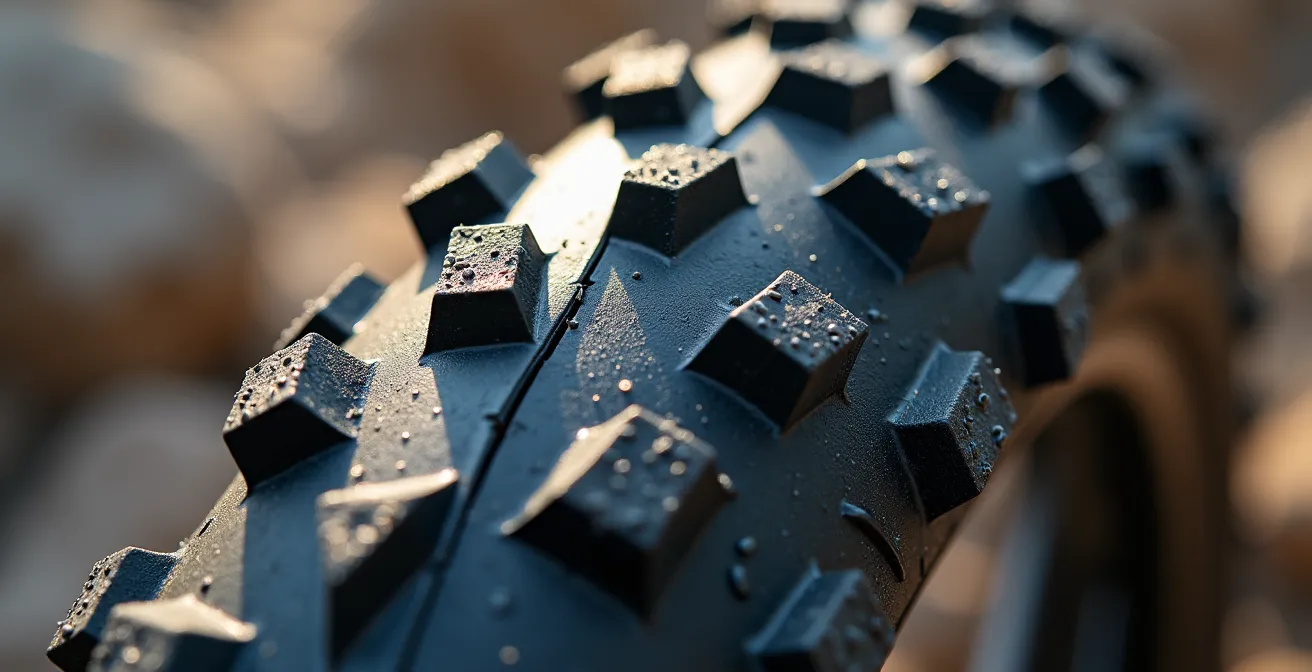
This table, based on common coaching observations, breaks down how each platform teaches you to handle corners and other skills. It highlights how a hardtail’s directness forces mastery, while a full-suspension forgives and allows for speed.
| Skill Aspect | Hardtail Impact | Full Suspension Impact |
|---|---|---|
| Line Choice | Forces optimal path selection | Forgives poor line choices |
| Body Position | Immediate feedback on errors | Masks positioning mistakes |
| Trail Reading | Essential for speed maintenance | Less critical due to absorption |
| Confidence Building | Gradual, skill-based | Immediate, equipment-based |
Action Plan: Auditing Your Core Riding Technique
- Points of contact: On your next ride, consciously analyze your hand, foot, and seat pressure. Are your hands in a “death grip”? Are your feet heavy or light on the pedals?
- Collect data: Ask a friend to film you riding through a corner where you feel hesitant. Watching yourself ride is the most powerful diagnostic tool available.
- Check for coherence: Compare your filmed body position to videos of professional riders. Notice how they separate their bike and body, keeping their torso upright while leaning the bike.
- Identify emotion vs. logic: When you enter a tricky section, are you reacting out of fear (stiffening up, looking at the front wheel) or executing a plan (looking through the turn, deliberate body position)?
- Integration plan: Pick ONE specific thing to work on for your next three rides. For example, dedicate your rides to simply “looking further down the trail through the exit of every corner.”
Cardio vs Explosive Power: What Does MTB Really Demand?
We’ve covered awareness, mechanics, and technique. Now, let’s talk about the engine: you. A common misconception among beginners is that mountain biking is purely an endurance sport. While a solid cardiovascular base is essential for long climbs, it’s only half the story. True on-trail performance demands a dynamic blend of sustained cardio and short-burst explosive power.
Think about a typical trail ride. The long, grinding fireroad climb? That’s pure cardio. Your heart rate is elevated but stable, and your body is in an aerobic state, efficiently using oxygen to fuel your muscles for a sustained effort. But what happens when you hit a short, punchy, technical climb? Or when you need to quickly accelerate out of a corner or pump through a series of rollers to gain “free speed”? That’s explosive power. These are anaerobic efforts, lasting only a few seconds, that require your muscles to produce maximum force instantly, without relying on oxygen.
Indeed, research shows that over 53.6% of mountain bikers actively focus on improving their skills, and fitness is a massive part of that equation. Neglecting either energy system creates a plateau. Great cardio with no power means you’ll spin out on technical features. Great power with no cardio means you’ll be walking the second half of every big climb. A well-rounded rider trains both. This can involve long, steady rides for the cardio base, and interval training, sprints, or even gym work (like squats and deadlifts) for the explosive power.
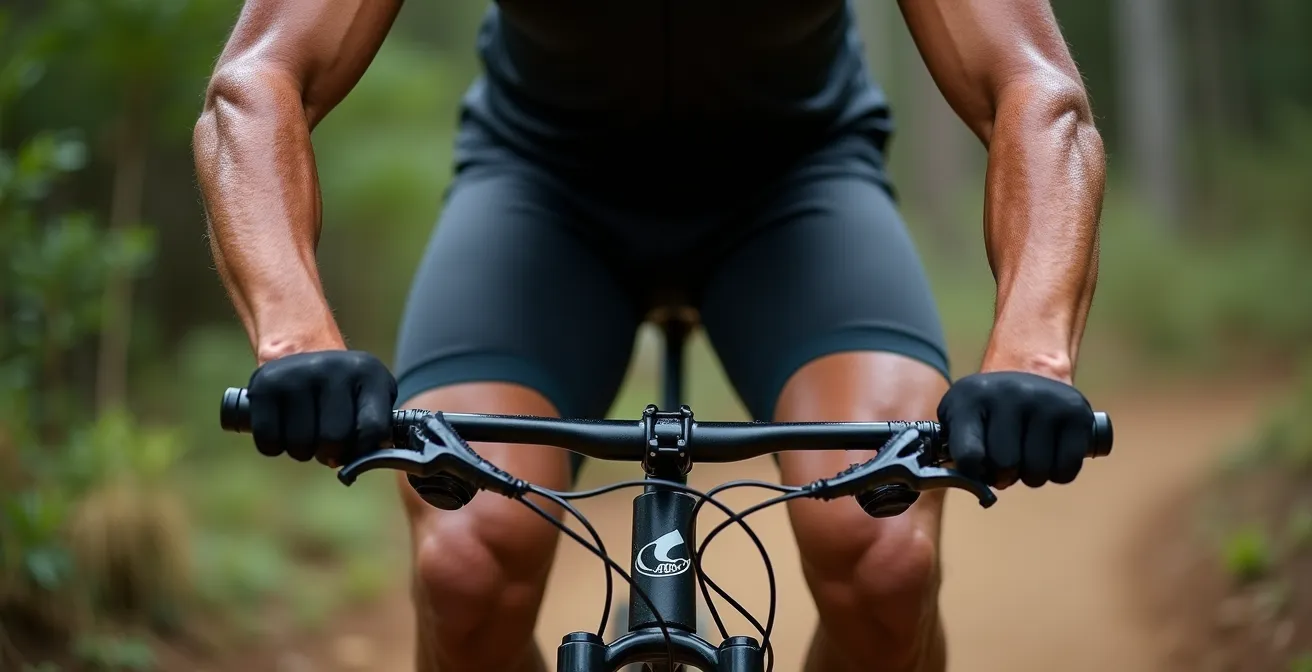
This dynamic need for power is another area where a hardtail shines as a teacher. Without rear suspension to absorb your inputs, learning to pump the terrain for momentum is a much more direct and rewarding process. You feel the bike surge forward with every well-timed push, a perfect application of explosive power.
Sag and Rebound: Setting Your Shock for Your Weight?
If you’ve opted for a full-suspension bike, you’ve traded the simplicity of a hardtail for a new layer of complexity and a new skill to master: suspension setup. Many beginners make the mistake of just hopping on their new bike and riding, but an improperly set up full-suspension bike can handle worse than a good hardtail. The two most critical adjustments you must learn are sag and rebound.
Sag is how much the suspension compresses under your static weight. It’s the starting point for all suspension tuning. Measured as a percentage of total travel (usually 20-30%), setting sag correctly ensures the suspension is in the optimal part of its travel, ready to extend into holes (negative travel) and compress over bumps (positive travel). To set it, you’ll need a shock pump. You dress in your full riding gear, sit on the bike in your “attack position,” and adjust the air pressure until the little rubber O-ring on your shock shows the correct percentage.
Rebound is the speed at which the suspension returns to its fully extended position after being compressed. It’s usually controlled by a red dial on your fork and shock. If your rebound is too fast (like a pogo stick), the bike will feel twitchy and buck you off after impacts. If it’s too slow, the suspension won’t recover in time for the next hit in a series of bumps (known as “packing down”), making the ride progressively harsher. The right setting is a balance: fast enough to track the ground, but slow enough to remain calm and controlled. A good starting point is to stand next to your bike, compress the suspension with your body weight, and let it go. It should return in about one second without overshooting.
Learning to tune your suspension is a core skill for any full-suspension owner. It’s the key to unlocking the bike’s potential and making it work for you, not against you.
Boots or Trail Runners: Which Prevents Ankle Sprains Better?
While this question often comes from the hiking world, it’s incredibly relevant to mountain biking, especially for riders using flat pedals. The point of contact between you and your bike is paramount, and your footwear plays a huge role in control, power transfer, and injury prevention. For mountain bikers, the debate isn’t really boots vs. trail runners, but rather skate-style flat pedal shoes vs. clipless MTB shoes, and the discussion around ankle support is key.
Traditional wisdom suggests that a higher-cuffed boot provides more ankle support and prevents sprains. In mountain biking, this translates to some flat pedal shoes that feature a “mid-top” or “high-top” design. This extra material around the ankle can provide a sense of security, offer some impact protection from the cranks or trail debris, and may offer minor support against rolling an ankle during an awkward dismount or a crash.
However, the counterargument is that a low-cut shoe (like a trail runner or most standard MTB shoes) allows for greater ankle mobility. This mobility is crucial for the subtle body English and ankle articulation required for advanced bike handling, like angulating the bike in corners or absorbing landings. Furthermore, some biomechanists argue that relying on external support can weaken the muscles and ligaments around the ankle over time, potentially making them more susceptible to injury when that support isn’t there. A strong, mobile ankle is often the best defense.
So, which is better? For a beginner on flat pedals, a shoe with some ankle protection can be a great confidence builder. But the ultimate goal should be to build strength and proper technique so that your body, not your shoe, is the primary defense against injury. For clipless pedal users, the shoe is locked to the pedal, making ankle rolls while riding less common, and the focus shifts entirely to stiffness for power transfer.
Ice Baths: Trend or Legitimate Inflammation Cure?
You’ve put in the work on the trail. You’ve climbed, descended, and pushed your physical limits. Now what? The final, and often most neglected, part of the skill-building curriculum is recovery. Getting stronger doesn’t happen during your ride; it happens when your body repairs itself afterward. This is where tools like ice baths enter the conversation. But are they a legitimate recovery tool or just a trendy form of self-torture?
The theory behind cold water immersion (CWI), or ice baths, is straightforward. Intense exercise causes micro-tears in your muscle fibers, leading to inflammation, which you experience as delayed onset muscle soreness (DOMS). Plunging into icy water causes vasoconstriction, or the tightening of your blood vessels. This is thought to help flush metabolic waste products (like lactic acid) out of your muscles. When you get out, the subsequent vasodilation (re-opening of vessels) brings a rush of fresh, oxygen-rich blood to the area, theoretically speeding up the repair process.
Does it work? The scientific community is divided. Some studies show a clear reduction in perceived muscle soreness, meaning athletes *feel* better and are able to train hard again sooner. However, other research suggests that blunting the inflammatory response might actually hinder long-term muscle adaptation. Inflammation, while painful, is a crucial signal for the body to rebuild and get stronger. For a professional athlete in the middle of a multi-day stage race, reducing immediate soreness to perform the next day is critical. For an everyday rider looking for long-term strength gains, consistently using ice baths might be counterproductive.
My coaching advice is this: use it as a strategic tool, not a daily ritual. After an exceptionally long or intense ride that leaves you feeling wrecked, an ice bath can be a powerful way to reduce soreness and get you back on your feet. For regular training rides, focusing on good nutrition, hydration, and sleep is a far more proven and beneficial recovery strategy.
Key Takeaways
- Your first bike’s main job is to be a good teacher; a hardtail provides honest, direct feedback, while a full-suspension teaches high-speed control.
- Becoming a skilled rider is a holistic process, combining technical skill, mechanical knowledge, physical fitness, and on-trail awareness.
- Fundamentals like cornering, body position, and trail etiquette are universal skills that are essential regardless of the bike you ride.
Rent vs. Buy: The Break-Even Point for Your First Mountain Bike
We’ve come full circle, from high-level trail philosophy back to the practical decision in front of you. With all this talk of skill development, it’s easy to feel pressured to make the “perfect” choice right away. But what if the smartest first move isn’t buying at all? For many aspiring riders, renting or demoing different bikes is an invaluable, and often overlooked, part of the decision-making process.
Renting allows you to experience both feedback systems—the direct hardtail and the forgiving full-suspension—on the actual trails you’ll be riding. A bike that feels great in a parking lot might feel completely different on a rooty climb. The break-even point is a financial calculation, but the real value is in the education. If renting three different bikes for a total of $300 prevents you from making a $3,000 mistake on a bike that doesn’t suit your style or local terrain, it’s the best money you’ll ever spend in this sport.
Don’t just think of it as a one-time choice. Think of it as a long-term strategy. As the legendary bike tech Luke Simson says, the platform is secondary to the practice:
Hardtail or full-suspension, you still need to understand the basics. And the main thing that will make you a better rider is riding a lot, and intentional, perfect practice with a specific goal in mind.
– Luke Simson, Specialized Lead Tech Professor
Your journey as a rider is a long one. The bike you start on is just that—a starting point. The goal is to learn the universal language of mountain biking. The following roadmap can help you structure your first five years in the sport.
Your 5-Year Skill Development Roadmap
- Years 0-1: Begin with a modern hardtail if possible, or rent both types. Focus entirely on fundamental bike handling: braking, shifting, and body position.
- Year 1-2: Master line choice on your chosen platform. Learn to read the trail, maintain momentum (flow), and perform all basic maintenance on your bike.
- Year 2-3: Begin developing more advanced skills like pumping for speed, learning to jump safely, and tackling more technical climbs and descents.
- Year 3-4: If you started on a hardtail, consider transitioning to a full suspension to progress your high-speed control and ability on rougher, more advanced terrain.
- Year 4-5+: Ideally, maintain both a hardtail and a full-suspension bike. Use the hardtail for skill refinement and smoother trails, and the full-sus for performance and big mountain days. Use each platform to target your individual weaknesses.
The best bike for you is the one that gets you excited to ride. Start with an informed decision, focus on intentional practice, and enjoy the process of becoming a skilled, confident mountain biker.