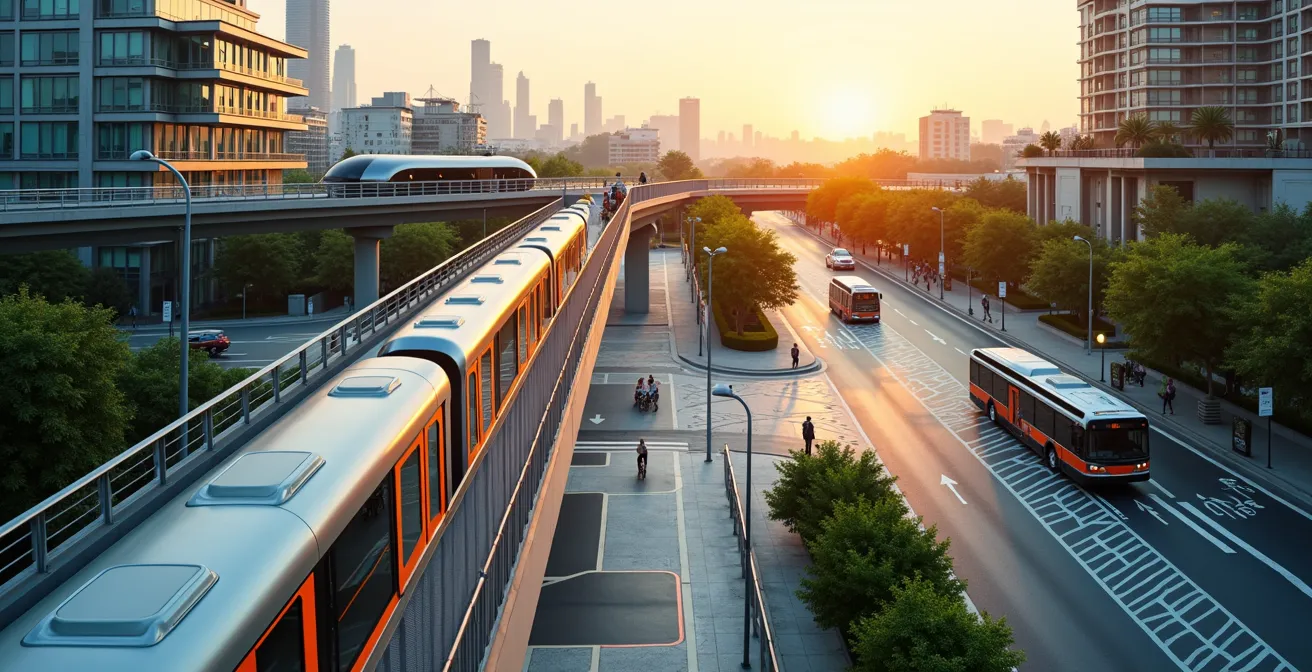
The true promise of the smart city isn’t a faster commute; it’s a complete renegotiation of urban life, forcing us to balance technological efficiency with core human values.
- AI-driven traffic management offers unprecedented efficiency but introduces complex challenges regarding surveillance and personal privacy.
- Integrated mobility platforms create seamless travel experiences but risk deepening the “digital divide” between connected urban centers and underserved areas.
Recommendation: To ensure a livable future, citizens must move from being passive users to active participants in demanding and co-designing human-centric smart cities.
The daily commute is a universal urban experience, often defined by frustrating bottlenecks, unpredictable delays, and a sense of time lost. For years, the promise of the “smart city” has been presented as the ultimate solution: a seamless, optimized world where artificial intelligence and interconnected sensors make traffic jams a relic of the past. We are told to anticipate a future of self-driving pods, responsive traffic grids, and integrated transport apps that make getting from A to B effortless.
But focusing solely on this technological utopia misses the profound social transformation already underway. The tools that promise to streamline our travel are also collecting unprecedented amounts of data, reshaping public spaces, and altering the very economic and social fabric of our neighborhoods. The most critical questions are not about the technology itself, but about the new set of rules we are implicitly agreeing to live by.
This article moves beyond the glossy brochures of tech companies to explore the fundamental trade-offs at the heart of the smart city revolution. We will argue that the real challenge is not a technical one, but a civic one: how do we build a civic contract for the 21st century that harnesses technological power for the public good while fiercely protecting privacy, ensuring equity, and preserving the human soul of our cities? This is about designing a future that is not just efficient, but also just and desirable for all its inhabitants.
For those who prefer a visual overview, the following video explores the dual nature of smart city projects, questioning whether they lead to utopia or a state of constant surveillance.
To navigate this complex but essential topic, we will explore the core tensions and opportunities presented by the rise of smart urban infrastructure. The following sections break down how these changes will impact everything from personal privacy and job security to the very design of the communities we call home.
Summary: Your 2030 commute and the new urban contract
- Why Smart Surveillance Makes Cities Safer but Less Private?
- How to Find Cities with the Best Digital Nomad Infrastructure?
- Human-Centric or Tech-Centric: Designing Future Neighborhoods
- The Infrastructure Gap Leaving Rural Areas Behind
- When Will AI Replace Traffic Control and Municipal Jobs?
- Connecting the Dots: How 5G Enables Smart City Sensors?
- Private Pods or Robotaxis: The Future of Public Transport?
- Connecting Disjointed Smart Devices Into One Ecosystem
Why Smart Surveillance Makes Cities Safer but Less Private?
The core promise of a smarter city is often a safer one. This vision is fueled by a vast network of sensors, cameras, and data-gathering devices that monitor everything from traffic flow and pedestrian density to public transit usage. The argument is compelling: by understanding urban patterns in real time, municipalities can respond faster to emergencies, deter crime, and optimize public safety resources. However, this enhanced security comes at a direct and often opaque cost to personal privacy. Every journey, every public gathering, and every interaction with city services becomes a data point in a massive, interconnected system.
This creates a fundamental paradox. While we may appreciate the benefits of reduced crime or faster emergency response times, the infrastructure enabling it creates an environment of pervasive monitoring. The question is no longer *if* we are being watched, but by whom, for what purpose, and with what oversight. This digital dragnet, while often implemented with good intentions, can have a chilling effect on public life, discouraging dissent and eroding the anonymity that has long been a hallmark of urban living. The scale of this transformation is immense, as the global smart city market is expected to grow from USD 699.7 billion in 2025 to USD 1445.6 billion by 2030.
As the National Committee on U.S.-China Relations notes, the societal implications of this rapid urbanization and technological integration are staggering.
With more than 70 percent of the world’s population expected to live in cities by 2030, the implications are significant.
– National Committee on U.S.-China Relations, Our Shared Technological Future: Smart Cities
Ultimately, the challenge is to establish a new civic contract around data. This requires transparent policies, robust citizen oversight, and a commitment to using data for public good without sacrificing the fundamental right to privacy. Without this balance, the safe city risks becoming a gilded cage.
How to Find Cities with the Best Digital Nomad Infrastructure?
For a growing class of professionals, the “commute” is no longer a daily trip to a local office but a global journey between cities. For these digital nomads, the quality of a city’s infrastructure is paramount. They seek not just fast Wi-Fi, but a seamless, integrated urban experience. The best cities for this lifestyle are those that have moved beyond siloed services and embraced the concept of Mobility-as-a-Service (MaaS), where public transit, bike-sharing, ride-hailing, and scooter rentals are all accessible through a single, intuitive platform.
This integration of work and mobility infrastructure is a key feature of a forward-thinking smart city. It creates a “frictionless” environment where residents can move, work, and live with unprecedented flexibility. This is more than just convenience; it’s a powerful economic driver, attracting talent and investment.

As the image above illustrates, the ideal is a fluid integration between living spaces, co-working environments, and multimodal transport hubs. A prime example is Helsinki’s Whim service, a MaaS platform that has fundamentally changed urban mobility. By integrating all transport options into one app, the service led 38% of users to replace daily car trips and pushed 95% of journeys onto public transportation, demonstrating the power of a truly connected ecosystem.
However, the rise of these hyper-connected urban havens also raises questions of equity. While they offer an incredible quality of life for a mobile, tech-savvy workforce, they risk leaving other residents behind. The focus on high-tech solutions can divert investment from basic, essential services and contribute to gentrification, pricing out long-term inhabitants. A truly smart city must therefore ensure its infrastructure serves everyone, not just the global elite.
Human-Centric or Tech-Centric: Designing Future Neighborhoods
At the heart of the smart city debate is a crucial philosophical question: are we designing cities for people or for technology? A tech-centric approach prioritizes efficiency, optimization, and data-driven management above all else. It views the city as a complex machine to be fine-tuned. The results can be impressive; for instance, Pittsburgh’s AI-powered SURTRAC system reduced travel times by over 25%, cut waiting at intersections by 40%, and lowered vehicle emissions by 20%. These are tangible benefits that improve the daily lives of commuters.
However, a purely tech-centric model can lead to sterile, soulless environments that ignore the social and cultural needs of their inhabitants. A human-centric approach, by contrast, starts with people. It asks what makes a neighborhood livable, vibrant, and inclusive, and only then considers how technology can support those goals. As the International Organization for Standardization (ISO) emphasizes, inclusivity is non-negotiable.
Smart city mobility must be inclusive. Whether it’s flexible travel options, shared mobility services or cost-effective public transport, transportation must be within reach for everyone.
– ISO, Smart city mobility: Transforming the future of urban transportation
This means designing for accessibility for the elderly and disabled, ensuring affordability for low-income residents, and creating public spaces that foster community interaction, not just efficient movement. It involves co-designing with communities, not imposing solutions from the top down. The ultimate goal of a human-centric smart city is not to become a perfectly oiled machine, but to be a more equitable, resilient, and enjoyable place to live. Technology is merely a tool to achieve that end, not the end itself.
The Infrastructure Gap Leaving Rural Areas Behind
As our major cities become increasingly “smart,” a new and more profound digital divide is emerging. This Digital Divide 2.0 is no longer just about access to broadband internet; it’s about access to the entire ecosystem of services that smart infrastructure enables. While an urban resident might enjoy seamless mobility, real-time public service information, and hyper-efficient logistics, their rural counterpart is often left grappling with dwindling public transport, slower emergency response times, and a lack of access to the digital economy.
This growing gap creates a dangerous feedback loop. As cities become more attractive hubs of opportunity and convenience, they pull talent, investment, and resources away from surrounding regions. This brain drain further hampers the ability of rural and smaller communities to develop their own infrastructure, leading to economic stagnation and a declining quality of life. The result is a nation of two halves: the hyper-connected, fast-paced urban cores and the increasingly disconnected, left-behind periphery.
Addressing this infrastructure gap is not just a matter of fairness; it’s an economic and social imperative. A nation cannot thrive when large swathes of its population are excluded from the benefits of technological progress. This requires a conscious policy shift, moving away from a city-only focus to a regional development strategy. It means investing in rural broadband, supporting remote work initiatives, and finding innovative ways to deliver “smart” services—like telehealth and on-demand transit—to less densely populated areas. Failure to bridge this gap will only deepen social and political divisions, undermining the cohesion of society as a whole.
When Will AI Replace Traffic Control and Municipal Jobs?
The rise of artificial intelligence in urban management is poised to automate many tasks traditionally performed by municipal workers. Traffic control is the most visible frontier. As noted by industry leaders like IBM, AI-powered systems are no longer just reacting to traffic; they are becoming predictive. They can analyze historical data, account for weather, and anticipate congestion from public events to optimize traffic flow proactively. This move from reactive to predictive management represents a paradigm shift that promises smoother, faster, and greener commutes.
This automation extends far beyond traffic lights. AI is being deployed for infrastructure maintenance (predicting pipe bursts or bridge stress), waste management (optimizing collection routes), and even administrative services through chatbots and automated processing. The efficiency gains are undeniable, leading to cost savings and improved service delivery. This futuristic vision of an automated city, managed by intelligent algorithms, is rapidly becoming a reality.
However, this transition raises urgent questions about the future of municipal employment. While new roles in data science and system management will be created, many traditional jobs in traffic enforcement, public works, and administration are at risk. As a civic-minded planner, one must ask: what is our social responsibility to the workers displaced by this progress? A truly smart city transition must include robust plans for reskilling and upskilling the existing workforce, ensuring that the benefits of automation are shared broadly.
Ignoring the human cost of this technological shift would be a profound failure of governance. The goal should be to augment human capabilities, not simply replace them, creating a collaborative model where AI handles the data-intensive tasks, freeing up human workers to focus on more complex, community-facing roles that require empathy and critical judgment.
Connecting the Dots: How 5G Enables Smart City Sensors?
If smart city sensors are the nervous system of the urban body, then 5G technology is the spinal cord. It is the critical connective tissue that allows for the instantaneous, high-volume data transmission required to make a smart city functional. Previous generations of wireless technology lacked the capacity and low latency to handle the sheer number of devices in a dense urban environment. 5G changes the game entirely, enabling a massive Internet of Things (IoT) ecosystem where millions of sensors—on traffic lights, lampposts, buses, and buildings—can communicate with each other and with central management systems in near real-time.
The growth in this area is explosive; while the global 5G infrastructure market is projected to grow at 22.9% annually, cellular IoT links are expanding at a staggering 17.9% each year. This is because 5G offers two key advantages: massive bandwidth to handle data from countless devices simultaneously, and ultra-low latency (the delay between sending and receiving a signal). This near-instantaneous response is crucial for applications like autonomous vehicle communication, where a millisecond delay can be the difference between a safe stop and a collision, or for dynamic traffic grids that must adjust to accidents in a split second.
Furthermore, 5G facilitates the rise of “edge computing.” Instead of sending all data to a centralized cloud for processing, much of the analysis can happen locally, closer to the sensor itself. This reduces network congestion and enables even faster decision-making. In essence, 5G is the foundational layer that moves the smart city from a collection of interesting but isolated pilot projects to a truly integrated, responsive, and intelligent ecosystem.
Private Pods or Robotaxis: The Future of Public Transport?
The future of the daily commute is likely to be autonomous, but its form is still up for debate. Two dominant visions are emerging: personalized pods and shared robotaxis. Private, autonomous pods offer a seamless, on-demand experience tailored to the individual. They represent the ultimate in convenience—a private, comfortable space that takes you directly from your doorstep to your destination without the hassle of driving or parking. This vision appeals to our desire for personal space and control.
On the other hand, robotaxis represent an evolution of the shared mobility model. They function like current ride-hailing services but without the driver, promising lower costs and greater efficiency. This model has the potential to drastically reduce the number of privately owned cars, freeing up vast amounts of urban land currently dedicated to parking. Consumer interest is already significant, with one survey showing that more than 40% of consumers would likely use a robotaxi.

The choice between these two models has profound implications for urban design and social interaction. A future dominated by private pods, while convenient, could lead to even greater social isolation and potentially worsen congestion if they simply replace single-occupancy cars. A future centered on shared robotaxis, integrated with high-capacity public transit, could foster a more communal and efficient urban fabric. It encourages a shift from vehicle ownership to mobility access.
The most likely outcome is a hybrid system where both coexist. The critical task for urban planners is to design policies and infrastructure that incentivize sharing and integration, ensuring that autonomous technology serves the collective good rather than simply reinforcing individualistic consumption patterns.
Key Takeaways
- The core challenge of the smart city is not technological but civic, requiring a balance between the efficiency of data-driven systems and fundamental human values like privacy and equity.
- True smart infrastructure must be inclusive, designed to serve all residents and bridge the growing “Digital Divide 2.0” between hyper-connected cities and underserved regions.
- The future of urban mobility is not pre-determined by technology; it will be shaped by conscious policy choices that prioritize shared, integrated transport over isolated, single-occupancy models.
Connecting Disjointed Smart Devices Into One Ecosystem
A city can have thousands of “smart” devices, but it only becomes a truly smart city when they are connected into a cohesive, interoperable ecosystem. For too long, urban technology has been deployed in silos: the transport authority has its system, the energy grid has another, and public safety operates a third. The result is a fragmented landscape of disjointed data streams that fails to deliver on the promise of holistic urban management. A truly smart city breaks down these walls, creating a unified platform where data from different domains can be shared and analyzed together.
This integration is what unlocks next-level insights. For example, by combining traffic data with air quality sensor readings and public health information, a city can develop policies that not only reduce congestion but also mitigate pollution hotspots and improve community well-being. This requires a commitment to open standards, shared data platforms, and inter-departmental collaboration. As a case in point, Amsterdam’s implementation of integrated mobility hubs, which connect different transport modes with shared options, is a success story rooted in decades of strategic, ecosystem-focused urban planning.
With the World Bank noting that 56 percent of the world’s population already lives in cities—a figure set to reach nearly seven in ten by 2050—the need for this integrated approach is more urgent than ever. Building this ecosystem of trust and technology is the final and most difficult step in the smart city journey. It is less about deploying new gadgets and more about fostering a culture of collaboration and building the governance structures needed to manage a city as a single, dynamic entity.
Action plan: Auditing your city’s smart ecosystem readiness
- Points of Contact: List all the digital touchpoints where citizens interact with city services (e.g., transit apps, utility portals, public safety alerts, parking payment systems). Are they fragmented or unified?
- Data Collection: Inventory the types of data being collected by different departments (e.g., traffic flow, energy usage, waste levels). Identify where data sharing is already happening and where critical information remains siloed.
- Coherence Check: Confront the stated goals of your city’s master plan (e.g., sustainability, equity) with the actual outcomes of its tech initiatives. Does a new traffic system benefit all neighborhoods or just a few?
- Memorability & Trust: Assess the city’s communication about its data practices. Is it transparent and easy to understand, or is it buried in legal jargon? An “ecosystem of trust” requires clear, accessible policies.
- Integration Plan: Identify the top 3-5 opportunities for cross-departmental data integration that would yield the most significant public benefit (e.g., combining transit and housing data to plan affordable developments).
The transformation of our cities is not a distant prospect; it is happening now. The technologies shaping your future commute are already being deployed. The most important action you can take is to become an engaged urban citizen. Attend local planning meetings, demand transparency on data collection policies, and advocate for solutions that prioritize human well-being and equity. The future of your city is not something that happens to you; it is something you help create.