
The most effective wilderness first aid “kit” isn’t a bag of supplies; it’s a system of knowledge that prevents you from ever needing them.
- Proactive risk management—from reading weather to understanding your own physiology—is your primary line of defense.
- Your physical kit is a last resort, designed for when prevention fails, not a solution for poor planning.
Recommendation: Shift your focus from simply packing supplies to actively building skills in environmental intelligence, physiological readiness, and strategic decision-making.
When an adventurous person considers wilderness first aid, the immediate thought is a checklist: bandages, antiseptic wipes, blister treatment. We’re taught to focus on the contents of a physical kit, a small bag of solutions for problems that have already occurred. This approach, while not wrong, is dangerously incomplete. It positions you as a reactive victim of circumstance, waiting for an incident to happen. The conventional wisdom about packing more supplies misses the fundamental principle of backcountry survival and performance.
The most critical component of your safety is not what you carry on your back, but what you carry in your mind. A true Proactive Safety System is built long before you step on the trail. It involves understanding the mechanism of injury, reading environmental cues, and making intelligent decisions that mitigate risk at its source. This is the mindset of a wilderness professional. The physical bag of supplies—the “Last Resort Kit”—is for the scenarios that persist despite your best efforts at prevention.
But what if the key to safety wasn’t packing a better splint, but choosing footwear that trains your ankles to be injury-proof? What if predicting a storm is a more effective tool than the most advanced emergency blanket? This guide re-frames the concept of a “first aid kit.” We will move beyond the checklist to construct a robust, knowledge-based system. We will analyze the choices and skills, from gear selection to training protocols, that form the real foundation of wilderness safety for the serious athlete.
This article explores the eight critical pillars of this proactive system, providing the strategic knowledge you need to manage risk effectively. The following sections will guide you through each component, from personal conditioning to your financial safety net.
Contents: Building Your Proactive Safety System
- Boots or Trail Runners: Which Prevents Ankle Sprains Better?
- Cloud Reading: Predicting Storms Before They Hit the Mountain?
- Solo vs Group: The Safety Trade-offs of Hiking Alone?
- Does Your Travel Insurance Cover Helicopter Rescue?
- The ‘Weekend Warrior’ Injury: Preventing Tears After 30?
- Optimizing Your Workout Schedule Using HRV Scores
- Solo Female Travel: Safety Protocols for Remote Areas
- Hardtail vs Full Suspension: Which Builds Better Skills?
Boots or Trail Runners: Which Prevents Ankle Sprains Better?
The debate between high-cuffed boots and lightweight trail runners is often framed around ankle support. The common belief is that a rigid boot acts as an external brace, preventing the ankle from rolling. This is a dangerously simplified view of biomechanics. While a boot can restrict movement, it can also inhibit proprioception—your body’s innate ability to sense its position in space. This sensory feedback is your primary defense against a sprain; it allows your muscles to react and stabilize the joint *before* an injury occurs.
A lightweight trail runner, by providing more ground-feel, can enhance proprioception. However, it demands that the user possess the requisite strength and stability to manage that feedback. Therefore, the question is not which shoe is better, but which athlete is better prepared. The most effective injury prevention is not found in a shoe, but in the conditioning of the wearer. True physiological readiness means building an ankle that is strong, stable, and reactive, regardless of the footwear.
Developing this resilience is a core part of your proactive first aid system. It requires dedicated, specific training that goes beyond general fitness. The goal is to create an “internal brace” of muscle and connective tissue that is far more effective and adaptable than any piece of leather or fabric. Committing to a strengthening protocol is the single best investment you can make in lower-leg health for the trail.
Cloud Reading: Predicting Storms Before They Hit the Mountain?
In the wilderness, exposure is a primary mechanism of injury. Hypothermia and lightning strikes are not random events; they are the direct result of being in the wrong place at the wrong time. Your most powerful tool against these environmental hazards is not in your pack—it’s your ability to look at the sky and understand what it’s telling you. This skill, a form of environmental intelligence, is a non-negotiable part of a proactive safety system.
Relying solely on a digital forecast is insufficient. Mountain weather is notoriously localized and can change with alarming speed. Learning to identify key cloud formations gives you real-time data that is specific to your exact location. It allows you to make critical decisions about whether to push for a summit, seek lower ground, or prepare for imminent weather. The drama of a changing mountain sky is not just a photographic opportunity; it is a vital bulletin about your immediate safety.

Recognizing the difference between a benign altocumulus formation and a developing cumulonimbus tower is the difference between a pleasant day and a potential epic. The following matrix is a field-ready tool for translating these observations into concrete action. It turns abstract cloud shapes into a clear, life-saving decision-making framework.
| Cloud Type | Altitude | Storm Timing | Action Required |
|---|---|---|---|
| Lenticular | High altitude peaks | 6-12 hours | Postpone summit attempt |
| Cumulonimbus | Vertical development | 0-2 hours | Seek immediate shelter |
| Mammatus | Below storm clouds | Storm passing | Wait 30 min before moving |
| Altocumulus | Mid-level | 12-24 hours | Monitor barometric pressure |
Solo vs Group: The Safety Trade-offs of Hiking Alone?
The decision to travel solo or with a group is one of a backcountry athlete’s most significant risk management choices. It fundamentally alters the safety equation. A group provides redundancy—more minds for navigation, more hands in an emergency, and shared carrying capacity for safety equipment. A solo traveler, by contrast, has zero redundancy. They must be self-sufficient in skill, decision-making, and equipment. This reality dramatically influences the design of one’s safety system.
The physical first aid kit is a clear example. For larger groups on extended trips, the equipment can become substantial. According to Wilderness Medical Associates instructor Danny Peled, on remote expeditions with 15 people, his kit expands to a 30L mini barrel to handle the increased probability of an incident. The solo traveler cannot carry this. Instead, they must rely on a different asset: improvisation. As Paul Nicolazzo of the Alpine Institute states, this principle is key:
Expeditions hope that they will NOT use their first aid kits and adhere to the principles of improvisation: they limit specialized items, focus on multipurpose equipment, and adapt expedition gear for medical uses (for example, using skis for splints and sleds for litters). As your ability to improvise increases, the size of your expedition first aid kit decreases.
– Paul Nicolazzo, Alpine Institute – Wilderness Medicine Training Center
For the solo athlete, skill is a direct replacement for weight. The ability to turn a trekking pole into a splint or a jacket into a sling is paramount. This necessitates a regular and honest assessment of one’s entire safety system—a process that goes far beyond a simple gear checklist.
Your Proactive Safety System Audit
- Risk Vectors: List all potential hazards for your specific sport and environment (e.g., weather, terrain, wildlife, gear failure, human factors).
- Skill Inventory: Honestly assess your current skill level against those hazards. What is your formal first aid training? Can you navigate with a map and compass if your GPS fails?
- System Cohesion: Compare your skills, gear, and trip plan. Do they align? (e.g., You carry a satellite messenger, but have you shared your detailed itinerary and check-in schedule with a reliable contact?).
- Improvisation & Redundancy: Identify single points of failure. What is your backup for critical systems like water purification, navigation, and fire starting? Can you improvise solutions with the gear you have?
- Action Plan: Based on the gaps identified, list 2-3 specific, measurable actions to take before your next trip (e.g., “Take a WFA course,” “Practice building a shelter,” “Create a laminated emergency contact card”).
Does Your Travel Insurance Cover Helicopter Rescue?
The final layer of any robust safety system is the contingency plan for a worst-case scenario. When prevention and improvisation fail, an external rescue may be the only option. However, initiating a rescue is a complex process with significant financial implications. A common, and potentially catastrophic, misconception is that “rescue is free.” While a search operation initiated by a county sheriff may be funded by taxpayers, the subsequent medical evacuation is almost always a private medical service.
A helicopter evacuation in a remote area can easily result in a bill exceeding tens of thousands of dollars. This is where insurance becomes a critical piece of your first aid system. Yet, not all policies are created equal. Most standard travel insurance plans contain specific exclusions for “high-risk” activities like climbing, backcountry skiing, or even hiking in un-patrolled areas. It is your responsibility to read the fine print and confirm that your specific sport is explicitly covered.
Furthermore, effective communication is the trigger for any rescue. Carrying a reliable satellite communication device, such as a Personal Locator Beacon (PLB) or satellite messenger, is a modern necessity for anyone venturing deep into the backcountry. As demonstrated countless times on long-distance trails like the PCT, these devices are the most reliable link to help. However, your policy may have specific protocols. In an emergency, your first call should often be to your insurance provider’s 24/7 emergency line. They will coordinate with local rescue services, ensuring the event is classified correctly for coverage and preventing devastating financial surprises after the fact.
The ‘Weekend Warrior’ Injury: Preventing Tears After 30?
While dramatic trauma incidents capture the imagination, the most common threat to a lifelong pursuit of outdoor sports is the insidious, non-traumatic injury. For the athlete over 30—the “weekend warrior” who balances a desk job with intense weekend pursuits—the risk of tendon tears, ligament strains, and chronic overuse injuries is exceptionally high. These are failures of the biological system, often caused by loading tissues that are ill-prepared for the stress of the activity.
Preventing these injuries is a form of proactive first aid. After age 30, collagen synthesis slows, and tendons and ligaments lose some of their elasticity. A body that could tolerate abrupt increases in activity in its 20s now requires a more deliberate and structured approach to training and recovery. Ignoring this physiological reality is a direct path to a season-ending injury like an Achilles rupture or rotator cuff tear. The focus must shift from simply “working out” to strategic physical preparation.
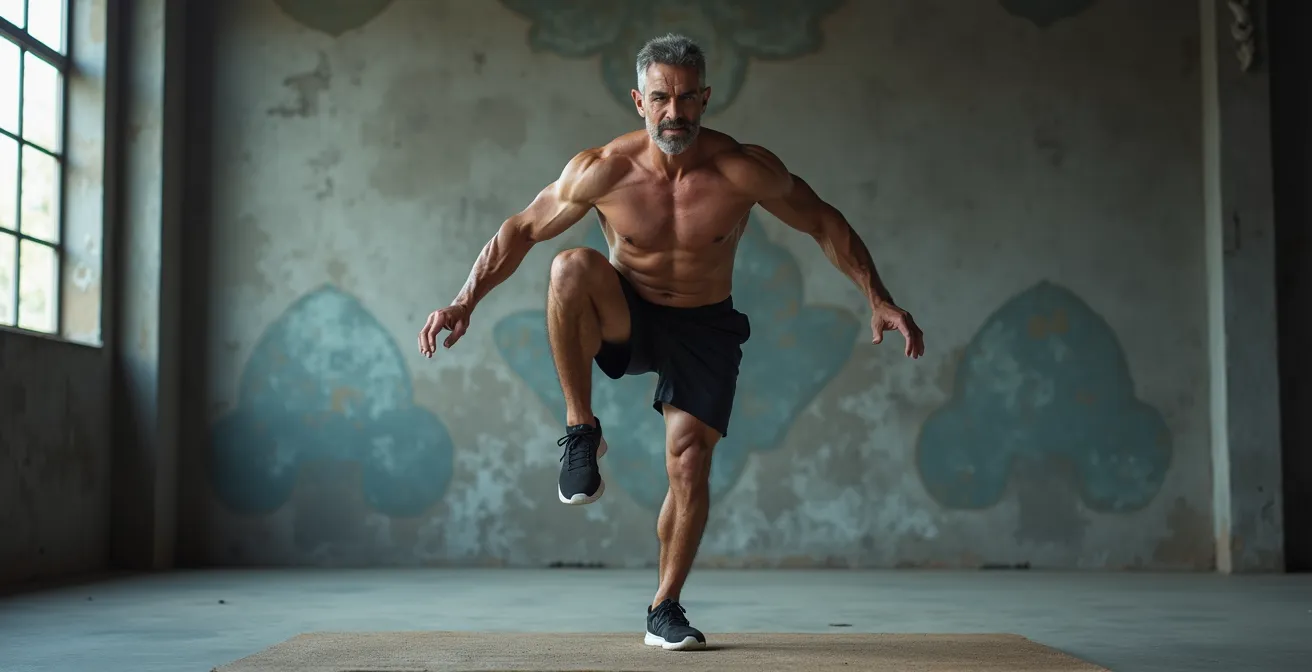
A dedicated pre-habilitation (pre-hab) routine is not optional; it is essential maintenance for the athletic body. This involves targeted exercises that strengthen stabilizing muscles and improve the load-bearing capacity of connective tissues. This is not about lifting the heaviest weight; it is about controlled, specific movements designed to build resilience in the areas most vulnerable to your chosen sport.
Pre-hab Routine for Weekend Warriors Over 30
- Eccentric Loading: Begin with eccentric loading exercises for Achilles and patellar tendons. Perform 3 sets of 15 slow, controlled heel drops off a step.
- Stabilizer Strength: Add rotator cuff stabilization for climbers or paddlers, such as resistance band external rotations for 3 sets of 20 on each side.
- Polarized Training: Structure your week with 80% of training time in Zone 2 (easy, conversational effort) and 20% in high-intensity intervals to build an aerobic base without chronic stress.
- Dynamic Warm-up: Never start an activity cold. Perform a 10-minute dynamic warm-up focusing on joint mobility and tissue preparation before every session.
- Mandatory Recovery: Schedule mandatory rest days. Listen to your body’s fatigue signals and use active recovery methods like walking or stretching instead of pushing through.
Optimizing Your Workout Schedule Using HRV Scores
Physiological readiness is not just about long-term conditioning; it’s about day-to-day management of stress and recovery. Pushing hard on a day when your body is not prepared is a direct invitation for injury or illness. One of the most powerful objective tools for assessing your daily readiness is Heart Rate Variability (HRV). HRV measures the variation in time between your heartbeats, providing a direct window into the state of your autonomic nervous system.
A high HRV generally indicates that your body is well-rested and ready to handle stress (a “parasympathetic” or “rest-and-digest” state). A chronically low HRV suggests your body is under significant stress (a “sympathetic” or “fight-or-flight” state), whether from hard training, poor sleep, illness, or psychological pressure. Training intensely on a low-HRV day can suppress your immune system and dramatically increase your risk of injury.
To use HRV effectively, you must first consistently measure it every morning over a two- to four-week period to establish a reliable baseline. Once your personal baseline is clear, daily deviations become meaningful data points. This data allows you to move beyond subjective feelings of fatigue and make informed decisions about your training schedule. The “Traffic Light” system is a simple, effective framework for translating your daily HRV score into an actionable training plan.
| HRV Status | Score Range | Training Recommendation | Recovery Priority |
|---|---|---|---|
| Green Light | Baseline or above | High-intensity training approved | Normal recovery protocols |
| Yellow Light | 5-10% below baseline | Light activity or technique work only | Extra sleep, hydration focus |
| Red Light | >10% below baseline | Active recovery or complete rest mandatory | Full recovery day, stress management |
Solo Female Travel: Safety Protocols for Remote Areas
For solo female travelers, the proactive safety system must include an additional layer: personal security and heightened situational awareness. While the wilderness is often safer than urban environments, remote settings can create unique vulnerabilities. The goal is not to foster fear, but to build empowerment through confident preparation and clear-cut protocols. This involves managing human encounters with the same strategic mindset used for environmental hazards.
Your first line of defense is projecting confidence. Body language—maintaining a steady posture, making brief but direct eye contact, and moving with purpose—can be a powerful deterrent. It signals that you are aware, prepared, and not an easy target. This should be paired with pre-planned de-escalation strategies. Having a few practiced phrases ready, such as “My group is just a little ways ahead,” can create a plausible reason to end an uncomfortable interaction quickly and move on.
Technology also plays a crucial role. A satellite messenger should be used not just for emergencies, but as a proactive deterrent. Making it visible and audibly setting an alert during an encounter can signal to others that your location is being tracked and that you are on a schedule. This reinforces the idea that you are not truly “alone.” The most vital protocol is establishing a rigid check-in pattern with a trusted contact. A scheduled “All’s Well” message sent at the same time each day creates a timeline of accountability. A missed check-in is an unambiguous signal that something is wrong, enabling a much faster and more targeted response if one is needed.
Wilderness De-escalation Strategies for Solo Travelers
- Confident Body Language: Maintain an upright posture with shoulders back, use steady eye contact, and walk with a purposeful, non-hesitant stride.
- Pre-planned Exit Phrases: Have two or three concise, believable phrases ready to end an unwanted conversation. Examples: “My hiking partner is waiting for me just around this bend,” or “I have to send my scheduled satellite check-in right now.”
- Proactive Technology Use: Don’t just carry a satellite device, use it visibly. If an encounter feels off, stop and create a “show” of sending a message or checking your location.
- Trust Your Intuition: If a person or situation feels wrong, it is. Act on that feeling immediately by altering your route, changing your timing, or simply leaving the area without apology.
- Establish Ironclad Check-ins: Create a non-negotiable daily check-in schedule with a reliable contact. The consistency is what creates the safety net.
Key Takeaways
- Your mind is your primary first aid tool. Prevention, knowledge, and decision-making are more critical than any piece of gear.
- Build a “Proactive Safety System” based on physiological readiness, environmental intelligence, and strategic planning.
- The physical first aid kit is a “Last Resort Kit,” to be used only when your primary system of prevention fails.
Hardtail vs Full Suspension: Which Builds Better Skills?
In the world of mountain biking, the choice between a hardtail (front suspension only) and a full suspension bike seems like a simple gear debate. However, it serves as a perfect metaphor for the entire philosophy of this guide: the tension between fundamental skills and technological compensation. A full suspension bike is designed to absorb impact, smoothing out the trail and allowing a rider to maintain speed over rough terrain. It is a technological solution to a problem.
A hardtail, by contrast, offers no such buffer for the rear wheel. It transmits every rock and root directly to the rider. As one expert puts it in the Baker Mountain Guides Technical Training Manual:
The hardtail acts as a ‘personal skills coach’ providing unfiltered feedback from the trail, forcing riders to develop proper technique that can’t be masked by technology.
– Mountain Biking Skills Expert, Baker Mountain Guides Technical Training Manual
This unfiltered feedback forces the rider to develop core skills: precise line choice, dynamic body positioning, and the ability to “unweight” the bike over obstacles. These are the foundational techniques of expert riding. A rider who masters a hardtail develops a deep, intuitive understanding of traction and momentum that translates directly to any bike. This is the essence of a proactive system: building mastery at the fundamental level, so that technology becomes an enhancement, not a crutch.
| Bike Type | Skill Development Focus | Training Application | Progression Timeline |
|---|---|---|---|
| Hardtail | Line choice, body positioning, bike-terrain feedback | Familiar trails, technique refinement | Weeks 1-3 of monthly cycle |
| Full Suspension | Speed management, advanced terrain navigation | Technical challenges, speed application | Week 4 of monthly cycle |
| Alternating | Complete skill transfer, adaptability | Progressive difficulty increase | 6-month comprehensive program |
Your next step is to move from passive learning to active assessment. Conduct a formal, honest audit of your personal safety system using the framework provided here. Identify your weaknesses, celebrate your strengths, and create a concrete plan to build the skills that will truly keep you safe in the wild.
Frequently Asked Questions About Wilderness Safety
What’s the difference between search and rescue vs medical evacuation?
Search and rescue is the operation to find you, which is often government-funded and may not be covered by insurance. Medical evacuation is the transport to a medical facility after you are found, and this is the service that most dedicated insurance policies are designed to cover.
Which activities commonly void coverage?
Be aware that high-risk named sports (e.g., mountaineering, rock climbing), going “out of bounds” in designated ski areas, or failing to follow the warnings and directives of local authorities can invalidate your insurance policy.
Who should I call first in an emergency?
To ensure an event is classified correctly for coverage, your first call should be to your insurance provider’s 24/7 emergency assistance line, not just local rescue services. They will then help coordinate the appropriate response.