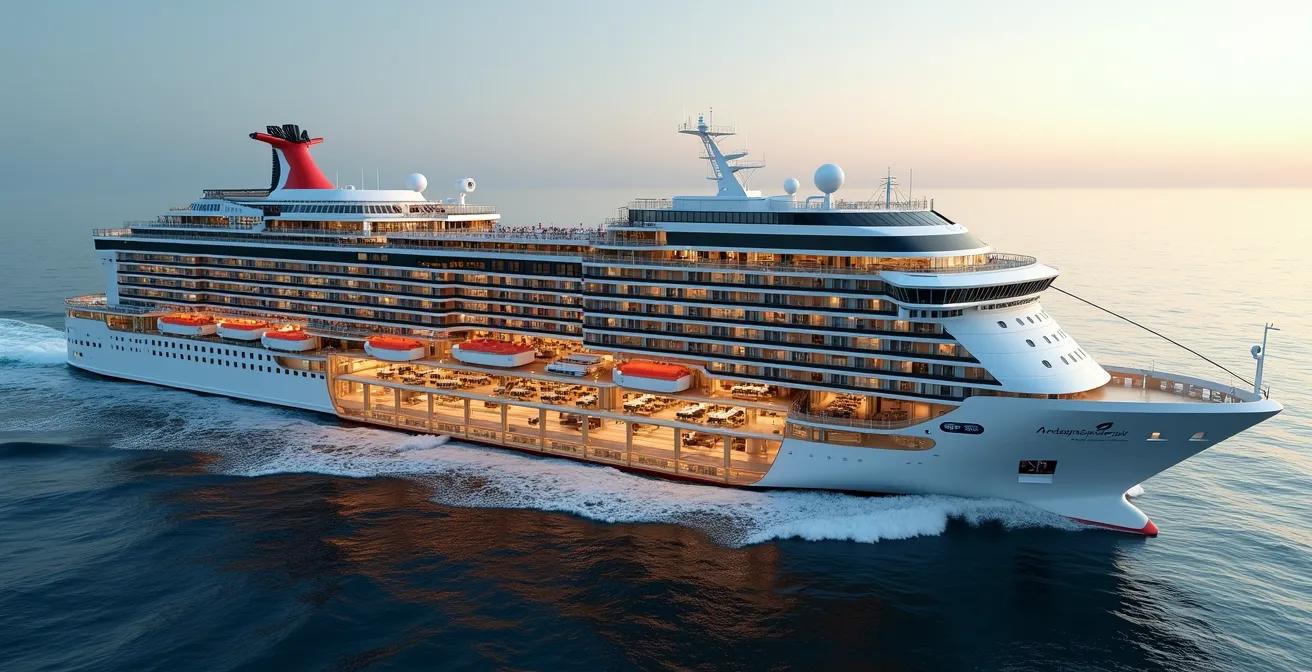
The secret to conquering seasickness isn’t just picking the right cabin; it’s about gaining psychological control over the “floating city” you’re about to board.
- Anxiety about the unknown amplifies motion sickness. Mastering the ship’s hidden systems—from finances to health protocols—reduces this anxiety.
- Insider knowledge on costs, safety, and onboard life provides the “psychological ballast” needed to feel stable and secure, even if the seas get choppy.
Recommendation: Shift your focus from simply avoiding motion to actively understanding the environment. This officer’s briefing gives you the control you need to find your sea legs.
If you’re a first-time cruiser, the fear of spending a week feeling green is real. You’ve probably already heard the standard advice: get a cabin in the middle of the ship, on a lower deck. It’s sound advice, based on simple physics. The center of the ship is its pivot point, so it moves the least. But let’s be honest, if it were that simple, nobody would be nervous. From my time on the bridge, I can tell you that for many passengers, seasickness is as much a psychological battle as it is a physical one. The feeling of being on a massive, unfamiliar vessel, disconnected from land and its rules, can create an underlying anxiety that makes you far more susceptible to motion sickness.
The real problem isn’t just the motion; it’s the feeling of having no control. You worry about hidden costs, getting sick, staying safe in port, and even what to wear to dinner. These aren’t trivial concerns; they are legitimate anxieties about navigating the complex logistics of a floating city. But what if the key to finding your sea legs wasn’t just about your cabin location, but about regaining that sense of control? What if you had an officer-level understanding of how the ship truly operates?
This is that briefing. We’re going to bypass the usual tips about ginger ale and acupressure bands. Instead, we’ll give you the insider intel on the ship’s core systems—financial, safety, health, and social. By understanding the environment you’re entering, you build what I call psychological ballast: a foundation of knowledge that keeps you steady, no matter the situation. This guide will walk you through the very questions that cause passenger anxiety, transforming you from a nervous guest into a confident, informed traveler ready to enjoy the journey.
To help you navigate these crucial aspects of your cruise, this guide is structured to address each key system of the ship. Below is a summary of the officer’s briefing that will give you the operational awareness you need for a smooth sailing.
Summary: An Officer’s Guide to Mastering the Floating City
- Gratuities and Drink Packages: The Real Cost of ‘All-Inclusive’?
- Ship Tours vs Local Guides: Which Is Safer and Cheaper?
- Norovirus Prevention: How to Touch nothing at the Buffet?
- Giant Ships vs Small Expeditions: Which Pollutes Less per Person?
- Formal Night: Is It Still Mandatory on Modern Cruises?
- All-Inclusive Resorts: Do They Really Benefit the Locals?
- Future of Malls: Dining and Entertainment vs Shopping?
- How to Plan a ‘Trifecta’ Trip That Pleases Everyone?
Gratuities and Drink Packages: The Real Cost of ‘All-Inclusive’?
One of the first sources of anxiety for new cruisers is money. The fear of a massive bill at the end of your trip is a significant stressor. Let’s demystify the ship’s financial system. “All-inclusive” is rarely what it seems. Your cruise fare covers your cabin, standard meals, and some entertainment. Almost everything else is extra, starting with gratuities. Most lines automatically add tips for the crew to your onboard account. You should budget for this, as automatic gratuities are typically $14 to $20 per person per day.
Then there are the drink packages. They promise unlimited sodas, coffees, and alcoholic beverages for a flat daily rate, but are they worth it? For some, yes. For many, it’s a financial loss. The break-even point is often five to seven alcoholic drinks per day, every single day. Before you buy, do the math. Think about your port days, when you’ll be off the ship, and your personal consumption habits. An 18-20% service charge is often added on top of the package price and any drinks bought à la carte. Understanding these costs upfront removes the financial uncertainty, which is a huge piece of psychological ballast.
To determine if a package is right for you, don’t guess. Follow a simple framework:
- Calculate Your Baseline: How many alcoholic drinks, specialty coffees, and bottles of water do you realistically consume on an average vacation day?
- Research Ship Prices: Look up the bar menus for your specific cruise line. A beer might be $8, a cocktail $14.
- Factor in Gratuities: Add an 18-20% automatic tip to the cost of every single drink you’d buy individually.
- Compare the Totals: Multiply your estimated daily à la carte spending by the number of days on your cruise. If that total is significantly higher than the drink package price (including its own gratuity), the package is a good deal for you. Otherwise, paying as you go offers more control and often saves money.
Mastering the ship’s financial system is the first step to feeling in command. By knowing exactly where your money is going, you eliminate surprises and can relax into your vacation.
Ship Tours vs Local Guides: Which Is Safer and Cheaper?
Your second major point of anxiety will likely surface when the ship docks: shore excursions. The central question is always a balance of safety, cost, and authenticity. Cruise lines offer a slate of vetted, official tours. They are convenient and come with a critical guarantee: the ship will not leave without you if your official tour is delayed. This peace of mind is what you are primarily paying for, and for a first-time, anxious cruiser, it can be invaluable.
However, these ship-sponsored tours are often more expensive and cater to large groups, which can dilute the experience. Independent local guides, on the other hand, can offer more authentic, personalized tours at a fraction of the cost. The trade-off is risk. If you book independently, you are solely responsible for getting back to the ship on time. A flat tire, bad traffic, or a simple miscalculation can result in you watching your floating hotel sail off into the sunset. This decision is a personal risk calculation, not a right or wrong choice.
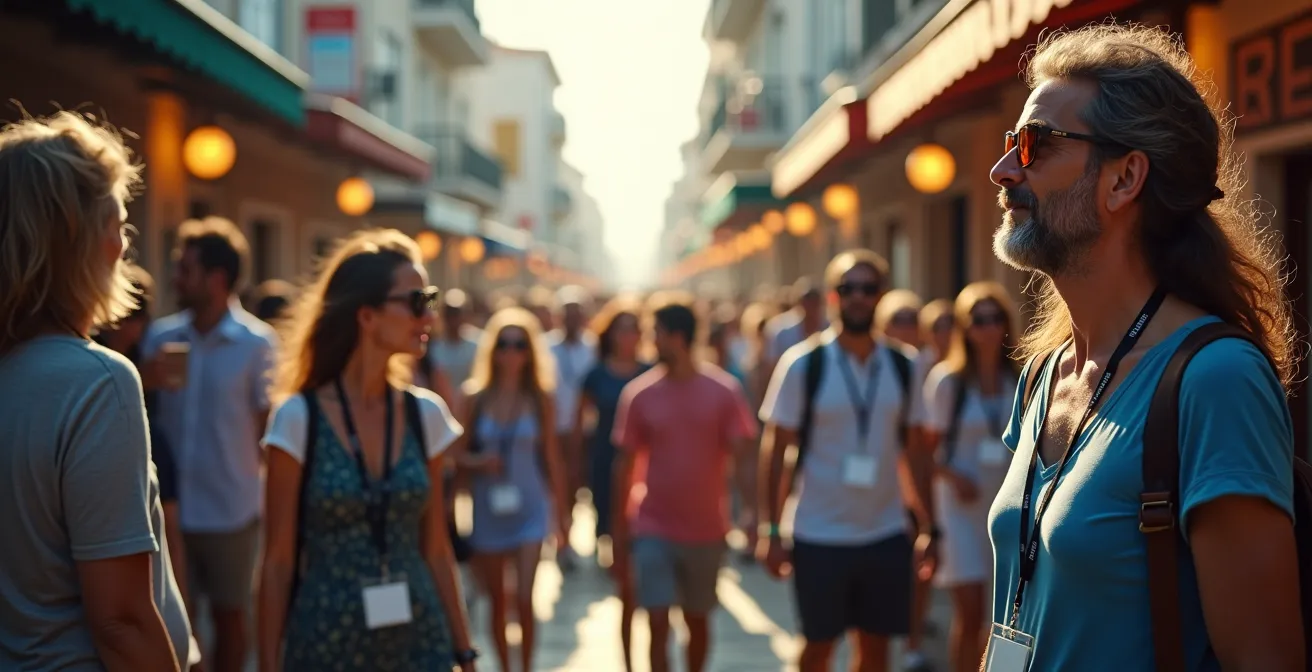
As the image suggests, the experience can be starkly different. On one side, a large, organized group in a crowded area; on the other, a small, intimate interaction in an authentic setting. Neither is inherently better—it depends entirely on your comfort level with managing logistics and risk in an unfamiliar port.
Case Study: The Cozumel Conundrum
A direct comparison of excursions in Cozumel, Mexico, highlights this trade-off perfectly. Ship-sponsored snorkeling tours often average $89 to $129 per person. This price includes transportation, equipment, and the “return-to-ship” guarantee. Meanwhile, highly-rated local operators found through independent research offer very similar snorkeling experiences for $45 to $65 per person. The savings are significant, but this requires you to arrange your own taxi, manage your time meticulously, and ideally have travel insurance that covers missed port departures.
Norovirus Prevention: How to Touch nothing at the Buffet?
Let’s address the elephant in the room: getting sick. Media stories about gastrointestinal outbreaks on ships are terrifying, but they are statistically rare. From an operational perspective, hygiene is the single most important protocol on board. The crew’s obsession with hand sanitizer isn’t just for show. But here is the officer-level intel: the ship is probably cleaner than the airport you flew from. The Centers for Disease Control and Prevention (CDC) data shows that fewer than 1% of cruise passengers are affected by gastrointestinal illness. The fear is far greater than the reality.
However, you can and should take control of your personal environment. The buffet is a point of concern for many. The strategy isn’t to “touch nothing”—that’s impossible. The strategy is to create a barrier. Use the provided serving utensils, but always use a napkin to hold them. Avoid touching your face while in the buffet line. And most importantly, wash your hands or use hand sanitizer both *before* you enter and *after* you leave the buffet area. The most critical time to take control of your health is within the first 24 hours. Your cabin has been cleaned, but taking your own measures provides an extra layer of defense and, crucially, peace of mind.
Your First 24-Hour Cabin Sanitization Protocol
- Bring your own travel-sized disinfectant wipes with at least 70% alcohol.
- Upon entering your cabin for the first time, wipe down all high-touch surfaces: doorknobs, light switches, the TV remote, and telephone.
- Thoroughly sanitize bathroom fixtures, including the toilet flush handle and all faucet handles.
- Clean the balcony door handle and any outdoor furniture if you have a verandah.
- After touching public surfaces like elevator buttons or stair railings on your way to the cabin, use hand sanitizer before touching your personal belongings.
- Establish a “clean zone” on a desk or nightstand where only sanitized items like your phone, glasses, and room key are placed.
By executing this simple plan, you are not just cleaning surfaces; you are performing a ritual that reinforces your sense of control over your health and well-being. This is a powerful dose of psychological ballast.
Giant Ships vs Small Expeditions: Which Pollutes Less per Person?
An informed cruiser is an aware cruiser, and that includes understanding your environmental footprint. The choice between a mega-ship (carrying 5,000+ passengers) and a small expedition vessel (100-200 passengers) isn’t just about the experience; it’s an ethical and environmental decision. The answer to “which pollutes less” is surprisingly complex. On a per-passenger basis, the numbers can be counterintuitive. A larger, more modern ship benefits from economies of scale and is often equipped with more advanced environmental technology.
Mega-ships, due to their size and public scrutiny, are increasingly built with advanced wastewater treatment systems and the ability to plug into shore power in port, reducing emissions. However, their sheer scale concentrates a massive impact on the local ecosystems of popular ports. Small expedition ships, while sometimes having a higher per-person carbon footprint, can have their own issues. They often lack the latest treatment technologies and their ability to access fragile, remote areas poses a different kind of environmental risk. There is no perfectly “green” option, only a series of trade-offs.
This comparative data, from an analysis of cruise ship environmental impacts, shows the complexity of the issue.
| Factor | Mega Ships (5000+ passengers) | Small Expeditions (100-200 passengers) |
|---|---|---|
| CO2 per passenger/day | 0.17-0.25 tons | 0.21-0.35 tons |
| Waste water treatment | Advanced systems mandatory | Variable, often basic |
| Shore power capability | Increasingly standard | Rarely available |
| Local ecosystem impact | High concentration in ports | Access to fragile areas |
Furthermore, even advanced technologies have their controversies. For instance, Norwegian Cruise Line’s newest ships feature exhaust gas cleaning systems, or “scrubbers,” which are designed to reduce sulfur emissions by up to 98%. However, environmental groups argue that these systems effectively transfer the pollution from the air to the sea, as the filtered pollutants are discharged into the water. Having this operational awareness doesn’t give you an easy answer, but it allows you to make a choice that aligns with your values.
Formal Night: Is It Still Mandatory on Modern Cruises?
Social anxiety is another hidden stressor that can ruin a perfectly good vacation. The idea of “formal night” conjures images of stuffy, rigid dress codes from a bygone era. For many, the question of what to pack and whether they’ll “fit in” is a genuine concern. Here’s the insider briefing: the traditional, mandatory formal night is fading fast on most mainstream cruise lines. It has been replaced by more flexible concepts like “Evening Chic,” “Elegant Night,” or “Dress Your Best.”
What this means in practice is that the requirement for tuxedos and ball gowns is largely gone. While you will see some passengers who enjoy dressing to the nines, you will see far more in cocktail dresses, suits, sport coats, or even nice jeans with a stylish blazer. The emphasis has shifted from a rigid uniform to personal expression and comfort. The goal is to feel good, not to conform to an outdated standard. No one will be turned away from the main dining room for wearing a collared shirt and smart trousers instead of a full suit.
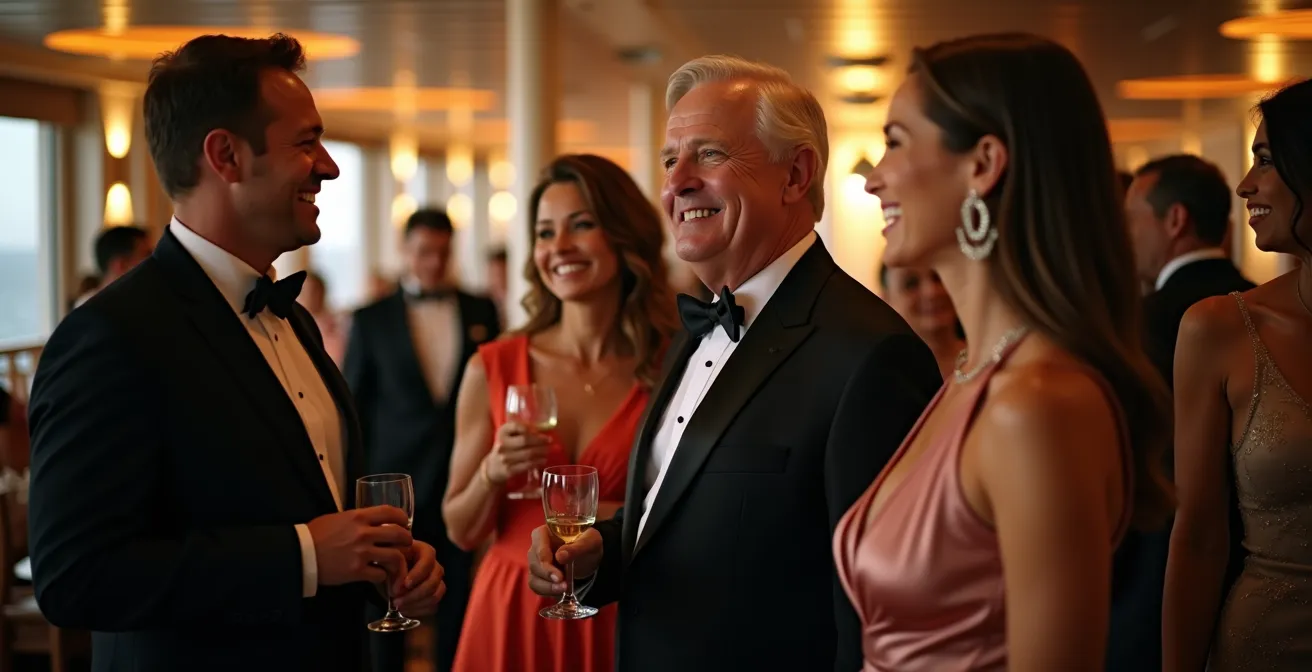
The modern “formal” night is about creating a festive atmosphere, not enforcing a strict rule. This shift has had a positive effect on the onboard experience, making specialty dining and other evening activities more accessible and enjoyable for everyone.
Case Study: Royal Caribbean’s “Evening Chic” Evolution
Royal Caribbean provides a clear example of this trend. They officially replaced their formal nights with “Evening Chic” across the fleet. The new dress code explicitly allows everything from cocktail dresses to dress slacks and even nice jeans paired with a blazer. The result? The line reported 15% higher bookings in their specialty restaurants on these nights, as passengers felt more relaxed and comfortable enough to opt for an upgraded dining experience without the pressure of a black-tie dress code.
All-Inclusive Resorts: Do They Really Benefit the Locals?
This question, typically asked of land-based resorts, has a powerful parallel on a cruise ship. The “locals” of your floating city are the crew—the thousands of individuals from dozens of countries who make your vacation possible. When you spend money onboard, it’s natural to wonder: does this benefit the crew, or just the corporation? It’s a valid concern. Just as in some tourism economies, where it’s estimated that 60-80% of tourist spending can leak out of the local community, the flow of money on a ship is complex.
Your onboard spending—on drinks, specialty dining, spa treatments—primarily goes to the cruise line. The crew are paid a salary, and while good service can be reflected in their performance reviews, your individual purchase of a margarita doesn’t directly translate into a bonus for the bartender. This is why the gratuity system is so important. The daily gratuity you pay is pooled and distributed among a vast number of crew members, including those you never see, like the laundry staff and cooks who are essential to your experience. It’s the most direct way to ensure your appreciation reaches the broader shipboard community.
Some cruise lines are making strides in crew welfare, much like some resort chains are focusing on local community impact. The most progressive lines offer better connectivity for crew to contact family, improved recreational facilities, and career development programs. While harder to research, choosing a line known for its positive crew culture can be a way to “vote with your wallet.” Just as the Sandals Resorts foundation has built a model for local partnership by sourcing produce locally and funding education, a conscious cruiser can seek out lines with transparent and ethical crew support programs. This adds another layer to your operational awareness—understanding the ship’s internal economy and your role within it.
Future of Malls: Dining and Entertainment vs Shopping?
Modern cruise ships are not just transportation; they are destinations in themselves—floating cities that are evolving much like their land-based counterparts. The question of the future of malls is surprisingly relevant to your onboard experience. Malls are transforming from purely retail spaces into community hubs focused on dining, entertainment, and experiences. Cruise ships are on the same trajectory. The “Royal Promenade” or “Atrium” on a mega-ship is, for all intents and purposes, a multi-story mall at sea.
Where older ships might have dedicated more space to lounges and libraries, new builds are mirroring land-based trends. An analysis of modern commercial properties shows that up to 35-40% of mall space is now dedicated to dining and entertainment, a huge leap from just 10% a decade ago. You see this exact shift on a cruise ship. The focus is now on celebrity chef restaurants, massive water parks, Broadway-style shows, and high-tech attractions like VR arcades and escape rooms. The retail shops, while still present, are no longer the main event.
Understanding this design philosophy helps you choose the right ship. Are you looking for a quiet, relaxing journey, or a high-energy “experiential” vacation? A ship’s layout and features are a direct reflection of this “floating mall” concept. The signs of a successful modern ship design are similar to those of a thriving community hub:
- Diverse Food Options: Chef-driven specialty restaurants and food-hall-style casual eateries replacing the traditional buffet as the centerpiece.
- Destination Entertainment: Full-scale production shows, water parks, climbing walls, and surf simulators that act as anchors.
- Community Spaces: Central parks, boardwalks, and green spaces designed for gathering and events.
- Varied Programming: A daily calendar filled with activities, from live music to outdoor movies and cultural lectures.
This shift from passive relaxation to active entertainment is the defining feature of modern cruising. Knowing this helps you manage your expectations and select a ship that functions as the type of “city” you want to inhabit.
Key Takeaways
- Controlling your budget by understanding gratuities and packages is a form of psychological control that reduces overall travel anxiety.
- Onboard health protocols are robust, but your own 24-hour sanitization ritual provides an essential layer of personal security and peace of mind.
- Your choices as a passenger, from the size of your ship to the tours you take, have tangible impacts on both the environment and the ship’s crew community.
How to Plan a ‘Trifecta’ Trip That Pleases Everyone?
You’ve now received the officer’s briefing on the ship’s core systems. With this operational awareness, you’re equipped to handle the final and most important task: planning a trip that works for everyone in your party. This is especially critical when traveling with someone prone to seasickness, an adventurous spirit, and someone who just wants to relax by the pool. The key is not to find one activity everyone loves, but to build an itinerary that strategically meets everyone’s primary needs.
This requires moving beyond simple questions of “what do you want to do?” and into a more structured approach. The goal is a “trifecta”: a plan where each person gets their non-negotiable “win,” making them more flexible and accommodating for other parts of the trip. For the anxious cruiser, the win might be guaranteed quiet sea days with a balcony overlooking the calm side of the ship. For the adventurer, it’s a challenging hike in port. For the relaxer, it’s an uninterrupted afternoon at the adults-only solarium.
Use a simple planning matrix to make this visible and collaborative. This turns planning from a source of conflict into a team exercise. The process looks like this:
- Identify Needs vs. Wants: Have each traveler secretly list their top 3 non-negotiable “needs” for the vacation to be a success, and then a separate list of 3 “nice-to-have” wants.
- Create a Visual Matrix: On a shared document or large piece of paper, map out everyone’s needs and wants. This immediately reveals common ground and potential conflicts.
- Schedule the “Wins”: Prioritize scheduling at least one “need” for each person. Lock these in first.
- Embrace Parallel Time: Not everyone has to do everything together. Schedule blocks of “parallel time” where the adventurer goes zip-lining while the relaxer hits the spa.
- Build in Buffers: Don’t overschedule. Plan for downtime and rest days, especially after high-energy port days. This is non-negotiable for preventing fatigue, which can exacerbate seasickness.
This structured approach ensures that by the time you step on the ship, everyone feels heard and is confident that their core vacation needs will be met. This shared sense of control is the ultimate form of psychological ballast for the whole group.
By shifting your perspective from a passive passenger to an informed operator, you’ve already won half the battle. This knowledge is your anchor in the unfamiliar world of a floating city. You understand the flow of money, the layers of safety, the realities of health, and the social dynamics. This confidence is the most powerful antidote to anxiety, allowing you to truly relax and enjoy the journey, regardless of your cabin’s location. To apply these principles effectively, the next step is to begin your own planning with this new-found operational awareness.