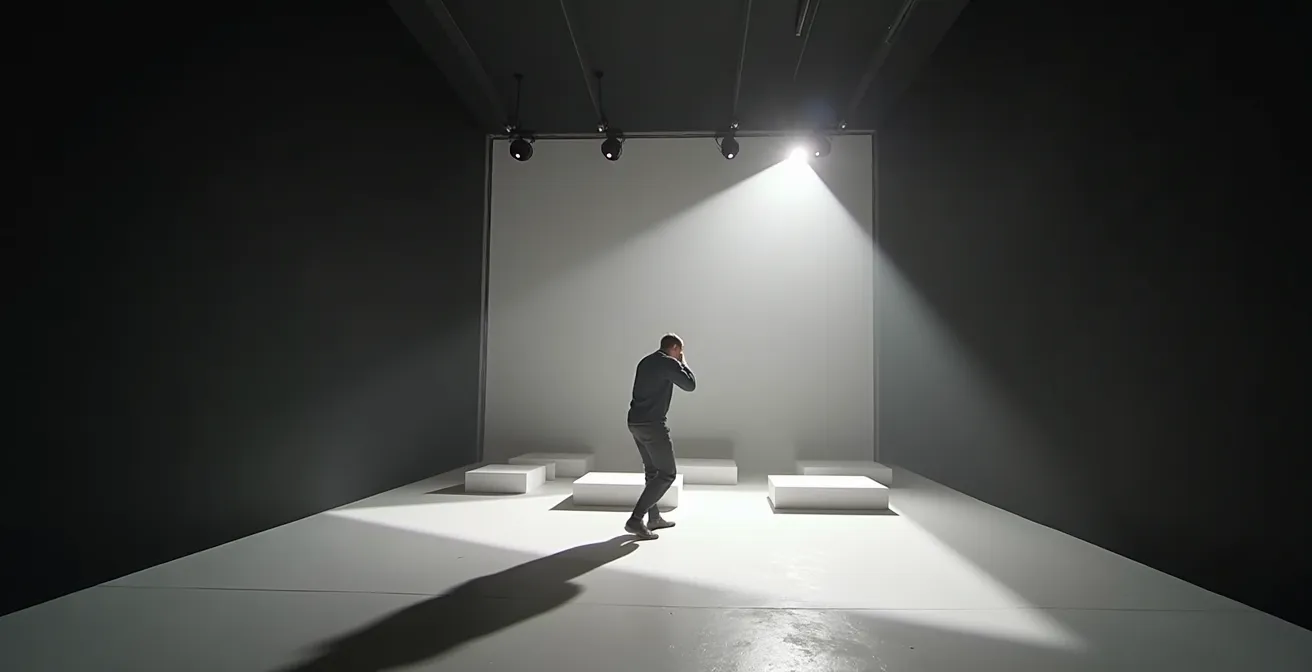
The secret to enjoying avant-garde theater isn’t about trying to “get it” in the traditional sense, but learning to decode the unique language of the performance.
- Modern plays often abandon linear plots to explore raw emotion and ideas more directly.
- Meaning is conveyed through the intentional use of space, sound, and the actor’s presence, not just dialogue.
Recommendation: Shift your mindset from being a passive viewer searching for a story to an active interpreter analyzing artistic choices.
There’s a familiar feeling for many culture enthusiasts: the lights dim, the performance begins, and within minutes, a sense of intellectual vertigo sets in. The characters speak in non-sequiturs, the set is a single, stark object, and the plot you were expecting has vanished. The fear of “not getting it” can be a powerful barrier, transforming a potentially thrilling experience into a confusing and alienating one. This intimidation is a common reaction to avant-garde theater, a form that deliberately challenges the conventions we’ve come to expect from a night out.
Conventional wisdom often offers little help, suggesting you simply “let the experience wash over you” or that “it’s all subjective anyway.” While there’s truth in this, such advice can feel dismissive, ignoring the genuine desire to engage with the work on a deeper level. You sense there is a method to the madness, a logic at play, but you lack the tools to decipher it. The problem isn’t a failure of your intellect; it’s that you’ve been given a toolbox designed for traditional storytelling to assemble a machine that runs on entirely different principles.
But what if the key wasn’t to find a hidden plot, but to learn how to read the performance itself as a text? This guide offers a different approach. We will move beyond the search for a linear narrative and instead build a “spectator’s toolbox” for active interpretation. By focusing on the *how* and *why* of the artistic choices—from the seating arrangement to the use of empty space—you can learn to decode the language of avant-garde theater. This will empower you to move from feeling lost to feeling engaged, transforming confusion into curiosity and appreciation.
This article provides a structured framework to help you navigate these complex performances. Each section tackles a key element of the avant-garde experience, offering practical insights and tools to enhance your understanding and enjoyment.
Summary: Your Toolkit for Decoding Modern Theater
- Why Modern Plays Often Abandon Traditional Plot Structures?
- Front Row vs Balcony: Which Seat Offers the Best Immersion?
- Minimalist Sets: How to Read Meaning in Empty Spaces?
- The Funding Crisis Threatening Your Local Independent Theater
- Reading the Script Beforehand: Spoiler or Necessary Prep?
- Digital Stream vs Front Row: Is the Presence Worth the Cost?
- Technique vs Concept: How to Tell Good Art from Bad?
- Why Ancient Folklore Still Resonates in Modern Movies?
Why Modern Plays Often Abandon Traditional Plot Structures?
The feeling of being unmoored in a play often begins with one simple question: “What is happening?” When a clear beginning, middle, and end are absent, it’s easy to feel that the artists have failed. In reality, this departure from linear narrative is a deliberate and foundational choice in avant-garde theater. It is not an absence of story, but a reframing of how a story can be told. The movement itself was born from a desire for new methods of expression. As Anton Chekhov famously wrote in *The Seagull*, a sentiment that echoes through the history of experimental performance, “What we need are new forms!”
This pursuit of “new forms” is about breaking free from the constraints of realistic plot to access a deeper, more visceral layer of human experience. Instead of showing you a sequence of events, an avant-garde play might aim to immerse you in a state of mind, a political argument, or a raw emotion. The structure becomes associative rather than chronological, using imagery, sound, and repetition to build a thematic world. The goal shifts from following a character’s journey to experiencing the thematic currents that drive the performance.
A powerful example of this is found in productions that deconstruct well-known classics. The Brooklyn Academy of Music’s Next Wave Festival has featured adaptations that reimagine Shakespearean histories by stripping away courtly language to focus on the raw, savage motivations of their characters. In doing so, they transform what could be “theatrical fossils” into living, breathing art. The story of kings and wars is still there, but it’s communicated through the intensity of performance rather than the progression of plot points.
Case Study: Reimagining Classics at BAM’s Next Wave Festival
Productions at the Next Wave Festival, such as Ivo van Hove’s *Kings of War*, demonstrate how dismantling traditional narrative can reveal deeper truths. By reimagining Shakespeare’s histories and focusing on the primal motivations of nobility, the performance moves beyond historical reenactment. This approach argues that producing classical works exactly as intended can turn them into museum pieces. As noted in a reflection on these adaptations, a theater living in the past becomes a museum with no danger, risk, or life, whereas deconstruction creates a vital, contemporary experience.
So, when you feel the plot slipping away, resist the urge to find it. Instead, ask yourself: What feeling is being created? What idea is being repeated? What is the emotional or intellectual journey, if not the narrative one? This shift in perspective is the first and most crucial tool in your spectator’s toolbox.
Front Row vs Balcony: Which Seat Offers the Best Immersion?
In traditional theater, the “best” seat is often a simple calculation of price and sight lines. In the avant-garde, however, your physical position in the auditorium is an integral part of your interpretive experience. It’s not just about seeing the play; it’s about defining your relationship to it. Your choice of seat is your first active decision as an interpreter, fundamentally shaping whether you are an observer or a participant. There is no single “best” seat, only the seat that is best for the kind of experience you want to have.
The front rows, for instance, thrust you into what can be called the ‘Participant’s Vortex.’ Here, you are overwhelmed by the physical presence of the performers. You see the sweat, you hear the breath, and you cannot escape the intensity of their gaze. This proximity makes you hyper-aware of your own role as a spectator, blurring the line between audience and performance. Conversely, a seat in the balcony offers the ‘Analyst’s Perch.’ From this distance, the individual performers become elements in a larger picture. You are better able to appreciate the director’s full visual composition, the geometric patterns of movement, and the overall “language of staging.”
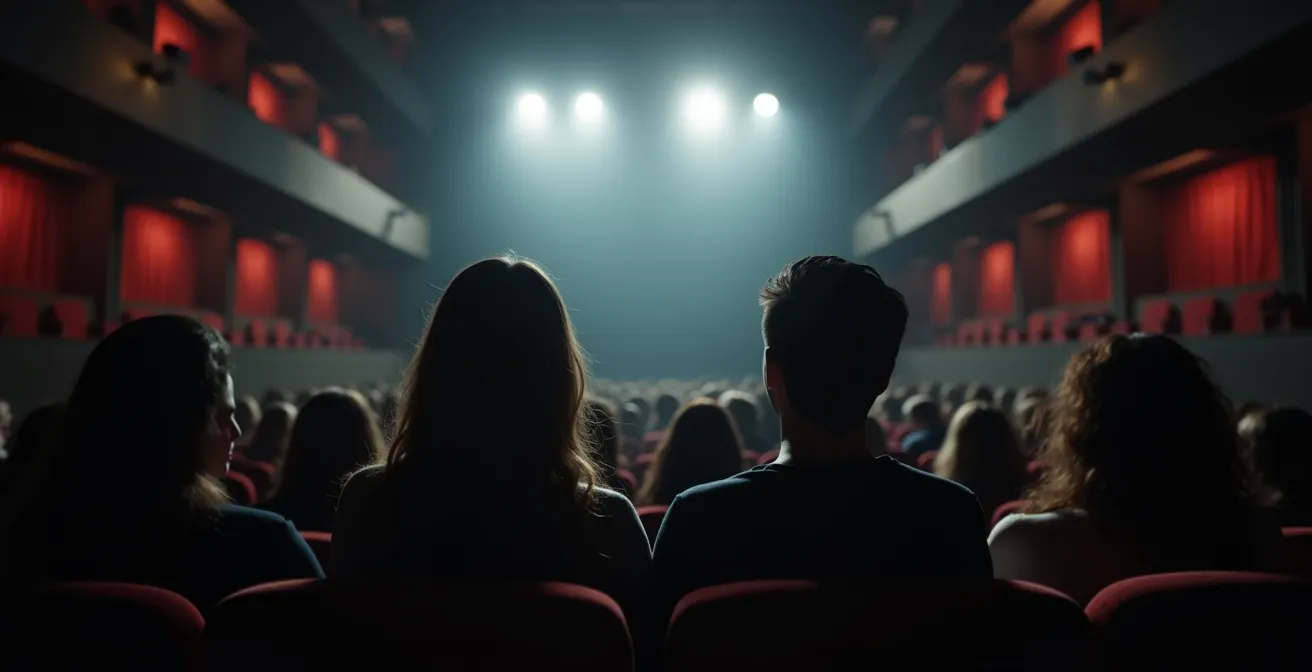
As this contrast shows, proximity trades a comprehensive view for an intense, sensory one. The choice depends entirely on your goal. If a production is known for its immersive or interactive elements, proximity is key. If it’s a visually spectacular piece with complex choreography or multimedia, distance can be more rewarding. Black box theaters, with their flexible seating, further complicate this choice, often eliminating the traditional proscenium divide altogether. Ultimately, selecting your seat is not a passive act of ticket-buying but an active part of your interpretive strategy.
Minimalist Sets: How to Read Meaning in Empty Spaces?
An empty stage can be one of the most intimidating sights in avant-garde theater. Where traditional sets are illustrative, filled with furniture and props to tell you exactly where and when you are, minimalist sets are suggestive. They hand the work of interpretation over to you. An empty stage, a single chair, or a bare wall are not signs of a low budget (though that can be a factor); they are intentional artistic choices designed to focus your attention elsewhere—on the actor’s body, the language, and the space created between them. The meaning isn’t in what you see, but in how what you see makes you feel and think.
This approach forces the audience to become an active interpreter. The absence of a detailed environment means you can’t be a passive observer of a realistic world. Instead, the “negative space” of the stage becomes a canvas. A single chair might represent a throne, a prison cell, or a lifetime of waiting. Its meaning is activated by the performer’s relationship to it. The focus shifts from the environmental context to the actor’s energy and movement. The emptiness amplifies the significance of every gesture and every object that *is* present.
Understanding this distinction is key to decoding minimalist design. The following table breaks down the philosophical shift from traditional to avant-garde staging, highlighting how empty space is used to generate meaning.
| Element | Traditional Theater | Avant-Garde/Experimental |
|---|---|---|
| Space Usage | Realistic sets with detailed props | Empty space activated by movement |
| Design Philosophy | Illustrative – shows location | Suggestive – implies meaning |
| Audience Role | Passive observer | Active interpreter |
| Focus | Environmental context | Actor’s body and energy |
| Meaning Creation | Through literal representation | Through negative space and absence |
When faced with a minimalist set, don’t ask, “Where are we?” Ask, “What does this space feel like?” “How does this emptiness affect the characters?” By asking these questions, you engage with the design on its own terms and begin to appreciate the profound power of absence.
The Funding Crisis Threatening Your Local Independent Theater
While we analyze the abstract choices on stage, it’s crucial to acknowledge a very concrete reality shaping them: money. The “aesthetics of scarcity” seen in many avant-garde productions—minimalist sets, small casts, unconventional venues—is not always just a stylistic choice. It is often a direct consequence of the severe financial pressures facing independent theaters. These small, bold companies are the lifeblood of theatrical innovation, yet they are the most vulnerable to economic instability.
The post-pandemic landscape has been particularly brutal. Many nonprofit and independent venues have reported a 20-50% audience decline from pre-pandemic levels, creating a perilous financial situation. This isn’t just a statistic; it represents a real threat to the cultural ecosystem. When a local independent theater closes, a community loses a vital space for risk-taking, dialogue, and the development of new artistic voices. The decision to produce a play with two actors and three boxes isn’t just postmodern theory; it’s often a pragmatic response to a budget that simply won’t allow for more.

Understanding this context adds another layer to your interpretation. It allows you to see the ingenuity born of constraint. A director who creates a universe with nothing but light and shadow is not just being experimental; they are being resourceful. This financial reality connects the abstract art on stage to the tangible world we live in. It reminds us that supporting avant-garde theater isn’t just an intellectual exercise; it’s an act of cultural preservation. When you buy a ticket to a small, independent show, you are funding the future of the art form.
Reading the Script Beforehand: Spoiler or Necessary Prep?
For the dedicated culture enthusiast, the question of preparation is a practical one: to read or not to read? Faced with a potentially non-linear or language-driven play, it’s tempting to study the script beforehand to get your bearings. However, there’s a fear this might spoil the “pure” experience of discovery. There is no single right answer to this dilemma; instead, it’s best to frame it as a strategic choice based on your viewing goals. Are you an ‘Explorer’ or an ‘Architect’?
The ‘Explorer’ thrives on the raw, unfiltered experience. For this type of viewer, the feeling of confusion is not a problem to be solved but a part of the journey. They embrace the disorientation, allowing the performance to unfold on its own terms without preconceptions. For an Explorer, reading the script beforehand would be like looking at a map of a maze before entering it—it defeats the purpose. The joy is in finding your own way through. If you choose this path, you prioritize the immediate, visceral reaction to the work.
The ‘Architect,’ on the other hand, wants to understand the blueprint. By reading the script in advance, this viewer can shift their focus from basic comprehension (“What are they saying?”) to a more sophisticated analysis of the production choices (“Why did the director stage this scene this way?”). Knowing the text allows the Architect to appreciate how the performance deconstructs or reimagines the written word, revealing layers of meaning in the staging, design, and acting. Instead of trying to follow the plot, they can focus on how the director’s vision and the performers’ interpretive freedom bring the text to life.
If you’re hesitant to read the full script, a middle ground exists. Reading director interviews, critical essays about the playwright, or production notes can provide valuable context without giving away specific plot points or surprises. This can attune you to the themes and artistic lineage of the work, enriching your experience without over-determining it.
Digital Stream vs Front Row: Is the Presence Worth the Cost?
The rise of high-quality digital streams of theatrical productions has presented audiences with a new choice. Is it better to experience a play from the comfort of home, with the ability to pause and rewind, or is there an irreplaceable magic to being physically present in the theater? While accessibility and cost make streaming an attractive option, it’s important to understand the fundamental experiential differences, especially for avant-garde work.
The most significant difference lies in what can be termed the ‘viewer’s agency.’ In a live performance, you possess a “free gaze.” You decide where to look. You can focus on the lead actor, watch the reactions of a minor character in the background, or even observe the audience around you. You are the director of your own experience. A digital stream, by contrast, offers a “curated gaze.” The camera director has already made those choices for you, guiding your eye with close-ups, wide shots, and edits. While this can provide a detailed and polished view, it removes your agency as an interpreter of the visual field.
Furthermore, the collective energy of a live audience is a powerful, unquantifiable element. The shared silence, the sudden gasp, the wave of laughter—these reactions become part of the performance itself. This communal experience is entirely absent in the solitary act of streaming. Of course, streaming has its own analytical advantages. The ability to pause, rewind, and deconstruct a particularly complex scene offers a level of detailed study impossible in a single live viewing. The following table from a resource on avant-garde theatre highlights these key trade-offs.
| Aspect | Live Attendance | Digital Stream |
|---|---|---|
| Viewer Agency | Free gaze – choose where to look | Curated gaze – camera director’s perspective |
| Analysis Capability | Single viewing, memory-based | Pause, rewind, detailed deconstruction |
| Collective Energy | Shared audience reactions influence experience | Individual viewing, no collective presence |
| Cost Factor | $50-150+ per ticket | $15-30 streaming access |
| Accessibility | Geographic and physical limitations | Available anywhere with internet |
Neither experience is inherently superior, but they are fundamentally different. For avant-garde theater, where the physical presence of the actor and the shared space are often central themes, the argument for live attendance is particularly strong. The cost of the ticket is not just for a show, but for the irreplaceable experience of communal presence and interpretive freedom.
Technique vs Concept: How to Tell Good Art from Bad?
Perhaps the most daunting question of all is that of judgment. Without the familiar markers of a good story or realistic acting, how can we possibly distinguish between “good” and “bad” avant-garde art? It’s easy to dismiss a confusing or challenging work as self-indulgent nonsense. However, a more productive approach is to develop a new framework for evaluation, one that aligns with the intentions of the art form itself. As practitioners of experimental theatre describe it, true experimentation is more than just a new style; it is “a light that illuminates one’s work from within… an amalgam of so many quests.”
To see that light, we must shift our criteria from personal enjoyment to artistic effectiveness. The question is not “Did I like it?” but “Did the work achieve what it set out to do?” A play that intends to disturb or alienate its audience and succeeds is, by this metric, a piece of successful art, even if it was an unpleasant experience. This requires distinguishing between productive discomfort—confusion that sparks curiosity and deepens engagement—and simple incoherence that stems from poor execution. This is the core of your critical toolbox.
The following checklist provides a practical framework for evaluating an avant-garde performance on its own terms. It helps you move past a simple “like/dislike” reaction and toward a more nuanced and informed critique.
Your Action Plan: A Framework for Evaluating Avant-Garde Quality
- Apply the Internal Coherence Test: Does the production follow its own established logic, even if unconventional? Look for consistent artistic choices in sound, movement, and design throughout the piece.
- Measure Effectiveness Over Enjoyment: If the play clearly intended to disturb, confuse, or alienate you, and you felt that way, it has succeeded in its artistic goal. Acknowledge the achievement of its intent.
- Distinguish Productive Discomfort from Incoherence: Does your confusion spark curiosity and make you ask questions about the work’s meaning? Or does it feel like the result of sloppy, accidental, or poorly executed choices?
- Examine Technical Precision Within the Form: Even “rule-breaking” requires immense skill. Assess whether the experimental choices appear intentional, controlled, and technically precise, or random and accidental.
- Consider Context and Innovation: Is the work genuinely pushing boundaries within its cultural moment, or is it merely repeating established avant-garde tropes from decades past without adding a new perspective?
Using this framework allows you to engage with the work as a critic, not just a consumer. It gives you a vocabulary and a structure to analyze your experience, turning a potentially frustrating evening into an intellectually stimulating one.
Key Takeaways
- Shift your focus from finding a linear plot to recognizing patterns in imagery, sound, and movement.
- Your physical and intellectual position matters; actively choose your role as either an immersed participant or a distant analyst.
- Evaluate a performance based on its internal logic and its effectiveness in achieving its own goals, not on traditional notions of enjoyment.
Why Ancient Folklore Still Resonates in Modern Movies?
After immersing ourselves in the seemingly radical newness of avant-garde theater, it may come as a surprise to find that its roots often dig deep into the most ancient forms of human storytelling: folklore, myth, and ritual. When a modern play dispenses with realistic characters and plot, it often taps into a more primal language of archetypes and symbolic actions that resonates with our collective unconscious. The “new forms” that artists seek are frequently built upon the foundations of our oldest stories.
This connection is not accidental. Theatrical pioneers like Antonin Artaud called for a “Theater of Cruelty” that would break down masterpieces to their ritualistic core, reflecting the primal struggles of existence. This approach aims to bypass the intellect and speak directly to the senses and emotions, much like an ancient tribal ceremony. The avant-garde, a French term for the “advance guard,” saw artists as agents of change, using their work to inscribe new ideas. Yet, these new ideas are often expressed through timeless structures: the hero’s journey, the sacrifice, the cyclical nature of life and death.

Recognizing these folkloric elements can be a powerful key to unlocking a play’s meaning. When you can’t find a realistic personality in a character, look for an archetypal function: are they a Trickster, a Martyr, a Sage? When dialogue becomes incantatory and movements repetitive, look for the patterns of ritualistic ceremony. These mythic structures often provide a hidden framework beneath a fragmented, non-linear surface. A play about a modern family’s breakdown might be echoing an ancient Greek tragedy. An abstract performance about isolation might be re-staging a mythic quest. By learning to spot these ancient patterns, you connect the strange, modern performance on stage to a deep well of shared human memory, making the alien feel suddenly, profoundly familiar.
Now armed with this spectator’s toolbox, the final step is to put it into practice. The next time you see a listing for an experimental play at a local independent theater, don’t be intimidated. Book a ticket, choose your seat with intention, and go in not with the fear of being lost, but with the excitement of active interpretation. Your most rewarding theatrical experience may be the one that challenges you the most.