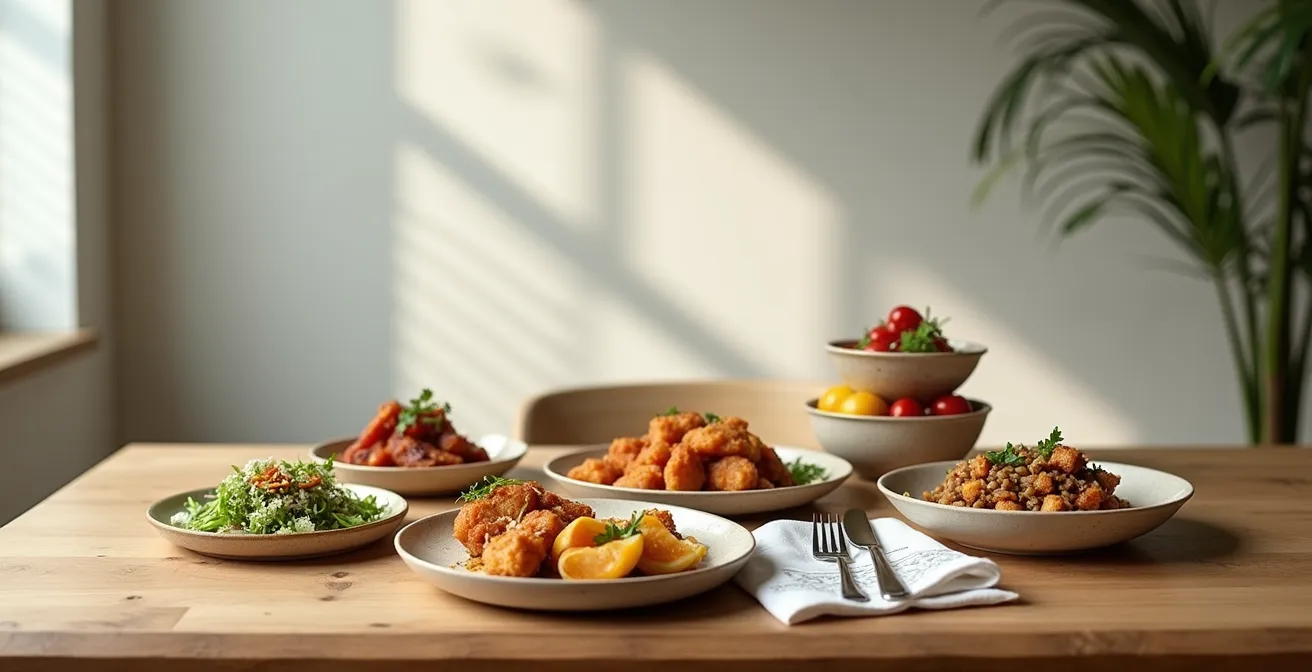
Third-culture cuisine is not a simple ‘mix’ of foods, but the birth of a new culinary language written by chefs whose lives span multiple cultures.
- It rejects the static idea of ‘authenticity’ in favor of a personal, evolving story told on the plate.
- It transforms nostalgic flavors and family recipes into codified, shareable dishes that create new traditions.
Recommendation: Instead of asking if a dish is ‘authentic,’ ask ‘What story does this dish tell?’ This shift in perspective is the key to understanding the future of global gastronomy.
When we talk about food born from migration, the conversation often flattens into simple, comfortable terms. We reach for words like ‘fusion’ or ‘eclectic,’ imagining a chef playfully tossing ingredients from two different pantries together. This perspective, however, misses the profound sociological shift happening in kitchens and on plates around the world. We see chefs who grew up between cultures—the children of immigrants, expatriates, and global nomads—not as mixers, but as creators of entirely new culinary languages. Their food isn’t a collage of borrowed ideas; it’s an edible narrative, a deeply personal syntax of flavors forged in the crucible of a ‘third culture’ identity.
The common impulse is to judge these new creations against a rigid yardstick of ‘authenticity.’ We ask if a dish is a ‘real’ representation of its supposed origin, a question that limits both the chef and the diner. But what if the most authentic thing a chef can do is cook their own story? This approach moves beyond a checklist of historical ingredients and techniques. It embraces the complex, sometimes contradictory, journey of identity. It acknowledges that a childhood memory of a specific spice, a longing for a dish from a land left behind, or the discovery of a new local ingredient are all valid and powerful sources of culinary inspiration.
This article explores this phenomenon not as a trend, but as a fundamental evolution in gastronomy. We will deconstruct the myth of authenticity, analyze how personal memory becomes a recipe, and draw the critical line between appreciation and appropriation. By understanding third-culture cuisine as a new culinary grammar, we can learn to ‘read’ dishes in a more meaningful way, appreciating the rich, personal stories they tell.
To fully savor the depth of this culinary movement, we will explore its key facets, from the philosophical underpinnings to the practical challenges chefs face. The following sections offer a complete tasting menu of the ideas shaping the future of food.
Summary: Why Third-Culture Cuisine Is the Edible Future of Gastronomy
- Why ‘Authentic’ Food Is a Myth That Limits Chefs?
- The ‘Pinch of This’ Problem: Standardizing Family Recipes?
- Why Certain Spices Trigger Instant Childhood Memories?
- Fusion vs Confusion: When Does Culinary Borrowing Become Theft?
- Holiday Tables: Why We Eat Specific Foods on Specific Dates?
- Seasonal Eating: Adapting Your Menu to Nature’s Rhythm
- Cultural Appreciation vs Appropriation: Where Is the Line?
- How to Taste Wine Like a Sommelier in 5 Steps?
Why ‘Authentic’ Food Is a Myth That Limits Chefs?
The concept of ‘authenticity’ in food is a comforting illusion. It suggests a pure, unchanging culinary tradition handed down through generations, a perfect, canonical version of a dish. For a food sociologist, this idea is a trap. It freezes cuisine in time, ignoring the reality that food has always been a dynamic, evolving entity shaped by migration, trade, and adaptation. For the third-culture chef, the pressure to be ‘authentic’ is particularly stifling. It asks them to choose one part of their identity over another, forcing them to perform a version of their heritage that fits an outsider’s expectation rather than reflecting their own lived experience.
This pursuit of a mythical authenticity often leads to a focus on historical accuracy over emotional truth. A third-culture chef’s goal is not to replicate their grandmother’s dish exactly as it was made in her village fifty years ago. Their goal is to channel the *feeling* of that dish, to translate its emotional resonance into a new context. This chef is not a museum curator preserving an artifact; they are a poet using a familiar vocabulary to write a new verse. The resulting dish might use different ingredients or techniques, but it carries the same emotional weight and tells a story that is both personal and deeply connected to their heritage.
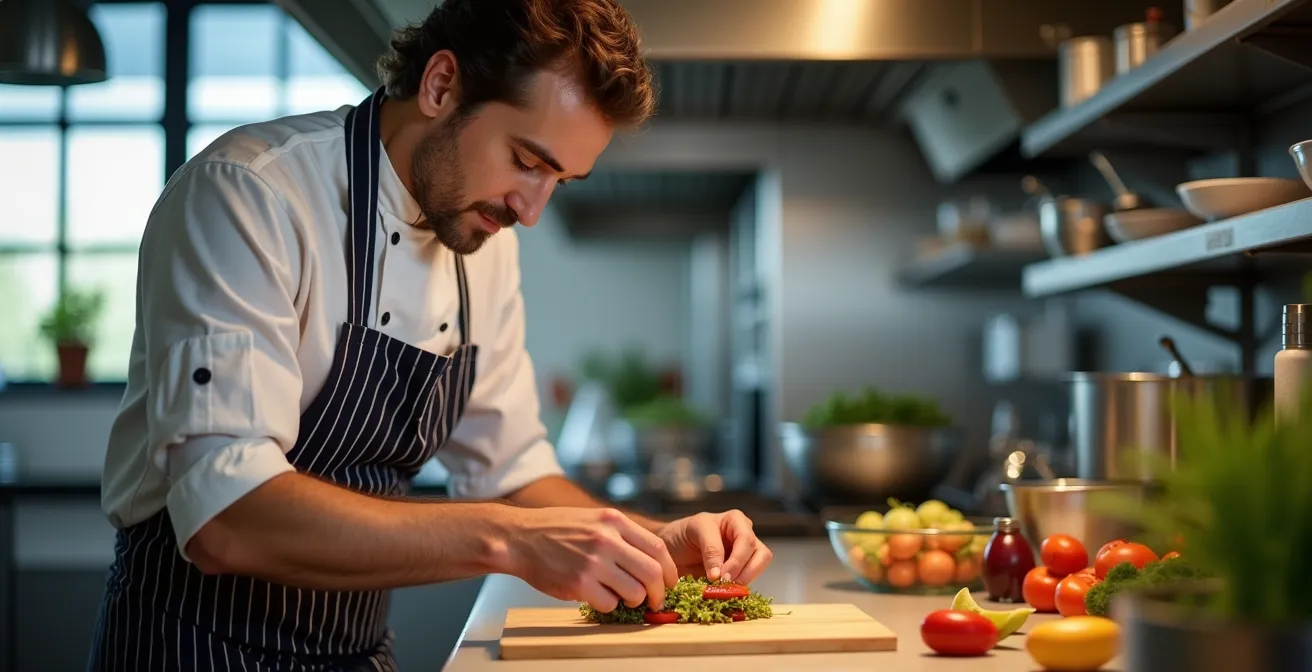
As the portrait above suggests, the modern chef’s expression is one of personal creation, not historical replication. They are crafting an edible narrative. True authenticity, therefore, is not found in a dusty, prescriptive recipe book but in the honest expression of a chef’s unique journey. It is the courage to create a dish that says, “This is who I am. This is where I’ve been. This is what home tastes like to me.” By letting go of the rigid and often arbitrary rules of ‘authenticity,’ we open ourselves up to a world of cuisine that is more personal, more innovative, and ultimately, more delicious.
The ‘Pinch of This’ Problem: Standardizing Family Recipes?
For many third-culture chefs, the bedrock of their culinary grammar is the family recipe. These are not written instructions but sensory archives passed down through observation and intuition. They are defined by a “pinch of this” and a “handful of that,” with doneness measured by color, aroma, and sound. This presents a fascinating challenge: how do you translate this deeply personal, non-standardized knowledge into a replicable dish for a restaurant menu or a cookbook? This is the ‘pinch of this’ problem—the intricate process of codifying an oral tradition without losing its soul.
This translation is not a simple act of measurement. It is an act of deep analysis and reverse-engineering. The chef must become a detective, identifying the core flavor compounds and essential techniques that give the dish its identity. They must ask: what makes this stew taste like *my mother’s* stew? Is it the brand of soy sauce, the specific way the onions are caramelized, or the precise moment the spices are added? Standardizing these elements creates a “spec sheet” that allows for consistency, but the true art lies in capturing the emotional context alongside the technical requirements. The recipe must retain its narrative integrity.
Case Study: Jon Kung’s Curry Mac and Cheese Development
A prime example of this process is Chef Jon Kung’s development of his curry mac and cheese. Intrigued by the Japanese use of cheese with curry, and armed with excellent family-style baked mac and cheese recipes from his time in Detroit, he began to experiment. As he explains, he chose a specific Japanese curry brand, S&B, because its unique spice blend was perfectly suited to complement the rich, savory flavors of the cheese. This wasn’t a random fusion; it was a deliberate synthesis, codifying a new idea born from distinct cultural exposures into a consistent, delicious dish.
Ultimately, solving the ‘pinch of this’ problem is a cornerstone of third-culture cuisine. It is the bridge between the private, domestic sphere of the family kitchen and the public, commercial sphere of the restaurant. By successfully translating these intuitive recipes, chefs not only preserve their heritage but also make it accessible, creating new traditions that can be shared, adapted, and savored by a wider audience. It is an act of generosity, sharing a piece of one’s personal history with the world.
Why Certain Spices Trigger Instant Childhood Memories?
The connection between scent, taste, and memory is a cornerstone of the human experience, a phenomenon deeply rooted in our neurobiology. The olfactory bulb, which processes smells, has direct connections to the amygdala (emotional processing) and the hippocampus (memory formation). This is why a specific aroma can instantly transport us back to a childhood kitchen, a holiday celebration, or a bustling market from a land left behind. For third-culture individuals, this sensory archive is not just a source of nostalgia; it’s a vital link to their heritage and a foundational element of their identity. When food-related connections are lost, the impact can be profound; a recent study of international students found that food-related unhappiness significantly impacted the mental health of 52 Chinese students.
Spices are the vocabulary of this sensory language. A single whiff of star anise, cardamom, or smoked paprika can unlock a complex web of emotions and associations. As Chef Jon Kung notes about a classic blend, “Five-spice powder has a lot of ‘holiday’ aroma in there: cinnamon, anise, clove, fennel and Sichuan peppercorns.” These specific combinations are not arbitrary; they are cultural signifiers, imbued with generations of meaning. For a third-culture chef, these spices are more than just flavoring agents. They are narrative tools used to build bridges between the different parts of their identity, weaving a coherent story on the plate.
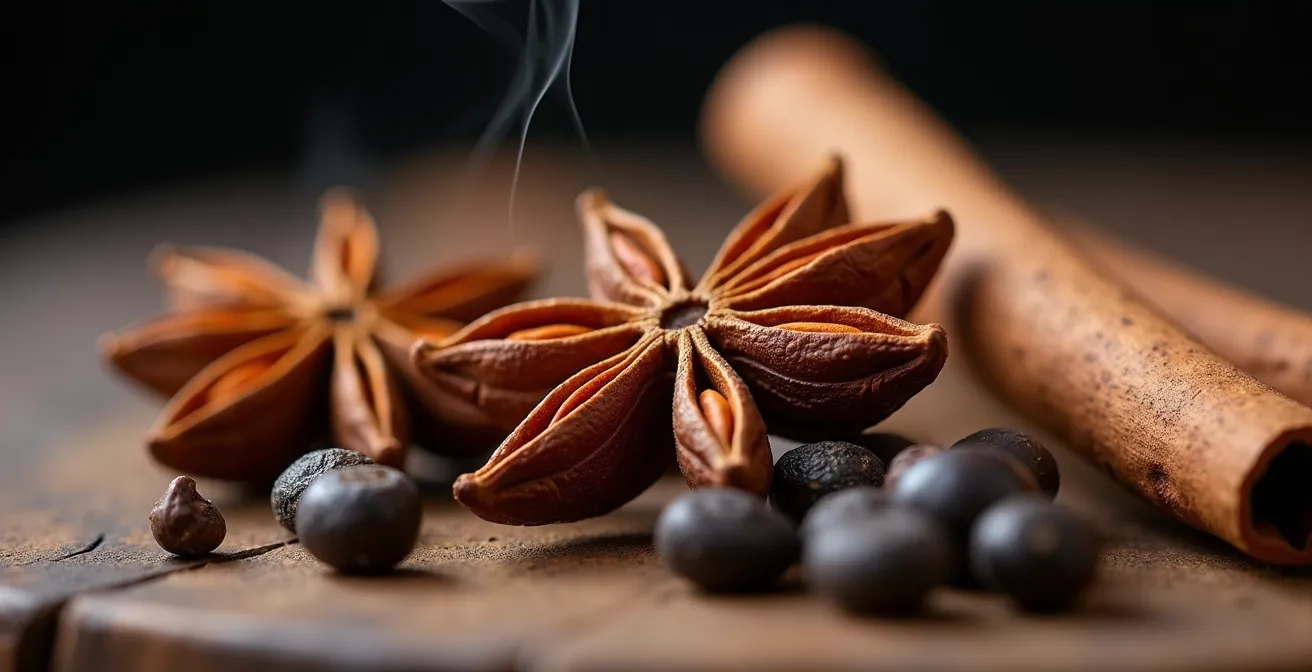
The magic of third-culture cooking lies in how it uses this sensory power to create new memories. By combining the aroma of a traditional spice blend with an ingredient from their new home, a chef can create a dish that is at once familiar and novel. It honors the past while firmly rooting itself in the present. This act of flavor syntax—arranging the sensory vocabulary in a new way—allows the chef to communicate their unique experience, offering diners a taste of a world that exists at the intersection of memory and place. It’s an invitation to share in a deeply personal moment, triggered by the simplest of things: the scent of a spice.
Fusion vs Confusion: When Does Culinary Borrowing Become Theft?
The terms ‘fusion’ and ‘third-culture’ are often used interchangeably, but they represent fundamentally different culinary philosophies. Understanding this distinction is key to navigating the complex territory between thoughtful combination, culinary chaos, and outright appropriation. ‘Fusion’ cooking, which rose to prominence in the late 20th century, often involved a surface-level combination of cuisines, typically driven by a commercial impulse to create something novel for a dominant, often Western, palate. As Chef Jon Kung puts it, “Fusion was always a showcase of another culture’s cuisine for a dominant culture. Third culture is informed by a lived experience.”
This “lived experience” is the crucial differentiator. Third-culture cuisine is not a mash-up; it’s a deep synthesis born from a chef’s personal history. It’s the result of growing up with the flavors of one culture in the geographical context of another. In contrast, ‘culinary confusion’ arises when ingredients are mixed without an understanding of their context or flavor profiles, resulting in a dish that lacks coherence and respect for its sources. This often stems from a misunderstanding of the underlying culinary grammar. At the far end of the spectrum is appropriation, where a dominant culture borrows elements from a marginalized one without credit, context, or compensation, often exploiting a power imbalance.
This comparative framework helps clarify the motivations and power dynamics at play. As the following analysis based on industry observation shows, the intent and origin story behind a dish are what separate a meaningful creation from a thoughtless combination or an exploitative act.
| Category | Definition | Power Dynamic | Example |
|---|---|---|---|
| Fusion | Surface-level combination of cuisines | Often commercial-driven | Tex-Mex from chain restaurants |
| Third-Culture | Deep synthesis from lived experience | Personal narrative-driven | TCK chef’s heritage-based dishes |
| Confusion | Failed combination lacking coherence | Misunderstanding of source | Random ingredient mixing |
| Appropriation | Borrowing without credit/context | Power imbalance exploitation | Corporation rebranding traditional dish |
The line between these categories is drawn with context and credit. A third-culture dish is an autobiography. A fusion dish is a collaboration. An appropriated dish is plagiarism. Recognizing this difference allows us as diners to engage with food more critically and ethically, appreciating the story behind the plate and the identity of the person who created it.
Holiday Tables: Why We Eat Specific Foods on Specific Dates?
Holiday tables are powerful arenas of cultural expression, laden with dishes that are as much about identity and memory as they are about sustenance. For many, the foods we eat on specific dates are anchors to our heritage, a sensory link to generations of tradition. These are not just meals; they are rituals, with each dish carrying a specific symbolic weight. For third-culture families, the holiday table becomes a fascinating space of negotiation and creation, a place where different traditions meet, merge, and are transformed into something new. The menu becomes a map of the family’s journey, reflecting both their origins and their current home.
This process is not about simply placing a dish from one culture next to a dish from another. It’s a more integrated, creative act. It might involve taking the form of a classic holiday dish from the host culture—like a Thanksgiving turkey or a Christmas roast—and infusing it with the flavors and spices of the heritage culture. This creates a new, hybrid tradition that honors every part of the family’s story. As Chef Jon Kung eloquently states, “Combining nostalgic experiences that were once separate into one unique creation—that’s meaningful. It’s taking the form of one dish with the flavors of another and honoring every part of the journey that led you here.”
Case Study: The Evolving Menus of Migrant Identity
Hetty McKinnon, an Australian writer of Chinese descent, embodies this philosophy in her cooking. Her recipes are a direct reflection of her personal history, circling back to memory and migration. As highlighted in a feature by Global Brands Magazine on the rise of third-culture food, she intentionally avoids labeling her dishes as strictly ‘Chinese’ or ‘Australian.’ Instead, she leans into the context of her life, proving that a dish doesn’t need a neat category to be meaningful. For McKinnon, identity itself is the defining ingredient, allowing her holiday table to be a fluid, authentic representation of her family’s unique narrative.
These new holiday dishes become powerful symbols for the next generation. They are edible heirlooms, representing a heritage that is not static but alive and evolving. They teach children that identity is not about choosing one culture over another, but about creating a personal space where all parts of their background can coexist harmoniously. The third-culture holiday table is therefore a testament to resilience and creativity, a celebration of a family’s unique place in the world.
Seasonal Eating: Adapting Your Menu to Nature’s Rhythm
The concept of seasonal eating—adapting one’s diet to the produce that is naturally available—is a universal principle of traditional cooking. Before global supply chains, cuisine was, by necessity, a direct reflection of its local environment. For third-culture chefs, this principle takes on a new layer of complexity and creativity. They are often working with a culinary grammar and a set of heritage recipes developed in one climate, which must now be translated using the ingredients available in a completely different one. This is not a limitation; it is a catalyst for innovation.
The challenge is to maintain the soul of a traditional dish while substituting key ingredients. How do you capture the essence of a tropical fruit stew in a temperate climate? How do you replicate the specific texture of a heritage vegetable using a local alternative? This requires a deep understanding of flavor profiles and food science. The chef must identify the core function of an ingredient—is it providing sweetness, acidity, bitterness, or a specific texture?—and then find a local, seasonal equivalent that can play that same role. This adaptation is a fundamental aspect of how cuisines evolve, and research on cross-cultural food preferences shows that geographic location determines 67% of traditional dish variations in migrant communities.
This process of local adaptation creates entirely new gastronomic dialects. A classic Southeast Asian salad, for example, might be reimagined with hardy winter greens and root vegetables in Northern Europe, while retaining its signature sweet, sour, and spicy dressing. The result is a dish that is a dialogue between heritage and locality. It pays homage to its origins while celebrating its new home. This approach also has significant benefits for sustainability, reducing food miles and supporting local agricultural systems.
For the third-culture chef, seasonal eating is not a restrictive trend but an opportunity. It is a framework for creativity that forces them to constantly innovate, to look at familiar ingredients in new ways, and to forge a deeper connection with their local environment. It is the ultimate expression of being present, of cooking in a way that respects both the rhythms of nature and the echoes of memory.
Cultural Appreciation vs Appropriation: Where Is the Line?
In the globalized world of food, the line between celebrating a culture and exploiting it can be perilously thin. Cultural appreciation is characterized by respect, credit, and a genuine effort to understand context. It involves engaging with a cuisine on its own terms, acknowledging its history, and supporting the community from which it comes. Cultural appropriation, on the other hand, involves taking elements from a marginalized culture without understanding or credit, often for commercial gain and in a way that perpetuates stereotypes. It’s the difference between being a respectful guest and a thief.
Third-culture chefs are uniquely positioned in this debate. Because their work is rooted in their own lived experience and heritage, it serves as a powerful model of appreciation. Their creations are not borrowed; they are owned through identity. A key element in drawing the line is the rejection of the word ‘authentic,’ which, as discussed, often serves as a tool for outsiders to police a culture’s boundaries. This idea is central to many new-generation food brands built by founders from the diaspora.
We never use the word ‘authentic’ in describing Omsom. We are trying to break open the box that Asian-American cuisine has been given. Authenticity sets chefs up to fail.
– Kim Pham, Fine Dining Lovers
This sentiment highlights a crucial point: appreciation champions evolution and personal expression, while the demand for authenticity can inadvertently fuel appropriation by creating a simplistic, marketable version of a culture. The founders of the brand Omsom provide a compelling example of ethical appreciation in practice. Their approach was not to create watered-down flavors for a generic “ethnic” aisle, but to center the tastes and experiences of Asian Americans themselves.
Case Study: The Omsom Framework for Appreciation
The founders of Omsom, first-generation Vietnamese Americans, created their brand as a direct response to a market that either ignored or “bastardized” Asian flavors for a Western audience. Their framework was built on what can be described as the 3 Cs: Context, Credit, and Community. By partnering with acclaimed Asian chefs to develop their products (Credit), telling the rich stories behind the flavors (Context), and creating a product designed first and foremost for Asian Americans (Community), they built a business model rooted in profound appreciation rather than appropriation.
Ultimately, the antidote to appropriation is to center the source community. This means amplifying the voices of chefs and creators from that culture, paying them for their labor and expertise, and engaging with their work in a way that is respectful and informed. For diners, it means choosing to support businesses that practice this ethos, moving beyond passive consumption to active, conscientious appreciation.
Key Takeaways
- Third-culture cuisine is not fusion; it is a new culinary language born from a chef’s personal migration story.
- The concept of ‘authenticity’ is a myth that limits creativity; true authenticity lies in expressing one’s lived experience.
- Tasting third-culture food requires a sociological approach: understanding the chef’s history is as important as identifying the ingredients.
How to Taste Wine Like a Sommelier in 5 Steps?
While the title suggests a focus on wine, the most insightful way to apply a sommelier’s methodical approach is to “taste” third-culture cuisine itself. Just as a sommelier deconstructs a wine into its component parts—terroir, grape, technique—we can learn to deconstruct a third-culture dish to understand its story. This is a shift from passive eating to active, sociological tasting. It moves beyond the simple question of “Is this good?” to the more profound questions of “What does this mean? Where does this come from?” This approach allows us to appreciate the full depth and complexity of the chef’s creation, recognizing the intellect and emotion baked into every bite.
This analytical tasting method is about identifying the different cultural threads woven together on the plate. It involves recognizing a specific spice from one tradition, a cooking technique from another, and a local, seasonal ingredient that grounds the dish in its current place. It’s a form of culinary archaeology, digging through the layers of flavor to uncover the story buried within. The ultimate goal is to understand the chef’s personal terroir—the unique combination of heritage, memory, and migration that defines their culinary point of view. As Chef Jon Kung explains, this personal narrative is the only thing a creator can truly claim: “My interest in third-culture cooking has taught me that the only things any of us claim are our own stories, our own experience and our own memories.”
Adopting this mindset transforms the dining experience. A plate of food ceases to be a static object and becomes a dynamic, living narrative. It’s an invitation into the chef’s world, a chance to travel through their history with every mouthful. To truly appreciate the future of gastronomy, we must learn to taste not just with our palates, but with our intellect and our empathy.
Your Action Plan: Tasting Third-Culture Cuisine with a Sociologist’s Palate
- Deconstruct the Plate: Identify the constituent cultural elements. Where does the technique come from? What are the origins of the primary ingredients and spices?
- Analyze the ‘Terroir’: Go beyond the food. Research the chef’s personal history, their migration story, and the cultural context of their upbringing.
- Synthesize the Narrative: Articulate the new story the dish tells. How do the different elements combine to create a unique, personal statement?
- Recognize Flavor Bridges: Pinpoint the specific ingredients or techniques the chef uses to connect different culinary traditions into a cohesive whole.
- Appreciate Context Over Category: Let go of the need to classify the dish. Instead, focus on valuing the personal meaning and the unique story it represents.
This deeper mode of engagement is the final, crucial step. By learning to taste with intent and curiosity, you not only enrich your own experience but also pay the highest respect to the chefs who pour their life stories onto the plate, offering a taste of a world remade.