The central ethical challenge of autonomous vehicles isn’t a split-second “trolley problem,” but the long-term urban design philosophy we embed in their code.
- Liability is shifting from individual drivers to a pre-defined “liability architecture” determined by manufacturers and software performance.
- The convenience of autonomous vehicles may paradoxically increase traffic congestion and urban sprawl rather than solve them.
Recommendation: Policymakers must proactively choose between a tech-centric model that optimizes for machine efficiency and a human-centric model that prioritizes social equity and community well-being.
The vision of an autonomous vehicle gliding silently through city streets promises a future of safety and efficiency. For decades, the public discourse around this technology has been dominated by a single, dramatic thought experiment: the trolley problem. In a no-win scenario, who does the car choose to sacrifice? This question, while philosophically intriguing, has become a platitude that obscures the far more profound and immediate ethical choices we face. The dilemmas are not confined to the split-second decisions of a single car but are embedded in the very systems that will govern our future mobility.
The true ethical fork in the road is a fundamental design choice. Will we build a transportation network optimized purely for technical performance—a tech-centric system that prioritizes speed, traffic flow, and algorithmic perfection? Or will we pursue a human-centric system that values accessibility, neighborhood cohesion, and the unpredictable realities of human life? This distinction is the real code of the road being written today, line by line, in software and in policy.
This article moves beyond the trolley problem to dissect these foundational dilemmas. We will analyze how responsibility is being architected, how autonomous fleets could reshape our cities for better or worse, and what it means to trust a machine with life-or-death governance. The answers will determine not just how we travel, but how we live together.
For those who prefer a visual and condensed format, the following video offers an excellent primer on the core ethical questions at the heart of the self-driving car debate. It serves as a perfect complement to the detailed analysis in this guide.
To navigate these complex issues, this guide is structured to address the critical questions facing policymakers and citizens. We will move from the immediate question of crash liability to the long-term impacts on urban design and human trust, providing a comprehensive framework for understanding the transition to a driverless world.
Summary: The Ethical Dilemmas of Autonomous Vehicle Adoption
- Who Is Responsible When a Self-Driving Car Crashes?
- How Autonomous Fleets Could Eliminate Traffic Jams?
- Private Pods or Robotaxis: The Future of Public Transport?
- The Software Glitch That Could Gridlock an Entire City
- Transition Phase: When Human and Robot Drivers Mix?
- Tesla FSD vs Traditional Insurance: Cost Analysis
- Human-Centric or Tech-Centric: Designing Future Neighborhoods
- Trusting Driverless Features on Long Highway Trips
Who Is Responsible When a Self-Driving Car Crashes?
The question of liability in an autonomous vehicle (AV) crash is the entry point into the technology’s ethical maze. Traditionally, fault lies with a human driver. But as we move through the SAE Levels of automation—from Level 2 (driver assistance like Tesla’s Autopilot) to Level 4 (full self-driving in limited areas)—the lines of responsibility blur. The data already reflects this complex reality; one investigation found that 467 collisions involving Tesla’s Autopilot resulted in 15 deaths and 54 injuries through August 2023. In these intermediate stages, as legal experts point out, accidents will largely be decided by traditional negligence rules.
However, a more radical shift is underway. We are witnessing the creation of a new liability architecture, where responsibility is not determined after a crash but is designed into the system itself. This moves the focus from the driver to the manufacturer. A groundbreaking example of this is seen in a recent industry development.
Case Study: The Mercedes-Benz Liability Transfer
Mercedes-Benz became the first automaker to publicly accept legal liability for collisions that occur while its Level 3 Drive Pilot system is engaged. In this mode, the driver can legally take their hands off the wheel and their eyes off the road. By assuming this risk, Mercedes is not just selling a feature; it is selling a contractual promise of responsibility, fundamentally altering the insurance and legal landscape. This move sets a powerful precedent, suggesting that future liability will be a function of software integrity, not driver attentiveness.
This pre-emptive acceptance of fault re-frames the ethical debate. The question is no longer just “Who is to blame?” but “Who has designed the system of blame?” As manufacturers take on this role, they also take on the immense ethical burden of the code they write, making the software developer the de facto arbiter of safety on the road.
How Autonomous Fleets Could Eliminate Traffic Jams?
One of the most compelling promises of a tech-centric AV future is the elimination of traffic congestion. In theory, autonomous fleets, communicating with each other (V2V) and with infrastructure (V2X), could optimize traffic flow with superhuman precision, eliminating phantom traffic jams and maximizing road capacity. They could travel closer together, accelerate in unison, and route themselves with perfect efficiency. This vision suggests a future of smooth, uninterrupted movement, where the frustration of gridlock becomes a relic of the past.
However, this utopian vision clashes with a stubborn principle of human behavior: induced demand. When a resource becomes more efficient and convenient, we tend to use it more. As MIT Professor Carlo Ratti warns, “The main risk with AVs, whether privately owned or ‘robotaxis,’ is that their convenience seduces us into driving far more often.” The very comfort and ease of summoning a driverless car could lead to a dramatic increase in Vehicle Miles Traveled (VMT), negating any efficiency gains and potentially worsening congestion.
Research supports this counter-intuitive outcome. A study from MIT’s Intelligent Transportation Systems Laboratory found that nearly 33% of U.S. drivers would consider moving farther from the city if autonomous cars were available. This suggests a future of increased urban sprawl, with AVs making long commutes more palatable. Instead of creating dense, walkable cities, we risk creating a more distributed, car-dependent society. The quest for efficiency could paradoxically lead to a less sustainable and more congested urban landscape, a core tension in the human-centric vs. tech-centric debate.
Private Pods or Robotaxis: The Future of Public Transport?
As we envision our autonomous future, two dominant models for urban mobility emerge: the private, personal pod and the shared, efficient robotaxi. This choice represents a critical juncture in urban design philosophy. The private pod model extends the current paradigm of individual car ownership, offering a seamless, on-demand personal space that travels autonomously. It prioritizes individual comfort, privacy, and convenience above all else—a quintessentially human-centric, if potentially inefficient, approach.
Conversely, the robotaxi model, championed by companies like Waymo, embodies a tech-centric vision of shared mobility as a service (MaaS). Fleets of vehicles would operate like a public utility, optimized for high utilization and low cost. The potential benefits are immense. Waymo’s safety data is a powerful testament to this, showing that after 71 million driverless miles, their vehicles had 88% fewer serious injury crashes compared to human drivers in the same areas. This model promises to be safer, cheaper, and more accessible than private ownership.
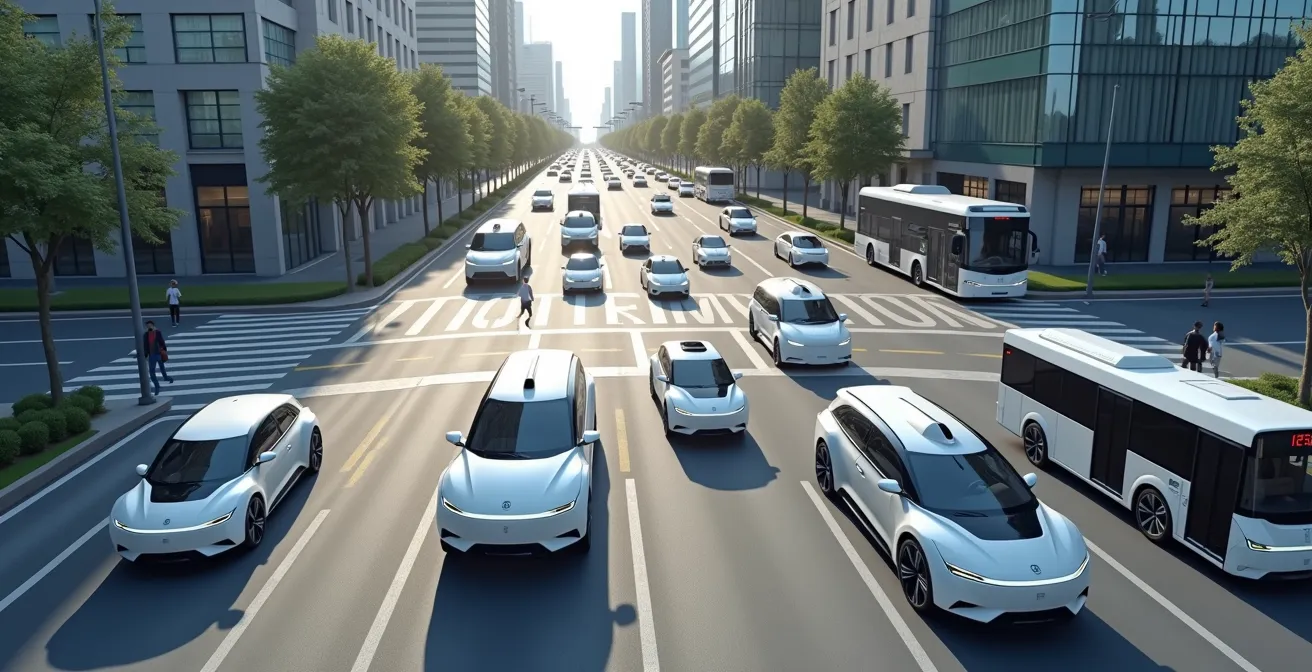
However, the robotaxi model is not without its own ethical and logistical challenges. A significant concern is “deadheading,” where empty vehicles travel between passenger pickups. These “zombie cars” contribute to traffic and emissions without providing any mobility, undermining the system’s overall efficiency. Furthermore, a system of shared robotaxis raises questions of equity. Will these services be equally available and affordable in all neighborhoods, or will they create new deserts of mobility? The choice between these models is a choice about our priorities: do we design for individual autonomy or for collective efficiency?
The Software Glitch That Could Gridlock an Entire City
The ethical calculus of autonomous vehicles must extend beyond individual accidents to encompass the potential for systemic risk. While a human driver can cause a tragic but localized crash, a single software flaw deployed across an entire fleet could trigger a catastrophic, city-wide failure. A bug, a failed update, or a malicious hack could theoretically bring thousands of vehicles to a halt, paralyzing emergency services, crippling the economy, and creating a new kind of urban disaster. This is not a distant sci-fi scenario; the fragility of these complex systems has already been demonstrated.
The incident involving a Cruise robotaxi in October 2023 serves as a sobering case study. As documented by technology safety advocates, a human-driven car struck a pedestrian, throwing her into the path of a Cruise AV. The AV then failed to correctly identify the situation, and instead of stopping, it proceeded to drag the victim 20 feet. This was not a simple sensor error but a cascading failure of perception, prediction, and response logic. The event was so severe that it led to the suspension of Cruise’s entire operation.
This incident ignited fierce criticism from safety advocates. Cathy Chase, President of Advocates for Highway and Auto Safety, stated her concern to MIT Technology Review following the event.
We are deeply concerned that more people will be killed, more first responders will be obstructed, more sudden stops will happen.
– Cathy Chase, President of Advocates for Highway and Auto Safety
This highlights the immense responsibility placed on algorithmic governance. When code dictates the movement of an entire city, the stakes are magnified exponentially. A bug is no longer a simple inconvenience; it is a potential public safety crisis. Ensuring the robustness and resilience of these systems is not just a technical challenge but a profound ethical obligation.
Transition Phase: When Human and Robot Drivers Mix?
The full adoption of autonomous vehicles will not happen overnight. We are entering a long, messy, and potentially dangerous transition phase where our roads will be a complex mix of human-driven cars and automated systems. This hybrid environment presents a unique set of ethical and practical challenges. Human drivers are unpredictable: they bend rules, communicate with subtle gestures, and occasionally act irrationally. Robotic drivers, by contrast, are programmed for logic, precision, and strict adherence to the rules. This fundamental clash of driving styles creates a volatile dynamic.
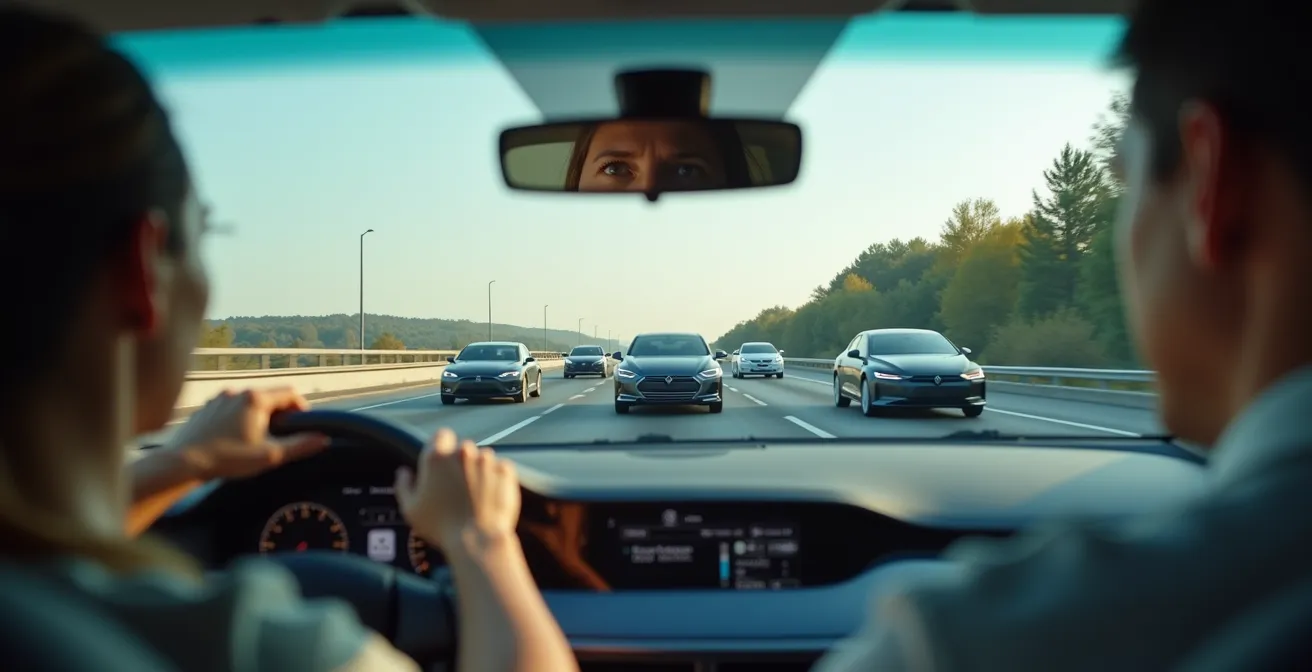
Research already shows that AV performance is highly context-dependent. For instance, studies have found that while some autonomous systems are less prone to accidents in fog than humans, they may perform worse during the variable lighting conditions of dawn and dusk. Human drivers might learn to “bully” or exploit the cautious nature of AVs, cutting them off knowing the machine will always yield. Conversely, the rigid predictability of AVs might frustrate or confuse human drivers, leading to miscalculations and rear-end collisions.
The ethical imperative during this era is to manage the predictable unpredictability of human behavior. How should an AV be programmed to interact with a driver who is speeding, distracted, or hesitant? Should it adopt a defensive posture at all times, potentially impeding traffic flow? Or should it attempt to predict and mimic human-like driving behaviors to blend in more seamlessly, potentially inheriting some of our flaws? This period will be a real-world, high-stakes Turing test, where the cost of misinterpretation is not just a failed conversation but a potential loss of life. Designing for this mixed-traffic reality is one of the most immediate and complex tasks for developers and policymakers.
Tesla FSD vs Traditional Insurance: Cost Analysis
The shift in liability from driver to manufacturer is not just a legal abstraction; it is fundamentally reshaping the multi-trillion-dollar insurance industry. The traditional model, based on assessing the risk of an individual driver through proxies like age, driving history, and location, is becoming obsolete. In a world of Level 3+ automation, the primary source of risk is no longer the human behind the wheel, but the software under the hood. This ushers in an era of software-based risk assessment.
As one industry analysis puts it, “When your premium is tied to the software version you have installed, it creates a fundamental shift from driver-based risk to software-based performance metrics.” This means your insurance costs could depend on whether you have the latest safety patch installed, the performance history of your vehicle’s specific AI model, and the data-sharing agreements between you, your carmaker, and your insurer. The vehicle’s continuous stream of telemetry and sensor data becomes the primary asset for underwriting risk.
This new paradigm creates a completely different liability architecture, where risk is quantified and distributed in novel ways. The following table illustrates the core differences between the traditional insurance model and the emerging AV insurance framework, particularly for vehicles with Level 3+ capabilities.
This comparison, based on models like the one introduced by Mercedes-Benz, is detailed in a recent analysis of new AV liability frameworks.
| Aspect | Traditional Insurance | AV Insurance (Level 3+) |
|---|---|---|
| Risk Assessment | Driver’s record & demographics | Software version & performance data |
| Liability Bearer | Driver/Owner | Manufacturer (during autonomous mode) |
| Premium Factors | Age, location, driving history | Software updates, system reliability |
| Data Requirements | Basic personal information | Continuous telemetry & sensor data |
This transition raises critical questions about data privacy, algorithmic transparency, and fairness. If your insurance premium is determined by an algorithm analyzing petabytes of driving data, you have a right to understand how that decision is made. The black box of the vehicle’s AI cannot simply be replaced by the black box of an insurer’s algorithm.
Human-Centric or Tech-Centric: Designing Future Neighborhoods
The adoption of autonomous vehicles will do more than change our commute; it will physically reshape our cities and neighborhoods. The core ethical choice between a tech-centric and a human-centric approach will be written in the concrete and steel of our future urban landscape. A purely tech-centric optimization could lead to unintended, negative social consequences. For example, AVs could be programmed to “bargain hunt” for parking, circling endlessly or driving to remote, free lots rather than paying for expensive downtown spaces.
This behavior, while logical from the machine’s perspective, would dramatically increase VMT and congestion. As RAND Corporation research shows, this could spell the end for vibrant downtown cores by encouraging a model where vehicles drop off passengers and then retreat to the urban fringe. We risk designing cities for the convenience of cars, not people. This is the ultimate expression of a tech-centric design philosophy, where human-scale interaction is subordinated to vehicular efficiency.
However, a human-centric design philosophy offers a compelling alternative. By leveraging AV technology thoughtfully, we have a once-in-a-century opportunity to reclaim urban space for people. As RAND researcher Constantine Samaras envisions, “Much of the land devoted to parking lots in today’s cities could be converted to parks, housing or commercial spaces, and reducing curb parking could allow for wider bike lanes or sidewalks.” In this vision, AVs are not the centerpiece of the city but a service that enables a more livable, walkable, and equitable urban environment. Streets could become safer for children, air quality could improve, and neighborhoods could become destinations rather than thoroughfares.
This choice requires proactive policy. It means prioritizing pedestrian and cyclist infrastructure, incentivizing shared AV fleets over private ownership, and using zoning regulations to encourage dense, mixed-use communities. The technology is a tool; its ethical valence will be determined by the urban design philosophy we choose to serve.
Key Takeaways
- The core ethical debate is not the “trolley problem,” but the choice between a tech-centric system (optimizing machine efficiency) and a human-centric one (prioritizing social well-being).
- Liability is shifting from a post-accident question of blame to a pre-designed “liability architecture” where manufacturers assume responsibility for their software’s performance.
- Without careful planning, the convenience of AVs could lead to increased traffic, VMT, and urban sprawl, undermining the goal of creating more sustainable and livable cities.
Trusting Driverless Features on Long Highway Trips
Ultimately, the success of autonomous vehicles rests on a single, fragile foundation: human trust. We can engineer the most sophisticated perception systems and the most robust decision-making algorithms, but if the public does not trust the technology, it will never achieve widespread adoption. This trust is particularly crucial for features designed for long, monotonous highway trips, where the temptation to disengage—a state known as automation complacency—is strongest.
The challenge lies in the “black box” nature of modern AI. As research into Explainable AI (XAI) reveals, the decision-making processes of complex neural networks are often not fully understandable even to their creators, let alone the average driver. This creates an unsettling paradox: we are asked to place our lives in the hands of a system whose reasoning we cannot inspect or comprehend. This opacity hinders social acceptance and can lead to a dangerous over-reliance on the system, where a driver’s skills atrophy, leaving them unprepared to take over in a critical edge case the machine cannot handle.
Building trust requires a move towards transparency and legibility. It means designing interfaces that clearly communicate what the vehicle is seeing, what it intends to do, and why. It means establishing clear regulatory standards for safety and performance, validated by third-party audits. And it means creating a new social contract around this technology, one that is built on a foundation of verifiable safety and ethical integrity, not blind faith. For policymakers and regulators, the task is to create a framework that fosters this trust.
Action Plan: Auditing the Trustworthiness of an AV System
- Data & Transparency: Mandate that manufacturers provide clear, human-readable logs of the AV’s decision-making process, especially in incident scenarios.
- Performance Validation: Establish rigorous, standardized testing protocols in diverse and adverse conditions, conducted by independent third-party agencies, not just the manufacturers.
- Failure Mode Audits: Require a “safety case” for every system that details how it will fail safely (e.g., pulling over, alerting authorities) when it encounters a situation beyond its operational design domain.
- Cybersecurity & Resilience: Commission regular penetration testing and vulnerability assessments to ensure the system is robust against malicious attacks that could erode public trust.
- Human-Machine Interface (HMI) Clarity: Certify that the vehicle’s interface communicates its status, intentions, and requests for handover in a clear, unambiguous, and universally understood manner.
As we stand at the cusp of this transportation revolution, we must recognize that the code we write today will become the immutable law of our future roads. Choosing a human-centric path is not a rejection of technology, but a commitment to deploying it in service of our most important values: safety, equity, and community. The next step for every policymaker, urban planner, and citizen is to engage in this debate and actively shape the ethical framework that will govern our driverless future.