The real price of “self-driving” isn’t the sticker cost; it’s the constant, draining mental tax of supervising a system that’s only almost perfect.
- Systems create “cognitive underload,” a state of boredom that makes it psychologically difficult to stay alert for emergencies.
- Hidden costs, like higher insurance premiums and specialized repair bills, often negate any advertised savings or convenience.
- In the event of a crash, manufacturers legally shift liability to the “supervising” driver, despite marketing the system as autonomous.
Recommendation: Evaluate these features not for their promised convenience, but for your willingness to accept the full-time job of being their safety monitor.
The promise of autonomous driving, especially on the monotonous expanse of a long highway trip, is seductive. A car that steers, brakes, and accelerates for you seems like the ultimate luxury, a co-pilot that never tires. Automakers are leaning heavily on this promise, offering sophisticated driver-assist packages—often with names like “Autopilot” or “Full Self-Driving”—for a hefty premium. The sales pitch suggests you’re buying freedom from the tedious task of driving.
But the reality is far more complex. These systems, classified as Level 2 or, at best, a contentious Level 3 autonomy, do not make the car self-driving. They make you a supervisor. This shifts your role from an active participant to a passive monitor, a change that has profound psychological, financial, and legal consequences. The common advice to “just pay attention” ignores the fundamental nature of the human brain, which is notoriously bad at sustained vigilance over a seemingly competent system.
This guide deconstructs that reality. We’re not just going to repeat the warnings. We will dissect the very mechanism of cognitive underload that makes supervision so difficult and dangerous. We will analyze the real-world financial burden—the “Supervision Tax”—that goes beyond the initial purchase price. This isn’t about what the car can do; it’s about what the car does *to you*. The core question isn’t whether the technology is impressive, but whether the partnership it forces upon you is one you’re truly prepared to accept.
While this guide focuses on the relatively controlled environment of highway driving, the ultimate challenge for autonomous systems lies in unpredictable urban traffic. The following video offers a compelling look at this frontier, showing a vehicle navigating the dense, stochastic traffic of India, highlighting just how far the technology still has to go.
To fully understand the gap between the marketing promise and the on-road reality, we must break down the key areas of friction. The following sections will provide a testing-based look at the dangers, the practicalities, the costs, and the responsibilities that come with handing over control to the machine.
Summary: A Skeptic’s Guide to Driverless Features
- Why Level 3 Autonomy Is Dangerous for Distracted Drivers?
- How to Use Adaptive Cruise Control Without Zoning Out?
- Tesla FSD vs Traditional Insurance: Cost Analysis
- The Complacency Error: Trusting Sensors in Bad Weather
- Comma.ai vs OEM: Can You Make an Old Car Smart?
- Who Is Responsible When a Self-Driving Car Crashes?
- Ring or Watch: Which Tracker Suits a Corporate Lifestyle?
- The Ethical Dilemmas Facing Autonomous Vehicle Adoption
Why Level 3 Autonomy Is Dangerous for Distracted Drivers?
The core danger of so-called “hands-off” driving systems isn’t just distraction; it’s a neurological state called cognitive underload. Unlike cognitive overload, where the brain is overwhelmed with information, underload occurs when the primary task is so monotonous and requires so little input that the mind naturally wanders. The system handles 99% of the driving, lulling you into a false sense of security. Your brain, starved of engagement, seeks other stimuli—your phone, the infotainment system, or simply daydreams.
This isn’t a theory; it’s a documented phenomenon. The driver’s mental effort is not spent monitoring the road but on secondary activities. In fact, research from 2024 demonstrates that cognitive workload primarily originates from performing non-driving tasks, even when the driver believes they are supervising. When the system suddenly needs to hand control back—a “takeover request”—the driver’s mind isn’t on the road. It’s elsewhere. This is the critical safety gap: the system expects immediate, informed intervention from a brain it has effectively put to sleep.

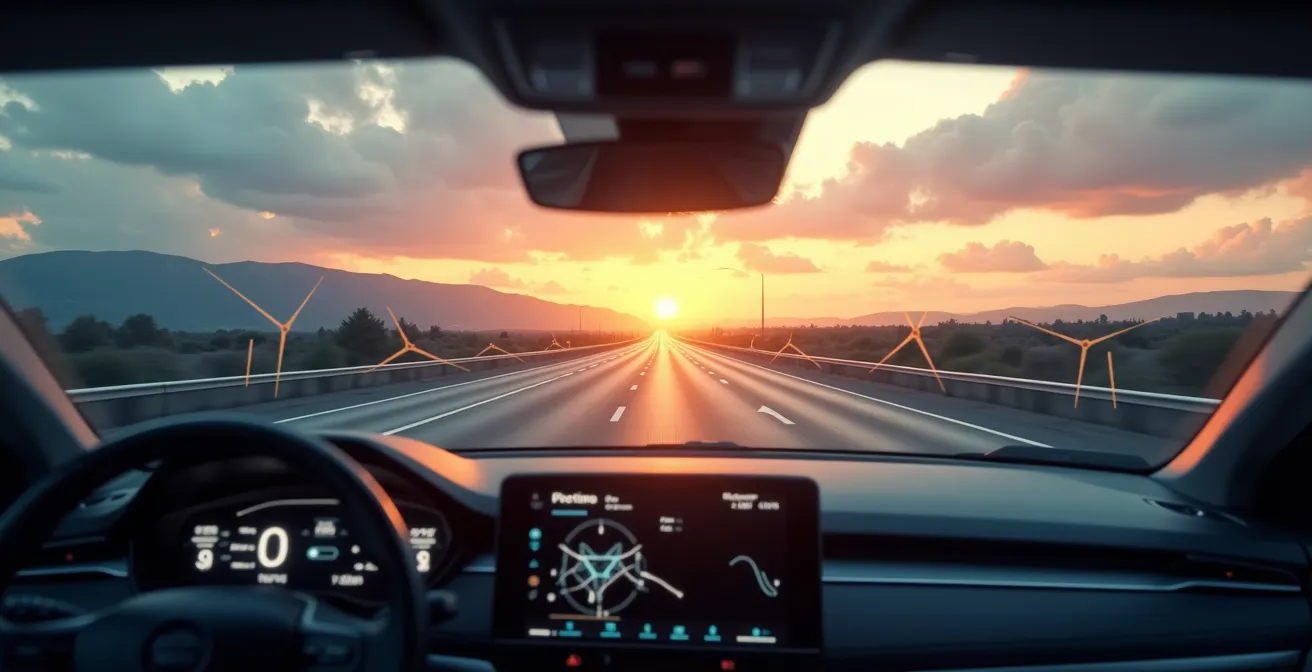
As the image above illustrates, the state of passive monitoring is one of relaxed disengagement. Studies on driver attention during automation confirm this safety risk. In automated conditions, even when the driving task is less demanding, fewer neural resources are allocated to monitoring. When a critical situation demands a takeover, the driver needs precious seconds to re-engage, comprehend the situation, and react. This delay, a direct result of cognitive underload, is the psychophysiological mechanism behind many reported automated driving accidents.
How to Use Adaptive Cruise Control Without Zoning Out?
Given that our brains are hard-wired to disengage during monotonous tasks, how can a driver safely use features like Adaptive Cruise Control (ACC) or lane-keeping assist without falling into the trap of highway hypnosis? The key is to transform the role from a passive supervisor into an active monitor. This requires deliberate, conscious effort to fight against the natural tendency toward complacency. It’s about creating habits that force engagement when the technology is encouraging you to check out.
The primary enemy is the vigilance decrement, the scientifically documented decline in our ability to stay focused over time. As one study notes, even in manual driving, monotony takes its toll. In an analysis of driver behavior, researchers observed a similar pattern.
The opposite trend was found for manual driving whereby, although no changes were observed in visual scanning over time, drivers seemed to be paying less attention to billboards toward the end of the drive, a pattern that might be interpreted as a vigilance decrement brought upon by monotonous driving
– Francesco N. Biondi et al., Cognitive Research: Principles and Implications
If this happens during manual driving, the effect is magnified when a machine is doing most of the work. To counteract this, you must introduce your own “tasks” that keep your situational awareness high. This isn’t about finding busywork; it’s about structured scanning and prediction that keep your brain in the driving loop. The following checklist outlines a practical system for maintaining active engagement.
Action Plan: Staying Engaged While Using ADAS
- Active Scanning Protocol: Intentionally cycle your gaze every 5-7 seconds between your mirrors, the instrument cluster (to check speed and system status), and the road far ahead. Name potential hazards out loud (“car merging on right,” “slow truck ahead”).
- “What If” Scenarios: Actively game out potential situations. “What if that car pulls out without signaling?” “What is my escape path if traffic stops suddenly?” This keeps your brain’s predictive-processing functions engaged.
- Manual Interventions: Periodically and safely disengage and re-engage the system. Take manual control for a few minutes every half-hour to reset your senses and remind your muscles of the task. Do not become a passive passenger.
- System Parameter Checks: Don’t just set it and forget it. Regularly check the follow distance setting on your ACC. Is it appropriate for the current traffic and weather? Adjusting it is a simple way to force re-engagement.
- Limit Non-Driving Tasks: Make a strict rule to avoid any task that requires you to look away for more than a second or involves complex mental processing. The system is an *assist*, not a replacement for your role as the commander of the vehicle.
Tesla FSD vs Traditional Insurance: Cost Analysis
The high sticker price or subscription fee for a system like Tesla’s Full Self-Driving (FSD) is only the beginning of the financial story. A prospective buyer must also factor in the often-overlooked impact on insurance and repair costs—the hidden part of the Supervision Tax. Insurers are still grappling with how to price risk for these vehicles, and the data so far suggests that the advanced technology comes with its own set of financial liabilities that can offset any potential safety-related discounts.
A primary factor is the cost of repair. The sophisticated sensors, cameras, and computing hardware embedded throughout the vehicle are expensive to replace and often require specialized calibration after even minor incidents. This is compounded by the fact that Teslas, in general, are more expensive to repair. One report highlighting data from Kelley Blue Book showed the $5,552 average repair cost for Teslas was significantly higher than the $4,474 for other EVs and $4,205 for gasoline vehicles. When a system designed to avoid accidents fails, the cost to fix the technology itself can be astronomical.
Tesla attempts to counter this with its own insurance product, offering discounts for “safe” driving and high FSD usage. However, a closer look at the numbers shows the math doesn’t always add up for the consumer, as the table below illustrates.
| Insurance Aspect | Without FSD | With FSD Active |
|---|---|---|
| Monthly Tesla Insurance | Standard Rate | $20-40 discount if >50% FSD usage |
| FSD Subscription Cost | N/A | $99/month |
| Net Monthly Cost Impact | Base premium only | $60-80 additional after discount |
| Coverage for FSD if totaled | N/A | Requires notification to insurer (+$63-200/year) |
As the analysis shows, the monthly subscription cost for FSD far outweighs the potential insurance discount, resulting in a significant net monthly cost increase. Furthermore, the value of the FSD software itself may not be covered in the event of a total loss unless you pay an additional premium. These are the real-world financial calculations a buyer must make, well beyond the initial “wow” factor of the technology.
The Complacency Error: Trusting Sensors in Bad Weather
Perhaps the most dangerous byproduct of an “almost-perfect” system is complacency. When a car successfully navigates hundreds of miles of highway without incident, the human brain starts to over-trust it. We begin to believe the system’s “senses”—its cameras, radar, and LiDAR—are infallible. This is a critical error, because sensor fragility is one of the technology’s biggest weaknesses. Unlike human eyes, which can adapt and infer information in challenging conditions, a car’s sensors can be easily blinded or confused.
Heavy rain, snow, fog, road grime, or even direct sun glare can degrade or completely disable a sensor’s ability to see the world accurately. A camera lens covered in mud cannot distinguish a lane marker from a shadow. A radar sensor pelted with snow may fail to detect a stopped vehicle ahead. The system, unaware of its own blindness, may continue operating with a dangerously incomplete picture of reality, while the complacent driver, lulled by hours of smooth sailing, is not prepared to intervene.

The consequences of this over-trust can be financially and physically devastating. The system is designed to detect and react to obstacles, but its ability to do so is entirely dependent on clean, clear data from its sensors. When that data is compromised, the car’s perception of reality is broken. A real-world incident with a Tesla Model Y on FSD illustrates this perfectly.
Case Study: The $22,000 Road Debris Incident
During a cross-country trip documented by a YouTuber, a Tesla Model Y using FSD at 70 mph failed to identify a large piece of metal debris on the highway. The vehicle struck the object head-on. While the occupants were safe, the impact caused significant damage, including a broken sway bar bracket and, most critically, damage to the underbody battery pack. The final repair bill, as detailed in a report by SlashGear, came to a staggering $22,000, with $17,000 for a new battery alone. This demonstrates that the system’s failure to “see” can have consequences far beyond a simple fender-bender.
Comma.ai vs OEM: Can You Make an Old Car Smart?
For drivers intrigued by driver-assist technology but wary of the high price tags on new vehicles, the aftermarket world offers a compelling alternative. The most prominent player is Comma.ai, a company offering an open-source hardware and software kit that can add sophisticated lane-keeping and adaptive cruise control capabilities to a wide range of older, compatible vehicles. This presents a fundamental choice: the polished, closed ecosystem of an original equipment manufacturer (OEM) like Tesla, versus the tinkerer-friendly, community-driven approach of an open-source project.
The appeal of Comma.ai is its philosophy. It’s built for transparency and user control, allowing for a level of customization and understanding that is impossible with an OEM’s “black box” system. You see the code, you understand the inputs, and you are part of a community actively improving the software. This contrasts sharply with OEM systems, which are deeply integrated into the vehicle’s architecture but are entirely controlled by the manufacturer, with updates and changes pushed wirelessly at their discretion.
However, this openness comes with significant trade-offs in support and liability. With an OEM, there is a clear line of accountability and access to official support channels. With an aftermarket system, the user often assumes a much larger portion of the risk and relies on community forums for troubleshooting. The following table breaks down the key differences in these two approaches.
| Aspect | Comma.ai (Aftermarket) | OEM Systems (Tesla FSD) |
|---|---|---|
| Philosophy | Open-source, community-driven, tinkerer-friendly | Closed ecosystem, manufacturer-controlled |
| Integration Level | Layer on top of existing systems | Deep integration with vehicle architecture |
| Support Model | Community forums, beta status accepted | Official support, warranty coverage |
| Legal Liability | Unclear, potentially user responsibility | Manufacturer accountability established |
| Long-term Viability | Risk of obsolescence if company pivots | Support for vehicle’s expected lifespan |
Ultimately, the choice reflects a driver’s priorities. Opting for an OEM system is a vote for convenience, integration, and a clear (if sometimes contentious) chain of responsibility. Choosing an aftermarket solution like Comma.ai is a vote for control, transparency, and a lower cost of entry, but it requires a willingness to accept a greater degree of personal risk and a hands-on, “beta tester” mindset.
Who Is Responsible When a Self-Driving Car Crashes?
This is the billion-dollar question at the heart of the autonomous driving revolution, and the answer is becoming increasingly messy. Manufacturers market their systems with names that imply full autonomy, but their user agreements tell a different story. In nearly all cases, the legal fine print places the ultimate responsibility for the vehicle’s actions squarely on the human in the driver’s seat. This deliberate transfer of risk is the most critical component of the liability shift; you buy the “self-driving” feature, but you are on the hook for its mistakes.
Automakers like Tesla publish safety statistics to bolster confidence. For instance, their data suggests vehicles with FSD are involved in fewer crashes per mile than the human-driven average. However, these statistics don’t change the fundamental legal doctrine: as long as the system requires supervision, the supervisor is liable. When an accident does occur, manufacturers have historically pointed to the driver’s failure to intervene as the proximate cause, a defense that is now being challenged in court.
The legal landscape is far from settled, and recent court cases show that juries are beginning to question the fairness of this liability shift, especially when a company’s marketing seems to contradict its own user agreement.
Case Study: The Florida Jury vs. Tesla’s Liability Shield
The core of the legal battle is the conflict between marketing and legal reality. As one expert puts it, “You have a company deciding to break the law, but the driver is being held responsible and suffering the consequences.” This tension came to a head in a landmark case in Florida. As reported by Fast Company, a jury rejected Tesla’s argument that the driver was solely responsible for a fatal crash involving its Autopilot system. The jury found the company negligent and awarded a significant sum to the victim’s family, signaling that manufacturers may not be able to completely shield themselves from liability for the actions of their software, even if a human is technically “in charge.” Tesla is appealing the verdict, but the case sets a critical precedent.
For a potential buyer, this legal gray area is a massive red flag. You are not just purchasing a feature; you are potentially opting into a legal experiment where you could be held responsible for the decisions of a complex algorithm you do not control or fully understand.
Ring or Watch: Which Tracker Suits a Corporate Lifestyle?
On a long highway commute, what are you tracking more closely: your fitness metrics or your car’s behavior? This question of tracking extends to the car itself. How should it track *you*? The debate over the effectiveness and intrusiveness of Driver Monitoring Systems (DMS) can be simplified with an analogy familiar to any tech-savvy professional: the smart ring versus the smartwatch.
A smartwatch is an active, overt monitor. It’s on your wrist, its screen is visible, and it constantly demands or presents information. Many in-car DMS function like a smartwatch: an infrared camera pointed directly at your face, actively tracking eye movement and head position. If you look away for too long, it sounds an alert. It is effective but can feel intrusive and nagging, an ever-present digital supervisor. For a driver who is already feeling the “Supervision Tax” of monitoring the road, this added layer of being monitored can increase stress.
A smart ring, by contrast, is a passive, subtle tracker. It collects data in the background without constant interaction. An alternative philosophy for DMS could function like a smart ring: instead of just watching your eyes, it monitors your inputs to the vehicle. Are your steering corrections smooth and deliberate, or are they jerky and reactive? Is the pressure on the accelerator pedal consistent? These subtle inputs can be powerful indicators of engagement or drowsiness, without the need for an invasive camera. This approach tracks the *result* of your attention, not just the direction of your gaze.
For the corporate professional on a long, monotonous drive, the “watch” approach offers robust, undeniable proof of attentiveness for liability purposes. However, the “ring” approach might be more conducive to a less stressful driving experience, inferring vigilance from confident control inputs rather than demanding a constant, fixed stare. The ideal system may be a hybrid, but as of now, most OEMs are betting on the camera-based “watch” as the most direct solution to the liability problem.
Key Takeaways
- Driver-assist systems create “cognitive underload,” a state of disengaged boredom that is more dangerous than simple distraction.
- The total cost of ownership must include hidden variables like higher insurance premiums and specialized repair costs, which can exceed $20,000 for a single incident.
- The “liability shift” is real: manufacturers market autonomy but legally define you as the responsible supervisor, putting you at risk in case of a crash.
The Ethical Dilemmas Facing Autonomous Vehicle Adoption
The conversation around the ethics of autonomous vehicles has long been dominated by the “trolley problem”—an unrealistic, binary choice between two catastrophic outcomes. While a fascinating thought experiment, it has very little to do with the real-world ethical decisions being programmed into cars today. The true ethical dilemmas are far more mundane, yet they have life-or-death implications all the same. They are baked into the thousands of tiny decisions the car makes every minute.
Should the car be programmed to slightly exceed the speed limit to match the flow of traffic, a common human behavior? Should it perform a “rolling stop” at an empty intersection to be more efficient? Should it change lanes aggressively or passively? These are not abstract problems; they are programming choices that define the car’s “personality” and its relationship with the law and other road users. A car programmed to be timid and strictly law-abiding may cause frustration and be a hazard in aggressive traffic, while one programmed to be assertive might increase collision risk.
As researchers from NC State University point out, focusing on these everyday moral decisions is far more productive than getting lost in hypothetical catastrophes.
Drivers have to make many more realistic moral decisions every day. Should I drive over the speed limit? Should I run a red light? Should I pull over for an ambulance? Those mundane decisions are important because they can ultimately lead to life-or-death situations. For example, if someone is driving 20 miles over the speed limit and runs a red light, then they may find themselves in a situation where they have to either swerve into traffic or get into a collision.
– Dario Cecchini and Veljko Dubljević, NC State University Research
This shifts the ethical debate from “who should the car hit?” to “what kind of citizen should the car be?” As a buyer, you are implicitly endorsing the ethical framework of the manufacturer. You are trusting that their answers to these small but critical questions align with your own values and your tolerance for risk. This is a level of trust that goes far beyond trusting a mechanical component; it’s trusting a codified moral compass.
Before you tick the box for that expensive driver-assist package, the ultimate test is an honest self-assessment. Evaluate if you’re truly buying a convenience or just signing up for a more demanding and stressful co-pilot. A thorough test drive focusing not on the “wow” moments, but on the system’s behavior in imperfect conditions and on your own mental fatigue, is the only real way to assess the true cost of this technology.