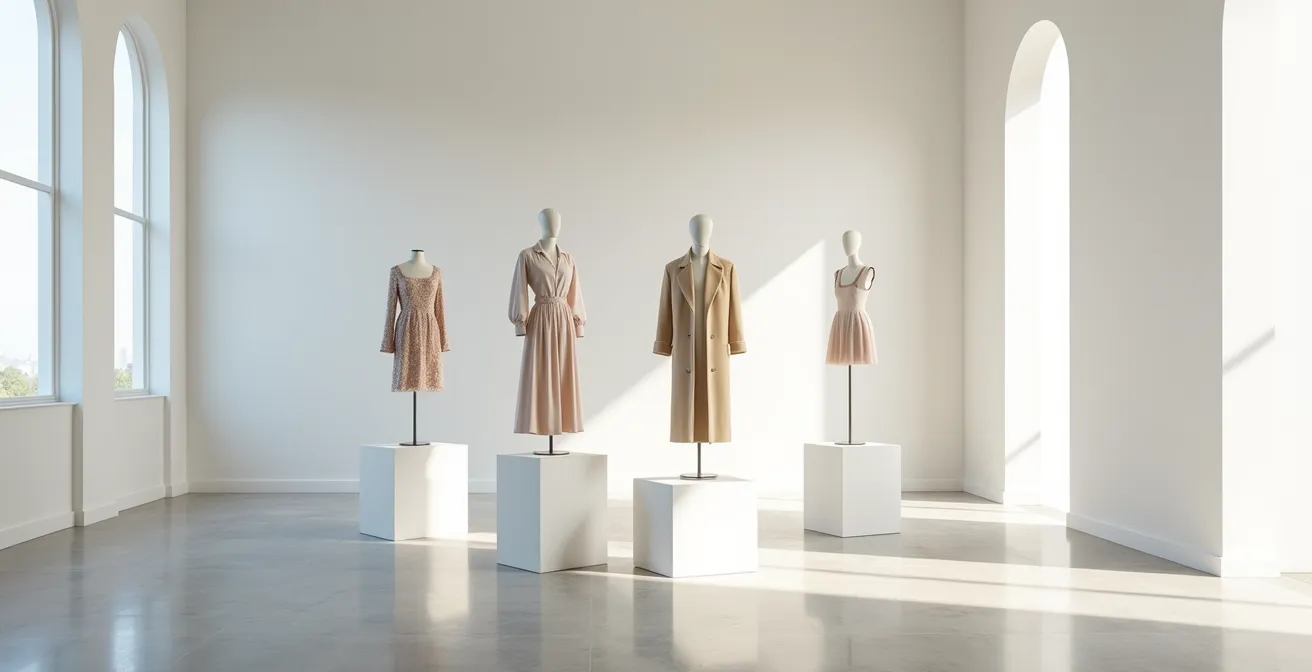
Vintage haute couture is increasingly viewed not as mere clothing, but as a high-performance tangible asset delivering non-correlated returns.
- Value is driven by verifiable scarcity and historical significance, not fleeting fashion trends.
- The vast gap in craftsmanship between true couture and ready-to-wear creates significant “Craft Alpha” for discerning investors.
Recommendation: Successful investment requires mastering auction dynamics, rigorous provenance verification, and archival-grade conservation to protect and grow the asset’s value.
For the astute high-net-worth individual, the art of portfolio diversification is a perpetual quest for untapped value. While fine art, rare timepieces, and classic cars are well-trodden paths, a new frontier is emerging—one that resides at the intersection of cultural history, unparalleled craftsmanship, and tangible artistry. This is the world of vintage haute couture, an asset class that demands the eye of a collector and the discipline of an investor.
Conventional wisdom often dismisses fashion as ephemeral. However, this overlooks a crucial distinction: the chasm between mass-produced luxury and the hand-constructed masterpieces of a Parisian atelier. To treat a 1950s Dior or a 1960s Balenciaga as simple “clothing” is to fundamentally misunderstand its nature. These are asset-grade garments, historical artifacts whose value is driven by principles of scarcity, provenance, and cultural significance—the very same metrics that define the blue-chip art market.
But if the true potential of this asset class lies not in its fashion appeal but in its investment fundamentals, how does one navigate it? The key is to move beyond appreciation and adopt a strategic framework. This involves understanding which eras generate superior returns, mastering the high-stakes environment of auctions, and implementing museum-level conservation practices. It is about treating a silk-embroidered gown with the same analytical rigor as a canvas.
This guide provides that framework. We will deconstruct the metrics that drive value in haute couture, offering a clear road map for acquiring, managing, and appreciating these unique pieces of wearable art as a serious component of a diversified investment portfolio.
Summary: Unlocking the Investment Value of Wearable Art
- Why Certain Couture Eras Appreciate Faster Than Others?
- How to Bid on Vintage Couture at Auctions Without Regrets?
- Prêt-à-Porter vs Haute Couture: Understanding the Craft Gap
- The Storage Mistake That Destroys Silk and Embroidery
- Proving Origin: The Importance of Documentation in Couture
- Why a Canvas with a Red Dot Costs More Than Your Car?
- Why Pre-Owned Luxury Is Outperforming the Stock Market?
- How to Buy Your First Original Artwork Without Getting Ripped Off?
Why Certain Couture Eras Appreciate Faster Than Others?
Not all couture is created equal, and the market disproportionately rewards pieces from specific, culturally significant periods. This phenomenon, the “Era Premium,” is what separates a merely beautiful vintage garment from a true investment-grade asset. As the broader category of luxury goods continues its ascent in the fine art world, with data showing luxury goods reaching a high market share at auction houses, understanding these nuances becomes paramount. The highest appreciation is found in pieces that represent a paradigm shift in design or a couturier at the absolute zenith of their creative power.
As Kate Osborn of Kerry Taylor Auctions, a leading expert in the field, explains, the strategy is to focus on pinnacle moments:
The pieces worth investing in are those by the best designers at the peak of their careers. For example, Christian Dior Paris couture from the 1950s, Balenciaga from the 1960s, Yves Saint Laurent in the mid-1960s and seventies.
– Kate Osborn, Kerry Taylor Auctions
These eras are not arbitrary; they correspond to periods of groundbreaking innovation. The 1950s Dior, for instance, represents the post-war “New Look,” a revolution in silhouette and femininity. A 1960s Balenciaga showcases architectural mastery of fabric that remains unmatched. This historical context, combined with extreme scarcity, creates explosive value growth. For example, an iconic Charles James evening dress saw a 65 percent increase in value in just two years, a testament to the power of a legendary designer and profound rarity.
For the investor, the task is therefore not to chase labels, but to identify and acquire these pivotal moments in fashion history. An asset-grade garment is an artifact of its time, and its value is inextricably linked to the importance of that time. Its appreciation is a function of its irreplaceability, both in craft and in cultural narrative.
How to Bid on Vintage Couture at Auctions Without Regrets?
The primary marketplace for asset-grade couture is the auction house. This is where record prices are set and where the most significant pieces, often from private collections, resurface. However, the auction room is an environment governed by its own strict rules and psychology. Success requires strategic preparation, not emotional impulse. It is a calculated process of acquiring a valuable asset, demanding discipline and a clear understanding of the total cost of acquisition.
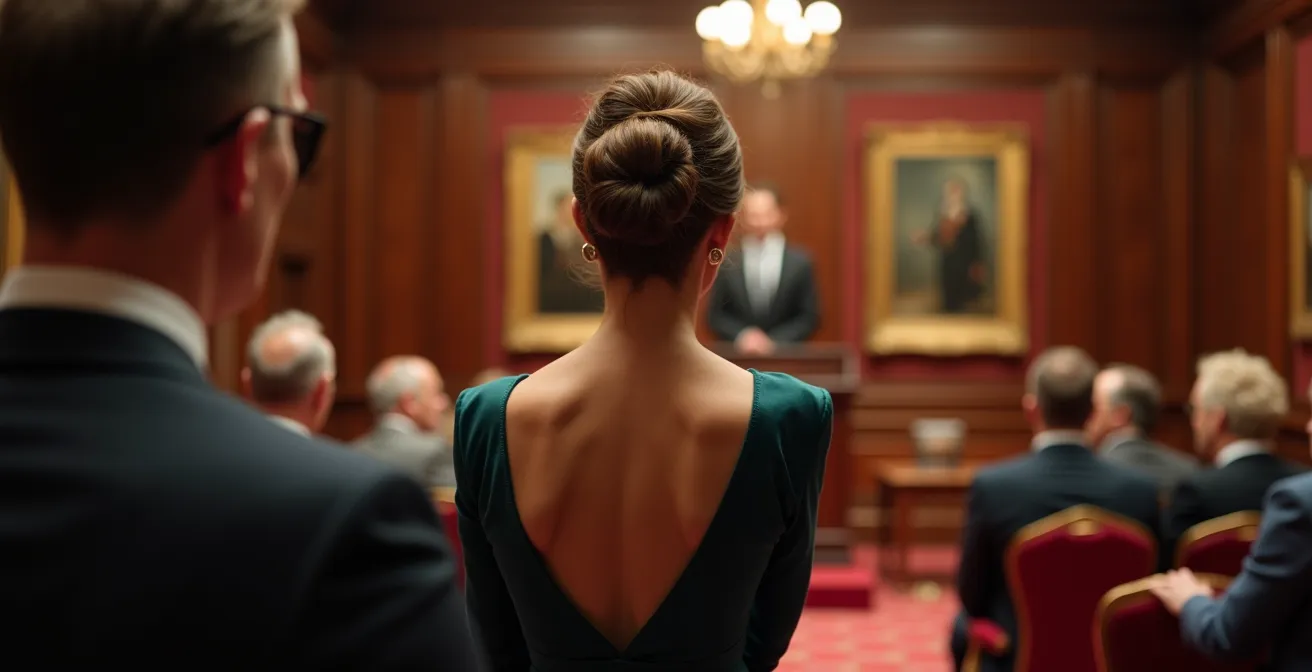
The process begins long before the auctioneer’s gavel falls. Prospective bidders must register with the auction house, often providing financial credentials. The most critical step is due diligence. This involves meticulously studying the auction catalogue, but more importantly, attending pre-sale viewings. This is the only opportunity to inspect the garment firsthand, assess its condition beyond the official report, and truly feel its presence. Understanding the buyer’s premium—a fee added to the hammer price, typically ranging from 25-28%—is non-negotiable for calculating your maximum bid.
For those new to this environment, a prudent approach is to start with lower-value lots to familiarise oneself with the dynamics and cadence of bidding. Many auction houses also offer telephone or online bidding, which can be a less intimidating entry point. Regardless of the method, the core principles remain the same: set a firm limit based on your research and budget, and never get caught in a bidding war. The goal is to acquire the piece at a price that aligns with your investment thesis, not simply to “win.”
Prêt-à-Porter vs Haute Couture: Understanding the Craft Gap
At the heart of vintage couture’s investment thesis lies the concept of “Craft Alpha”—the measurable and non-replicable value derived from superior, hand-executed craftsmanship. To the untrained eye, a high-end designer dress and a true haute couture gown may appear similar. For an investor, understanding the profound gap between them is the difference between acquiring a depreciating luxury good and a appreciating art asset. Prêt-à-porter, or ready-to-wear, is a factory-made product. Haute couture is a commissioned work of art.
This distinction is not merely philosophical; it is quantifiable across every metric of production, from time and materials to scarcity and construction techniques. The following comparison highlights the structural differences that create long-term investment value.
| Aspect | Haute Couture | Ready-to-Wear |
|---|---|---|
| Production Time | 100-150 hours for a suit, up to 1000 hours for embellished evening dress | 2-10 hours mass production |
| Fabric Cost | £100+ per meter, exclusive designs | £5-50 per meter, mass market materials |
| Annual Production | Less than 200 clients worldwide | Millions of units |
| Resale Value | Can appreciate 65%+ in 2 years for rare pieces | Typically depreciates 50-80% |
| Construction | Hand-sewn, individually fitted, archival techniques | Machine-made, standard sizing |
As the table demonstrates, haute couture operates on a completely different economic and artisanal scale. The thousands of hours of hand-sewing, the custom-milled fabrics, and the microscopic number of pieces produced create an intrinsic value that machine-made garments can never replicate. This principle of scarcity and superior craft driving long-term appreciation is seen even in high-end accessories. For instance, the value of certain iconic Hermès handbags reportedly demonstrates the power of this dynamic. This inherent, non-scalable value is the engine of “Craft Alpha,” ensuring that true couture pieces behave more like fine art than apparel over time.
The Storage Mistake That Destroys Silk and Embroidery
Acquiring an asset-grade garment is only the first step; protecting its value is an ongoing commitment. The greatest threat to a vintage couture investment is not market fluctuation, but improper storage. Delicate materials like silk, intricate beadwork, and historic embroidery are highly susceptible to degradation from light, humidity, and even the wrong storage container. For an investor, ensuring archival integrity is as critical as insuring a painting. A single mistake, such as storing a silk gown in a plastic garment bag, can cause irreversible chemical damage and erase thousands of dollars in value.
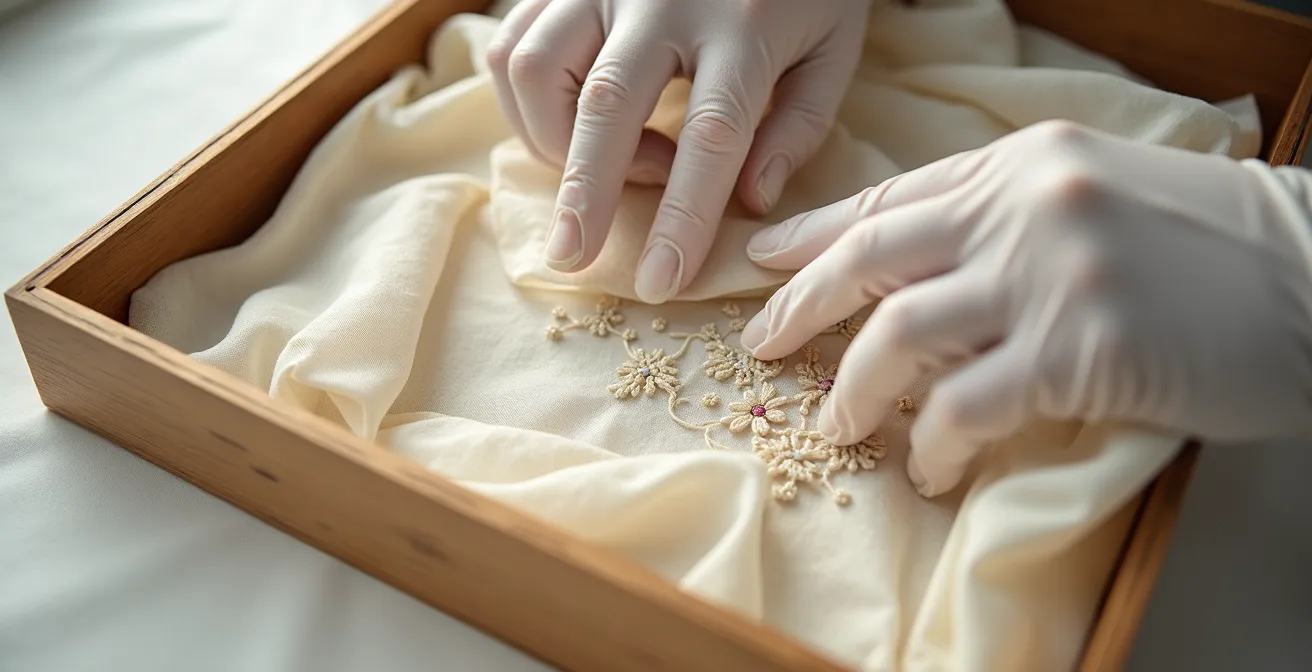
Professional conservation is a science. It involves creating a stable, controlled environment that slows the aging process to a near halt. This means moving beyond the closet and adopting museum-grade practices. It requires specific materials, techniques, and a budget for ongoing care. The initial investment in the garment must be accompanied by a long-term plan for its preservation, which itself is a significant financial consideration.
Your Action Plan: Auditing Your Couture Storage
- Environmental Assessment: Identify all points of contact for the garment. Audit the storage area for exposure to natural light, fluctuating humidity, and potential pests. Install a museum-grade hygrometer to monitor conditions.
- Material Inventory: Document the garment’s specific materials (e.g., silk, wool, metallic embroidery, beading). Research the unique preservation needs of each component.
- Coherence Check: Confront your current storage methods with archival principles. Are you using plastic covers (which trap moisture) or wire hangers (which distort shape)? Compare this against the gold standard: unbuffered, acid-free boxes and padded hangers.
- Fragility Mapping: Inspect the garment to identify areas of extreme fragility, such as heavily beaded sections or delicate seams. Plan your storage technique, such as the ‘accordion fold’ with acid-free tissue, to relieve stress on these points.
- Conservation & Budgeting Plan: Create a prioritized action plan. Budget for annual archival supplies ($100 to $500 per garment) and establish a fund for professional conservation ($250 to $1,000+) should any damage be discovered.
Treating storage as an afterthought is the most common and costly error an investor can make. Archival integrity is not a passive state; it is an active, strategic process of value preservation.
Proving Origin: The Importance of Documentation in Couture
In the world of high-value collectibles, value is a function of story. An object’s history, its previous owners, and its journey through time are what elevate it from a beautiful item to a priceless artifact. In haute couture investment, this is encapsulated in the concept of the Provenance Chain—an unbroken, verifiable record of ownership and authenticity. Solid provenance can multiply a garment’s value exponentially, while a gap in its history can cast a shadow of doubt that depresses its price, regardless of its beauty or condition.
The documentation that forms this chain can include original purchase receipts, fitting photographs, letters from the couture house, or exhibition records. It is the tangible proof that connects the garment to a specific person, place, and time. This is never more apparent than when a piece is linked to a figure of immense cultural significance. The garment becomes more than a dress; it becomes a relic.
Case Study: The Power of Royal Provenance
The ultimate illustration of provenance’s power is the 1981 ‘sheep’ sweater worn by Princess Diana. While charming, the garment itself is a simple knit. However, its direct, documented connection to one of the 20th century’s most iconic figures transformed its value. In September 2023, the sweater sold for an astonishing $1.1 million at Sotheby’s, setting a world record. The key driver was not the wool or the design, but the irrefutable provenance that made it a tangible piece of royal history.
This case study, though extreme, highlights a universal principle for investors. When evaluating a potential acquisition, the accompanying documentation is not an accessory; it is a core component of the asset itself. A strong provenance chain provides security, underwrites value, and is the foundation upon which a successful couture investment is built. It is the narrative that you are ultimately acquiring.
Why a Canvas with a Red Dot Costs More Than Your Car?
The question of why a simple canvas can achieve an astronomical price is central to understanding the modern art market. The answer lies in a confluence of factors: the artist’s reputation, critical acclaim, exhibition history, rarity, and, of course, provenance. The “red dot” signifies it has been sold, often for a price that seems disconnected from its physical materials. This same logic is precisely what now governs the valuation of investment-grade haute couture. An investor who understands the dynamics of the fine art market is already equipped to understand the couture market.
These two worlds are not just parallel; they are converging. Major auction houses are increasingly blending these categories, recognizing that the new generation of collectors sees little distinction between a painting, a rare watch, or an iconic gown. A prime example is Sotheby’s inaugural Abu Dhabi Collectors’ Week, which seamlessly integrated sales of cars, real estate, jewellery, and handbags, demonstrating the holistic view of luxury collectibles as a unified asset class. The success of such events proves that the modern portfolio is diversifying into tangible assets of all kinds.
However, this parallel also carries a cautionary note. The fine art market is subject to cycles and corrections. In 2024, the top 100 lots at auction saw a significant decline from their 2022 highs. This market sensitivity is a crucial lesson for couture investors. While top-tier pieces have shown remarkable resilience, no market is immune to broader economic shifts. Understanding the valuation principles of fine art provides the essential framework for investing in couture, including an appreciation for both its immense potential and its inherent risks.
Why Pre-Owned Luxury Is Outperforming the Stock Market?
In an era of market volatility, investors are increasingly looking towards tangible assets that offer a hedge against inflation and non-correlated returns. Within this landscape, the top tier of the pre-owned luxury market, particularly vintage haute couture, has demonstrated remarkable performance. This is not about second-hand clothing; it is about a market for rare, highly sought-after artifacts whose value appreciation is driven by factors entirely separate from the fluctuations of traditional equity markets. The result is a powerful tool for portfolio diversification.
The strength of this market is reflected in the bottom line of the world’s leading auction houses. Even as other sectors faced uncertainty, the demand for rare luxury goods has propelled significant growth. For instance, Sotheby’s projected a 17% increase in revenue in 2024, largely driven by its luxury divisions. This robust demand is fueled by a global base of collectors who recognize these items as stores of value.
The outperformance of this asset class stems from its fundamental drivers: scarcity and desirability. Unlike a stock, a 1960s Balenciaga gown cannot be created again. Its supply is permanently fixed. As global wealth grows and more collectors enter the market, the demand for this finite supply intensifies, creating a natural upward pressure on prices. This dynamic provides a buffer against economic downturns that impact more conventional investments. For a diversified portfolio, owning an asset whose value is determined by its historical importance and rarity, rather than by interest rates or corporate earnings, is a uniquely powerful strategic advantage.
Key Takeaways
- Investing in haute couture mirrors the principles of the fine art market, where value is determined by artist, era, and rarity.
- The worth of an asset-grade garment hinges on verifiable scarcity, a complete provenance chain, and archival-grade conservation—not on fashion trends.
- The demonstrable “Craft Alpha” of true, hand-made couture provides a distinct and non-replicable investment advantage over mass-produced luxury.
How to Buy Your First Original Artwork Without Getting Ripped Off?
For the discerning investor, acquiring your first piece of investment-grade haute couture is akin to buying your first piece of original art. The same principles of due diligence, research, and strategic patience apply. The goal is to avoid costly mistakes by approaching the purchase with a clear, analytical framework, ensuring your first acquisition becomes the cornerstone of a valuable collection, not a source of regret. The process is not about finding a “deal,” but about paying the right price for a verified asset.
Your strategy should be built on three pillars: knowledge, verification, and a full accounting of costs. Before even considering a bid, immerse yourself in the work of the couturier, understand their key periods, and study comparable sales results. When a piece is identified, rigorously verify its provenance and demand a detailed condition report. Finally, calculate the total cost, which extends far beyond the hammer price to include the buyer’s premium, taxes, specialized shipping, insurance, and future conservation costs. These “hidden” costs are integral to the investment’s total return.
The future of this market appears robust, underwritten by a new wave of passionate and knowledgeable collectors. Data from major auction houses shows a powerful demographic shift, with more than 30 percent of new buyers being Gen Zers and millennials. This influx of a younger, digitally native generation of investors ensures continued demand and liquidity for the most significant pieces, securing the market’s long-term health.
To build a truly resilient and diversified portfolio, the next logical step is to apply these principles and begin the meticulous process of identifying your first asset-grade garment.
Frequently Asked Questions About Investing in Haute Couture
How do I get started buying at major auction houses?
Begin by registering as a bidder, providing financial credentials, and attending viewing sessions. Study catalogues, understand buyer’s premiums (typically 25-28%), and start with lower-value lots to gain experience.
What research should I do before bidding?
Research provenance, condition, comparable sales, and authentication history. Attend pre-sale viewings, review condition reports, analyze estimate ranges, and investigate literature/exhibition history.
What are the total costs beyond the hammer price?
Factor in buyer’s premium (25-28%), local taxes, specialized shipping, insurance, and potential conservation costs ($250-$1,000+ for restoration).