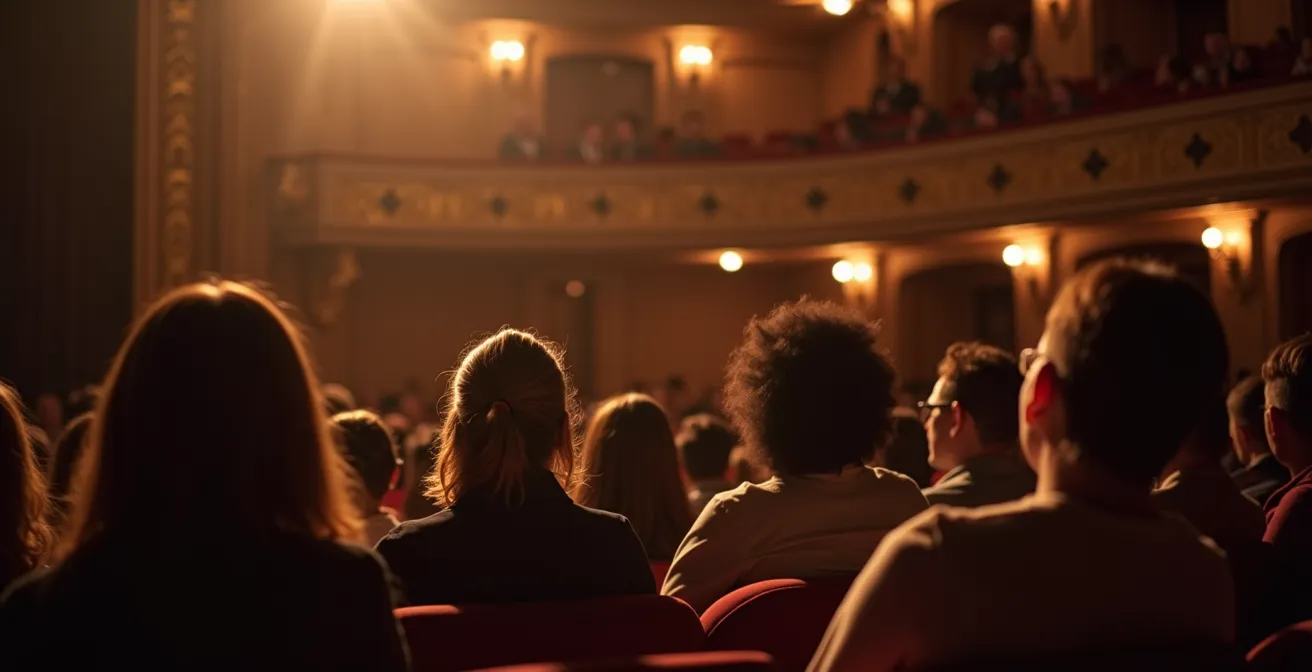
Paying for a live show isn’t about the content; it’s an investment in a unique neuro-biological process that streaming fundamentally cannot replicate.
- Live events trigger greater brain synchronization and amygdala activity, fostering measurable empathy and emotional connection.
- The shared physical space creates “collective effervescence,” a contagious energy that enhances emotional impact and social bonding.
Recommendation: View the cost of a ticket not as a purchase for passive consumption, but as an access fee for a transformative psychological experience.
In an age of flawless 4K streams and algorithmic playlists that know our tastes better than we do, the question feels more pressing than ever: why endure the cost, the crowds, and the inconvenience of a live performance? The digital replica is near-perfect, instantly accessible, and infinitely repeatable. We’re told the magic is in the “atmosphere” or the vague notion of “being there,” but for a generation raised on digital immediacy, such arguments often feel thin and unconvincing. They fail to capture the profound, almost primal, transaction that occurs in a shared physical space.
The truth is, comparing a live stream to a concert is a category error. It’s like comparing a photograph of a meal to the act of tasting it. One is a record of an event; the other is the event itself, a multi-sensory and deeply psychological process. The real value of a live performance lies not in the passive reception of sound and light, but in an active process of neuro-biological co-creation between the performers and every single person in the room. What you are paying for is not just to see the artist, but to participate in a temporary, collective consciousness that digital interfaces are structurally incapable of creating.
This article moves beyond platitudes to explore the tangible psychological mechanisms at play. We will examine the neuroscience of empathy in a theater, the cognitive cost of a smartphone in a crowd, the neurological basis of the “post-concert blues,” and why feeling “lost” at an avant-garde show might be the entire point. It’s time to understand that the ticket price is not for content, but for connection—a currency our increasingly isolated minds desperately need.
Table of Contents: The Psychological Architecture of Live Experience
- Why Live Theater Builds Empathy Faster Than Movies?
- How to Master Concert Etiquette in the Smartphone Era?
- Digital Stream vs Front Row: Is the Presence Worth the Cost?
- The Scalping Risk That Ruins Concert Experiences
- Post-Concert Blues: Dealing with the Dopamine Crash?
- The Hearing Risk of sitting Too Close to the Brass Section
- The Tourist Mistake of Watching Instead of Participating
- How to Interpret Avant-Garde Theater Without Feeling Lost?
Why Live Theater Builds Empathy Faster Than Movies?
The ability of a film to evoke emotion is undeniable, yet live theater operates on a different psychological plane. The core distinction lies in the concept of empathic resonance, a process accelerated by the shared vulnerability of physical co-presence. Unlike a movie screen, which presents a finished, unalterable product, a live performance is a living entity, unfolding in real-time with all its potential for triumph or error. This shared, unmediated experience creates a powerful bio-feedback loop between the actors and the audience. We see their sweat, we feel the vibrations of their voices, and our nervous systems begin to mirror their emotional state in a way a digital recording cannot facilitate.
This isn’t merely a feeling; it’s a measurable neurological event. Groundbreaking neuroscience research from the University of Zurich reveals that live music elicits significantly higher and more consistent amygdala activity—the brain’s emotional processing center—compared to recorded music. Furthermore, a Stanford study found that watching live theater produced significant, lasting increases in empathy and perspective-taking among audience members, irrespective of their political leanings. The physical presence of the performers and fellow audience members forces our brains to engage in a more complex and embodied form of emotional simulation.
The actor’s risk becomes our own, their triumphs feel earned, and their sorrow is processed not as a narrative point but as a shared human moment. This is why you might leave a theater feeling more connected to humanity; your brain has just completed an intense, collective workout in emotional mirroring, an exercise that movies can only approximate.
How to Master Concert Etiquette in the Smartphone Era?
Concert etiquette in the digital age is not about a rigid set of rules; it’s about understanding the psychology of collective experience and choosing to be a contributor rather than a detractor. The smartphone, our portal to the world, becomes a significant barrier in this context. Every time an audience member raises a phone to record a song, they are not just documenting a memory; they are creating a perceptual rupture for everyone around them. The glowing screen shatters the carefully constructed immersive environment, pulling adjacent minds out of the shared “flow state” and back into individual, disconnected realities.
Mastering modern etiquette means embracing the concept of “contributing presence.” This is the conscious decision to be fully there, to offer your undivided attention as an active ingredient in the performance’s energy. Artists often speak of feeding off the crowd’s energy; this is not a metaphor. It is a tangible bio-feedback loop where an engaged, present audience genuinely elevates the quality and intensity of the performance. By “offloading” the experience to your device, you are not only weakening your own memory encoding of the event but also withdrawing your energy from this crucial collective exchange.
True mastery involves a shift in mindset: from a consumer documenting a product to a participant co-creating a moment. It means silencing the device, making eye contact with the performers, and allowing your physical senses—your proprioceptive awareness of the crowd, the bass vibrating in your chest—to be your primary recording tools. This active presence is the most respectful and, ultimately, most rewarding way to engage.
Digital Stream vs Front Row: Is the Presence Worth the Cost?
The debate between streaming and attending a live show often boils down to a cost-benefit analysis. Yet, this framing misses the fundamental difference in what is being consumed. A stream delivers auditory and visual data. The front row delivers a holistic, embodied cognitive experience. The financial cost is an investment in neurological synchrony, a phenomenon that University of Western Ontario research shows happens when attending live concerts. The brain waves of audience members literally synchronize with each other and with the performers, creating a unified state of engagement that a solitary viewing experience cannot induce.
This is the essence of what psychologists call collective effervescence—the sense of shared energy and simultaneous experience that binds a group together. From the front row, this is amplified a hundredfold. You are not just hearing the music; you are feeling the heat from the stage lights, the percussive force of the kick drum in your bones, and the raw, unmixed sound from the stage monitors. This multi-sensory immersion floods the brain with information, deepening the emotional and physical imprint of the event.
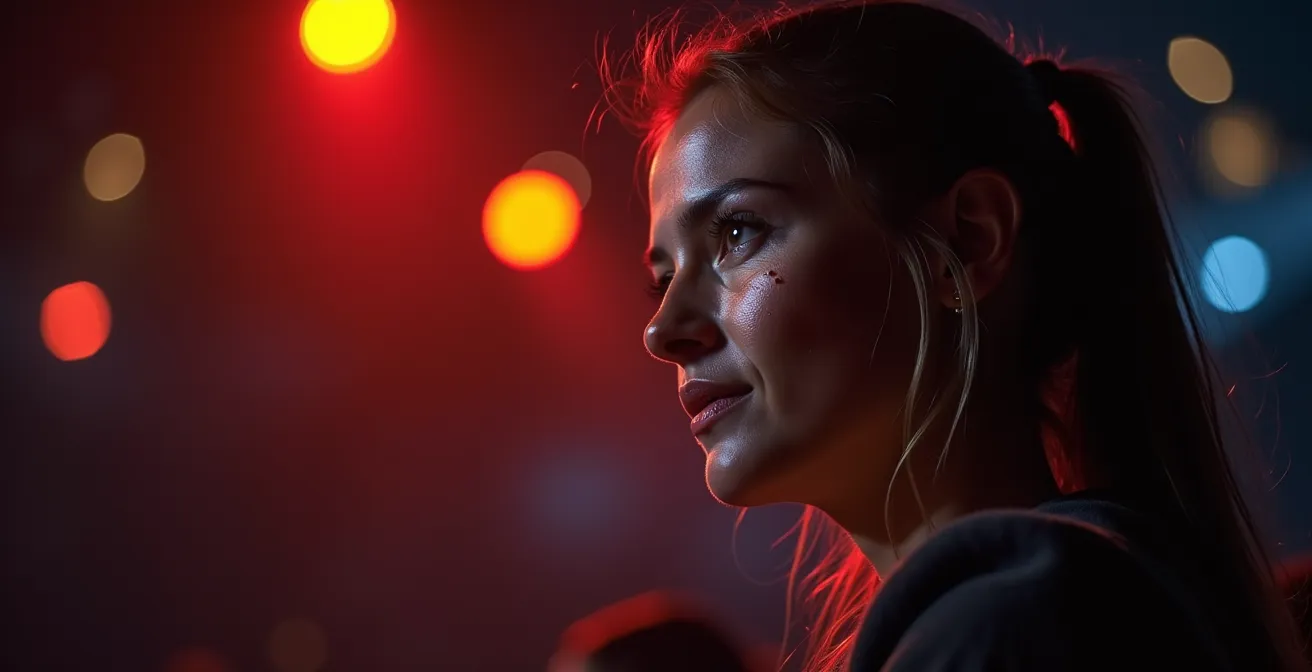
As this immersive experience demonstrates, the proximity allows you to witness the micro-expressions of the artists—the subtle interplay and non-verbal cues that are often lost in a wide-shot camera edit. You become a privy observer to the art’s creation. As cognitive neuroscientist Sascha Frühholz of the University of Zurich notes, this is precisely what we seek:
People want the emotional experience of live music. We want musicians to take us on an emotional journey with their performances.
– Sascha Frühholz, University of Zurich cognitive and affective neuroscience study
The cost, therefore, is not for a better view, but for a more profound level of brain synchronization and emotional participation. It is the price of moving from a spectator to a resonant part of the performance itself.
The Scalping Risk That Ruins Concert Experiences
The psychological journey of a concert experience begins long before the first note is played. It starts with a sense of anticipation and excitement. However, the modern ticketing landscape, plagued by scalping and exorbitant resale prices, can poison this crucial initial phase. The risk of encountering unfair pricing doesn’t just impact one’s wallet; it inflicts a significant psychological wound that can prevent the very enjoyment the ticket is meant to provide.
This phenomenon can be understood through the lens of cognitive dissonance. When a person pays a price they perceive as unjust or extortionate, a conflict arises between their desire to enjoy the event and the feeling of having been exploited. This internal conflict generates stress and anxiety, replacing the joyful anticipation with a gnawing sense of resentment. According to concert psychology research, these high expectations, when coupled with a strong sense of injustice, can effectively block the brain’s ability to enter a positive “flow state” during the performance. Instead of losing oneself in the music, the mind remains preoccupied with justifying the cost.
The Anxious Audience: Cognitive Barriers from Unfair Pricing
Australian research on the psychology of live events highlights that the high cost of attending can be a significant privilege. When this cost is perceived as being artificially inflated by scalpers, it creates a powerful cognitive barrier. The psychological impact of this perceived unfairness can transform the entire experience. The focus shifts from the upcoming artistic immersion to the financial transaction, leading to heightened anxiety and a diminished capacity for emotional engagement, effectively sabotaging the psychological benefits of the performance before it even begins.
In this state, the music is no longer an escape but a constant reminder of the unfair transaction. The entire event becomes tainted by this initial negative framing. The scalping risk, therefore, is not just financial; it’s an emotional and cognitive gamble that can ruin the very experience it promises to sell.
Post-Concert Blues: Dealing with the Dopamine Crash?
The intense high of a live performance—the lights, the sound, the collective energy—is a potent neurochemical cocktail. Your brain is flooded with dopamine (reward and pleasure), oxytocin (social bonding), and endorphins (euphoria and pain relief). It’s no surprise that frequent attendance at live events is linked to better mental health; Australian psychological studies demonstrate that individuals who frequently attend show higher levels of happiness and greater social connectedness. However, the abrupt end of such a powerful stimulus can lead to an equally powerful crash, often known as the “post-concert blues.”
This feeling of emptiness or melancholy the day after a show is not imagined; it’s a genuine neurochemical recalibration. Your brain, having become accustomed to a high level of stimulation, experiences a sudden deficit as neurotransmitter levels return to baseline. This “dopamine crash” can leave you feeling lethargic, unmotivated, and nostalgic for the peak experience you just left behind. It’s the psychological equivalent of a physical hangover. Acknowledging this as a normal biological process is the first step toward managing it.
Instead of passively succumbing to this trough, you can actively manage the transition from the collective consciousness of the event back to your individual reality. The key is to channel the residual energy and emotion productively, helping to regulate your neurotransmitter levels more smoothly.
Your Action Plan for Managing the Post-Performance Transition
- Channel Creative Energy: Within 24 hours, engage in a creative outlet. Journal about the experience, detailing specific moments, feelings, and thoughts to process the memories actively.
- Maintain Social Bonds: Reach out to friends who also attended. Sharing memories and discussing the show helps maintain the flow of oxytocin from social bonding, easing the sense of isolation.
- Plan Your Next Engagement: Transform the emotional void into productive anticipation. Research and plan your next cultural outing, whether it’s another concert, a play, or a museum visit. This gives your brain a new future reward to focus on.
- Practice Mindful Re-entry: Consciously acknowledge the shift. Take a walk in nature or practice mindfulness to gently ground yourself back in your personal space and time, away from the high-stimulus environment.
- Engage in Light Physical Activity: A gentle workout, such as a jog or yoga, can help naturally boost and regulate your neurotransmitter levels, providing a smoother “comedown” from the concert high.
The Hearing Risk of sitting Too Close to the Brass Section
While the goal of a live performance is immersion, there is a point where sensory input becomes overwhelming and even damaging. The raw acoustic power of an orchestra or a big band is exhilarating, but proximity to the loudest sections, particularly the brass, carries a tangible risk not just to your hearing, but to your cognitive engagement. Excessive volume doesn’t just feel loud; it imposes a significant cognitive load on your brain as it struggles to filter and process the overwhelming auditory information.
At very high decibel levels, the brain’s perceptual filters become strained. Instead of appreciating the nuance and texture of the music, you may find your attention narrowing defensively, focusing more on enduring the volume than on engaging with the performance. This can lead to auditory fatigue, headaches, and a diminished ability to enjoy the full emotional spectrum of the music. The ideal position is a careful balance between intimacy and auditory safety, a spot where you can feel the energy without incurring a cognitive or physical cost.
The following table breaks down the typical sound exposure levels in a concert hall and their corresponding impact, providing a framework for choosing a seat that optimizes both enjoyment and well-being.
| Distance from Brass | Decibel Level | Cognitive Impact | Protective Measure |
|---|---|---|---|
| Front Row (3-5m) | 95-105 dB | Increased cognitive load, perceptual filtering strain | High-fidelity earplugs essential |
| Mid-Section (10-15m) | 85-95 dB | Optimal engagement, minimal fatigue | Optional protection for sensitive individuals |
| Back Section (20m+) | 75-85 dB | Safe levels, full frequency appreciation | No protection needed |
The Tourist Mistake of Watching Instead of Participating
A common mistake, especially when experiencing cultural performances in a new place, is to adopt the mindset of a passive observer—a tourist behind a camera lens. This approach fundamentally misunderstands the nature of many collective artistic expressions. The performance is not always a product presented *for* an audience; often, it is a ritual that *requires* the audience’s participation to be complete. To simply watch is to remain on the outside, missing the core psychological transaction of the event.
True engagement demands a shift from observation to participation. This doesn’t necessarily mean knowing the specific dance moves or song lyrics. It means embodying a spirit of active co-creation: clapping along with the rhythm, swaying with the crowd, offering vocal encouragement. This physical engagement is a form of non-verbal communication that signals to the performers and fellow audience members, “I am with you.” It is the critical act that transforms a collection of individuals into a unified, energetic body.
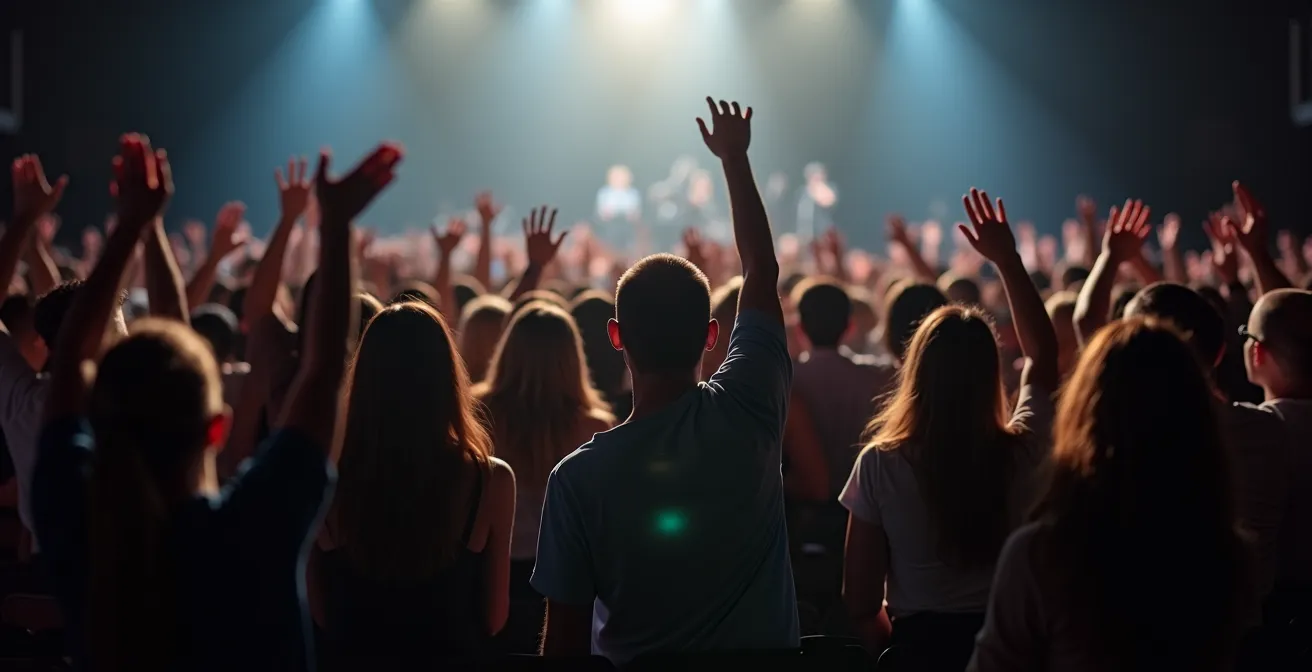
This transformation is driven by the contagious nature of collective emotion. As Jace Dean Bowren observes in “The Psychology of Live Entertainment,” this shared energy is a powerful force:
The energy and atmosphere of the live environment can be contagious, leading to heightened excitement, joy, or even shared sorrow.
– Jace Dean Bowren, The Psychology of Live Entertainment
By refusing to participate, you are effectively inoculating yourself against this contagious energy. You are choosing to spectate a fire instead of feeling its warmth. The most profound experiences are reserved not for those who watch, but for those who allow themselves to become part of the collective ritual.
Key Takeaways
- Live performance is an act of neuro-biological co-creation, not passive consumption, engaging unique psychological pathways.
- The physical presence of others triggers measurable brain synchronization and empathic responses that digital formats cannot mirror.
- True engagement requires mindful presence, transforming the audience from spectators into active participants in the collective experience.
How to Interpret Avant-Garde Theater Without Feeling Lost?
Confronted with non-linear narratives, abstract symbolism, and a deliberate break from convention, the natural response to avant-garde theater is often confusion. The feeling of “being lost” or “not getting it” is common, but it stems from a misunderstanding of the art form’s psychological goal. Unlike traditional narrative, which aims to provide clear answers, avant-garde performance often aims to provoke powerful questions. The goal is not passive comprehension, but active, personal interpretation.
The key to navigating this experience is to embrace the concept of productive discomfort. When our brains are deprived of a clear storyline, they are forced into a more effortful state of cognitive and emotional engagement. We can no longer rely on familiar tropes and must instead draw upon our own memories, emotions, and associations to construct meaning. Research on embodied simulation shows that this ambiguity activates deeper levels of processing, making the individual’s interpretation an integral part of the artistic outcome. You are not failing to find the meaning; you are actively creating it.
Therefore, to interpret avant-garde theater, you must abandon the search for a single, “correct” answer. Instead, focus on your internal response. What emotions does a scene evoke? What personal memories does a symbol trigger? How does the performance make you feel in your own body? The “meaning” of the play becomes the unique tapestry of thoughts and feelings it weaves within you. Feeling lost is not a sign of failure; it is the starting point of a deeply personal and co-creative artistic journey.
The next time you consider attending a live event, view the ticket not as a price of admission, but as an investment in your own psychological landscape. Engage with this new perspective and discover the profound impact of collective experience for yourself.