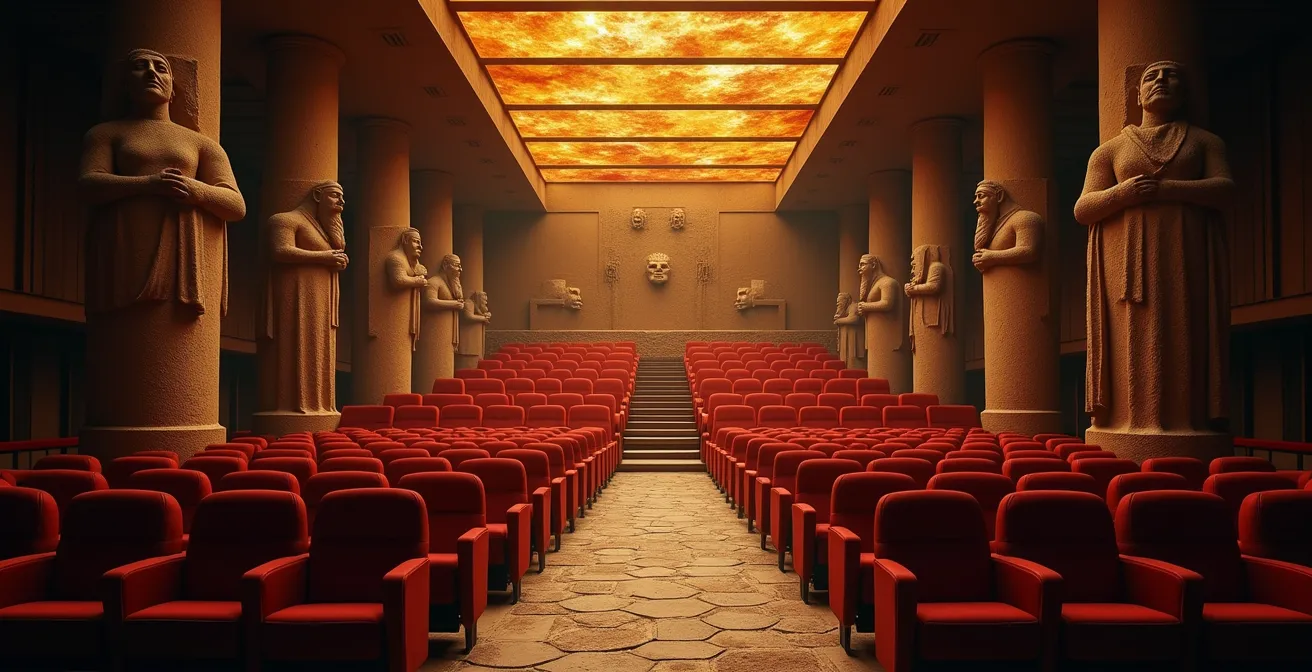
Modern films resonate so deeply because they function as subconscious rituals, allowing us to engage with the same psychological archetypes our ancestors did.
- Beyond retelling plots, successful adaptations translate the core psychological function of a myth into a modern context.
- We often act as “psychological tourists,” watching stories from a distance instead of participating in the transformation they offer.
Recommendation: To truly connect with a story, shift from passively following the plot to actively identifying the archetypal patterns and their echoes in your own life.
There is a strange and profound sense of familiarity that washes over us while watching certain films. A new hero embarks on a perilous quest, a wise mentor offers cryptic advice, a monstrous force tests the limits of courage—and though the special effects are modern, the story feels ancient, as if we have heard it a thousand times before. Many will point to structural formulas like the “Hero’s Journey” as the reason for this resonance, explaining that most stories follow a predictable pattern. This observation is true, but it remains on the surface of a much deeper ocean.
This common analysis mistakes the map for the territory. The power of ancient folklore in modern cinema is not found in the repetition of plot points. It is rooted in something far more fundamental: the story’s ability to act as a modern-day ritual. These films are not just entertainment; they are vessels for the timeless psychological archetypes that have shaped human consciousness for millennia. They provide a space for us to confront the same universal questions of life, death, identity, and transformation that our ancestors explored around a flickering fire.
The real reason these stories persist is that they serve a deep, unconscious need. They allow us to participate in a narrative that gives structure and meaning to the chaos of existence. Instead of simply acknowledging that movies retell old myths, this exploration will delve into *how* they function. We will uncover why historical accuracy often matters less than psychological truth, how we can move from being passive viewers to active participants in these narrative rituals, and why these ancient patterns are not only found in epic fantasies but also in the very structure of our family histories.
This article provides a map to understand this profound connection between the ancient and the modern. Each section will explore a different facet of how folklore’s DNA continues to shape the stories we tell ourselves today.
Summary: Why Ancient Folklore Still Resonates in Modern Movies?
- King Arthur: Separating Historical Fact from medieval Fiction
- How Folklore Keeps Endangered Dialects Alive?
- The Tourist Mistake of Watching Instead of Participating
- Why Grimms’ Fairy Tales Were Originally So Dark?
- Retelling Myths: How to Update Stories Without Disrespect?
- Why Modern Plays Often Abandon Traditional Plot Structures?
- Holiday Tables: Why We Eat Specific Foods on Specific Dates?
- Why Documenting Family Oral History Is Urgent Right Now?
King Arthur: Separating Historical Fact from medieval Fiction
The legend of King Arthur is a perfect starting point for understanding the power of myth. For centuries, historians have searched for the “real” Arthur, a 5th or 6th-century warlord who may have fought against Saxon invaders. But this quest for historical fact, while fascinating, misses the point of why the story has endured for over a millennium. The figure of Arthur resonates not because he was a real person, but because he is a psychological archetype—a symbol of the just king, the promise of a golden age, and the hope of return in a time of need.
Modern adaptations often understand this instinctively. As David Lowery’s approach to The Green Knight demonstrates, the film’s power comes not from its historical accuracy, but from its deep dive into the psychological and moral turmoil of its hero. A CBR analysis of the film highlights this by stating:
The power of the Arthurian myth lies not in its historical truth, but in its function as a psychological archetype—the ‘Once and Future King’ as a symbol of the collective unconscious.
– David Lowery’s approach, CBR analysis of The Green Knight
This focus on psychological truth over historical fact is precisely why these stories remain potent. They are not records of what happened, but mirrors reflecting what is always happening within the human soul. The conflict between honor and survival, duty and desire, is a timeless human struggle, and the Arthurian legend provides a rich, symbolic landscape in which to explore it.
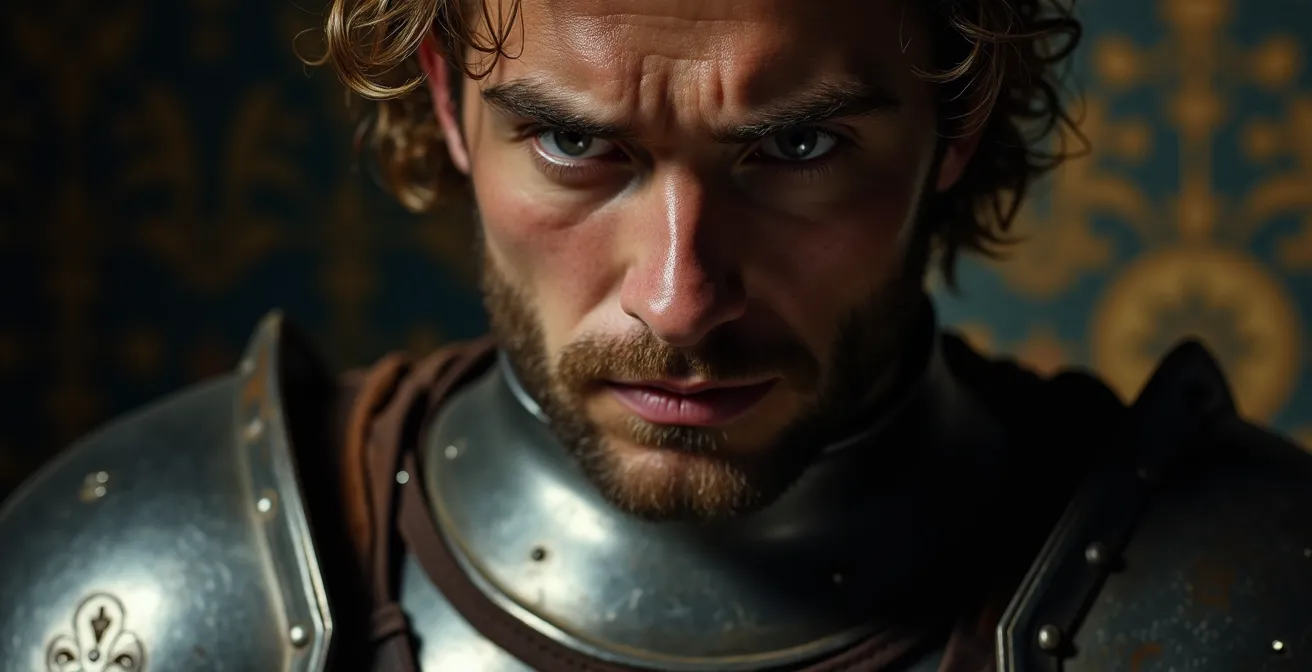
As the illustration suggests, the enduring knight is a figure merged with abstract symbols. The weathered armor represents a historical shell, but the contemplative expression and inner conflict visible in the eyes speak to the universal, psychological core that audiences truly connect with. The story functions as a bridge between a supposed past and our present inner world.
How Folklore Keeps Endangered Dialects Alive?
Folklore’s function extends far beyond providing plot structures for blockbuster films. It is a living ecosystem of culture, and one of its most vital roles is the preservation of language itself. When a dialect or language is endangered, it is not just a set of words that is at risk, but an entire worldview, a unique way of describing reality, and the collective memory of a people. Folktales, songs, and myths act as natural archives, carrying the specific cadence, vocabulary, and grammar of a language through generations.
This is because folklore is intrinsically oral. Before it is written down, it lives in the spoken word. The telling of a story requires the use of specific phrases and local idioms that might not survive in standardized, written forms of a language. For instance, Irish mythology films, even when primarily in English, often pepper their dialogue with Gaelic words and phrases, re-introducing them to a global audience. These films, drawing from a rich well of tales about supernatural beings and epic heroes, become modern conduits for an ancient linguistic heritage.
The vast majority of our modern narratives are built upon these ancient foundations. Indeed, research shows that over 70% of today’s movies and books are based on old myths in some form. While many of these adaptations are in dominant global languages like English, they often retain key terms or conceptual frameworks from their source culture. Each time a character in a movie invokes a name like “Banshee” or “Púca,” a small fragment of the linguistic past is carried into the present, reminding us that stories are not just made of plots, but of specific, resonant words.
In this way, folklore is a vessel of cultural memory. The stories demand to be told in a certain way, with a certain rhythm, using words that have been passed down. By engaging with these stories, whether through film, literature, or oral tradition, we inadvertently participate in the act of cultural and linguistic preservation. The narrative becomes a living sanctuary for the words that gave it birth.
The Tourist Mistake of Watching Instead of Participating
Even as modern movies expose us to this rich folklore, a profound disconnect often occurs in how we consume it. We have become what one might call “psychological tourists.” We watch the hero’s journey from the safe distance of a cinema seat or a couch, observing their trials and transformations as a spectacle. We appreciate the artistry and follow the plot, but we rarely allow the story to do its real work on us. We watch, but we do not participate.
This mode of passive consumption is a modern invention. Historically, myths were not just stories to be heard; they were rituals to be experienced. They were performed in a communal setting, inviting the listener to step into the symbolic reality of the tale and undergo a parallel transformation. As a film analysis in Smithsonian Magazine astutely observes, modern audiences often act as ‘psychological tourists’ in movies. They admire the archetypal landscape but remain observers, never truly leaving the tour bus to walk the sacred ground themselves.
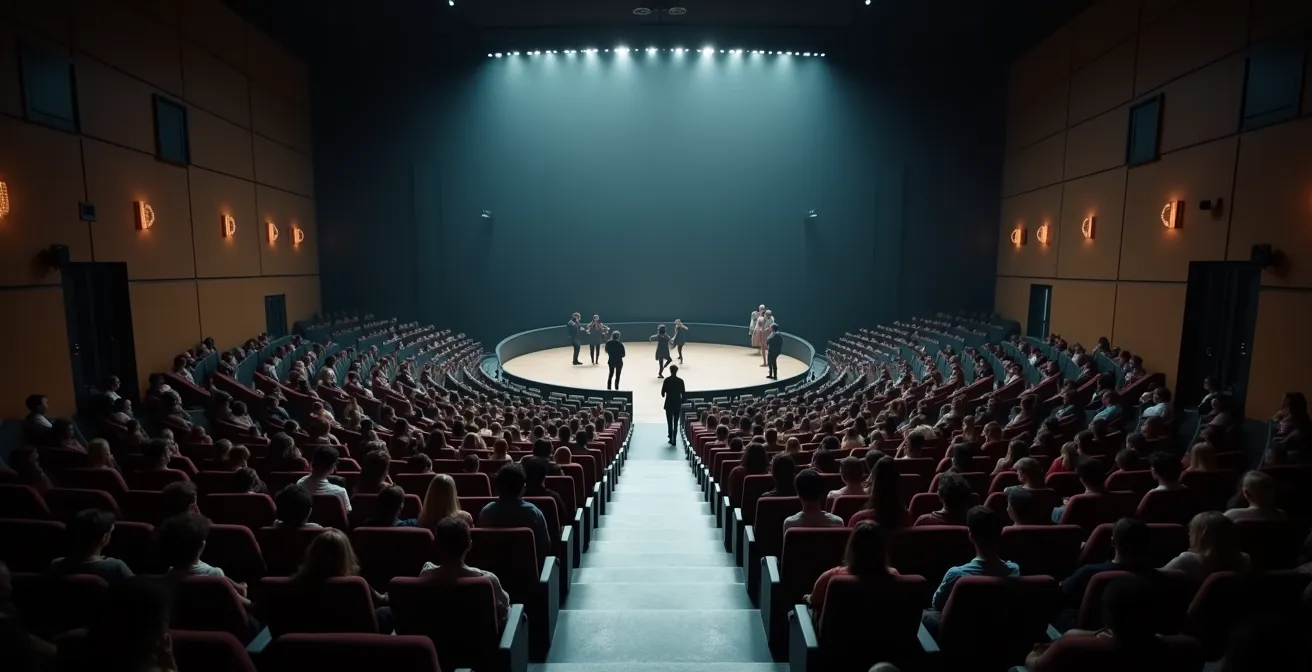
The consequence of this passive stance is that the story’s transformative potential is neutered. It becomes mere entertainment, a temporary escape, rather than a tool for self-reflection and growth. To reclaim the true power of these narratives, we must learn to shift from passive consumption to active interpretation. This means consciously engaging with the archetypes on screen, recognizing their patterns not just in the hero’s life but in our own, and allowing the story’s symbolic journey to illuminate our own inner conflicts and potential.
Action Plan: How to Engage with Archetypal Stories
- Recognize the archetypal patterns: Look beyond the surface plot and identify the universal roles (The Mentor, The Trickster, The Shadow) and situations (The Quest, The Underworld Journey, The Rebirth).
- Identify personal connections: Ask yourself where you have seen the hero’s psychological journey—their fears, doubts, and triumphs—in your own life or in the lives of those around you.
- Consider interactive media: Explore formats like video games where you are not just a spectator but the protagonist, forced to make archetypal choices with real consequences within the game’s world.
- Engage in communal discussion: Share your interpretations with others. Storytelling has always been a communal act; discussing a film’s deeper meaning re-establishes that ancient circle.
- Practice active interpretation: Instead of asking “What happens next?”, ask “What does this mean?”. Treat the story as a symbolic dream from the collective unconscious, rich with meaning to be unpacked.
Why Grimms’ Fairy Tales Were Originally So Dark?
Many of us grew up with sanitized versions of fairy tales, where Cinderella’s stepsisters are merely sent away and the wolf in Little Red Riding Hood is captured by a woodsman. The original versions collected by the Brothers Grimm, however, were far darker and more brutal. The stepsisters mutilate their own feet to fit the slipper and are later blinded by birds; the wolf is cut open with scissors while he sleeps. This original darkness is often seen as a morbid historical curiosity, but it serves a crucial psychological function.
These tales were never meant to be gentle bedtime stories. They were tools of psychic survival, designed to map the most terrifying landscapes of the human experience in a safe, symbolic container. The darkness—the threat of abandonment, starvation, violence, and the monstrous unknown—was a frank acknowledgment of the harsh realities of life. By confronting these fears in the form of a story, the tales provided a way to process them. They acted as a form of psychological inoculation, exposing the listener to a controlled dose of terror to build inner resilience.
Modern dark fantasy films continue this tradition. A film like Guillermo del Toro’s *Pan’s Labyrinth*, for example, is not dark for the sake of horror. Set against the brutal backdrop of 1940s fascist Spain, the film uses the fantastical and often grotesque world of the faun to process the real-world horrors of war and oppression. The story of Ofelia is a modern fairy tale that uses its darkness to explore themes of innocence, sacrifice, and moral choice in a world gone mad. It is a testament to the idea that fairy tales are not an escape from reality, but a way of confronting it.
These stories acknowledge that the world contains real monsters, both external and internal. The “darkness” is not gratuitous; it is a necessary component of the archetype. Without the genuine threat of the wolf, there is no true test of courage for Little Red Riding Hood. Without the profound cruelty of the stepmother, there is no deep catharsis in Cinderella’s triumph. The darkness is what gives the light its meaning.
Retelling Myths: How to Update Stories Without Disrespect?
When a modern creator decides to adapt an ancient myth, they face a difficult question: how do you update a story for a new audience without disrespecting the original? This often leads to two extremes: slavish, lifeless reproductions that feel dated, or radical reinterpretations that lose the story’s soul. The key to navigating this challenge lies in understanding what “respect” truly means in a mythological context.
A successful retelling does not depend on preserving every plot point or character detail. Instead, it requires what can be called psychological fidelity. The creator must identify the core archetypal function of the original story—its central psychological truth—and find a way to translate that function into a modern context. As scholars David M. Perry and Matthew Gabriele state in Smithsonian Magazine, “‘Respect’ is psychological fidelity, not narrative fidelity.” The goal is to make the story *work* on a modern psyche in the same way the original worked on an ancient one.
The Coen Brothers’ film *O Brother, Where Art Thou?* is a masterclass in this approach. It is an adaptation of Homer’s *The Odyssey*, but it is set in 1930s Mississippi. The plot points are not a one-to-one match, but the psychological fidelity is perfect. The core archetypal journey of a man trying to get home, facing trials that test his character, and battling his own hubris is preserved entirely. The Sirens become gospel singers by the river, the Cyclops becomes a con-man Bible salesman. The context is new, but the archetypal function is identical.
This principle helps explain why some adaptations succeed while others fail, as a comparative analysis from No Film School highlights.
| Aspect | Successful (O Brother Where Art Thou) | Unsuccessful (Generic Adaptations) |
|---|---|---|
| Core Archetype | Maintains the journey home theme | Copies names without meaning |
| Cultural Translation | The American South setting works | The modern setting feels forced |
| Psychological Truth | Characters face real, meaningful obstacles | Challenges are surface-level only |
| Audience Reception | Garnered 2 Oscar nominations | Often forgotten quickly |
As this comparative look at mythological adaptations shows, the most resonant retellings are not copies; they are translations. They respect the source material not by embalming it, but by ensuring its ancient heart continues to beat within a new body.
Why Modern Plays Often Abandon Traditional Plot Structures?
While mainstream cinema often leans heavily on traditional mythic structures, the world of modern theatre frequently seems to be moving in the opposite direction. Many contemporary plays abandon the clear, linear plot of rising action, climax, and resolution that has dominated Western storytelling for centuries. This move away from traditional structure is not a rejection of meaning, but an attempt to reflect a modern psychological reality that is often fragmented, cyclical, and non-linear.
However, this experimental fringe should not be mistaken for the mainstream. The archetypal power of traditional structure remains incredibly dominant, especially in cinema. Despite the rise of experimental narratives, statistics show that approximately 90% of hit movies still follow the classic hero’s journey pattern. This overwhelming prevalence suggests that this structure satisfies a deep and enduring psychological need. It provides a sense of order, progress, and eventual resolution that helps us make sense of the often-unstructured nature of our own lives.
Even films that appear to break the mold often do so by substituting one traditional structure for another. A film like *The Green Knight* may not be an action movie with a clear-cut victory, but as one analysis points out, it is structured as a psychological thriller. The emphasis is not on external battles, but on internal “games, exchanges, and hunts.” The external plot is subdued to allow the internal, archetypal journey to become the central focus. The structure is still there, but it is a psychological one, mapping the hero’s inner transformation rather than his physical progress.
The traditional plot, therefore, can be seen as a narrative ritual in itself. Its familiar stages—the call to adventure, the refusal of the call, the meeting with the mentor, the ultimate ordeal—are like stations in a ceremony. We know the steps, and their predictability is not a weakness but a comfort. It provides a reliable framework within which the chaos of transformation can safely unfold.
Holiday Tables: Why We Eat Specific Foods on Specific Dates?
The power of archetypes is not confined to the stories we watch or read; it is embedded in the most tangible and sensory parts of our lives, including the food we eat. The tradition of eating specific foods on specific holidays—turkey at Thanksgiving, lamb at Easter, fruitcake at Christmas—is far more than a matter of culinary habit. These meals are a form of myth-making, a way of connecting with the great, ancient cycles of life, death, and rebirth.
As one analysis on food and mythology puts it, “Specific holiday foods are not just traditions; they are edible archetypes.” A harvest festival feast connects us to the archetype of abundance and gratitude. The eating of lamb, a symbol of spring and sacrifice, ties us to the theme of renewal. These foods become tangible links to the foundational myths that underpin our cultures, often without us even consciously realizing it. The act of preparing and sharing a specific holiday meal is a ritual that reaffirms our connection to a story much larger than ourselves.
This symbolic power of food is a narrative shortcut frequently used in film. A grand feast scene in a movie like *Harry Potter* or *The Lord of the Rings* is not just there to show characters eating. It is a powerful symbol of community, safety, and belonging. The shared meal creates a moment of communion, reinforcing the bonds of the group before they face their next ordeal. The food itself—the overflowing plates, the warm bread—becomes an outward manifestation of the archetypal “home” or “sanctuary.”
By recognizing this symbolic layer, we can see that our holiday tables are stages on which ancient myths are re-enacted year after year. The specific menu is a script passed down through generations. Each dish is a character, and every shared meal is a performance that connects the present moment to a timeless, cyclical story of the seasons and of life itself.
Key Takeaways
- Ancient stories resonate because they are not just plots, but vessels for timeless psychological archetypes that help us process universal human experiences.
- The most powerful way to engage with these stories is to move from being a passive “psychological tourist” to an active participant who interprets the narrative as a ritual of transformation.
- A successful modern retelling of a myth respects the original not by copying its plot (narrative fidelity), but by translating its core psychological function for a new era (psychological fidelity).
Why Documenting Family Oral History Is Urgent Right Now?
We have explored how grand, global myths from ancient civilizations continue to live and breathe through our modern media. Yet, there is another, more intimate layer of mythology that is equally powerful and far more fragile: the mythology of the family. Every family has its own foundational stories, its own oral history, and its own set of unique archetypes: The Resilient Matriarch, The Prodigal Son who returned, The Trickster Uncle whose jokes hide a deeper wisdom.
These family stories function in precisely the same way as the great myths. They shape identity, transmit values, and provide a sense of belonging and continuity. They are the personal folklore that tells us who we are and from whence we came. However, unlike the myths of King Arthur or Odysseus, which are preserved in countless books and films, this personal folklore is incredibly vulnerable. It exists primarily in the memories and voices of our elders. When they are gone, these stories can be lost forever.
In an age dominated by globalized media, where a 50% increase in superhero films drawing from mythology has been seen since 2010, it is easy for these personal mythologies to be drowned out. The urgent task, then, is one of documentation. To sit with our parents and grandparents, with a recorder or a notebook, and become the scribes of our own lineage. To ask the questions that unlock the stories: “What was the hardest decision you ever had to make?” “Tell me about the day you left home.” “What is the story behind this old photograph?”
Doing so is an act of profound importance. It is the work of a mythologist applied to the most immediate and personal material. As Family Mythology Research suggests, “Each family has its own set of archetypes… and foundational myths that shape its identity.” By documenting these stories, we honor our ancestors, give a precious gift to our descendants, and, most importantly, we come to understand ourselves as part of a story that is both deeply personal and universally archetypal.
To truly understand the stories you love, the next step is not to watch another movie, but to become a folklorist of your own life. Begin by documenting the oral history of your family. Explore the archetypes that reside within your own lineage and see for yourself how the great myths live not only on screen, but within each of us.