
That quiet anxiety you feel about your grandparents’ fading stories is a crucial warning sign. The greatest risk isn’t just forgetting; it’s losing this irreplaceable history forever. This guide reframes family archiving not as a sentimental hobby, but as an urgent act of cultural preservation. By adopting a professional archivist’s mindset—focusing on quality, context, and long-term security—you can transform this anxiety into a tangible, enduring legacy that will resonate for generations.
There is a silence that grows heavier with time. It’s the space left by stories untold, by memories that live only in the minds of our elders. You feel it, that quiet, pressing urgency—the realization that the voices of your grandparents, the living libraries of your family’s past, will not be here forever. We often tell ourselves we’ll ask them “one day,” that we’ll get around to recording their experiences. We might even jot down a few notes or use a basic phone app, thinking that’s enough.
But what if the key to truly honoring their legacy isn’t just to record, but to preserve? What if the real task is not simply to collect memories, but to become the careful, dedicated guardian of your own family’s archives? This isn’t about creating a simple keepsake; it’s about an urgent act of cultural preservation. It requires an archivist’s mindset, a focus on methods that ensure these stories—their texture, their context, their emotional truth—survive for generations you may never meet. This is your chance to turn fleeting moments into a permanent legacy.
This guide will walk you through the essential, practical steps to do just that. We will explore how to capture high-quality recordings, preserve precious physical artifacts like photos, and even consider the ethical and financial dimensions of your project. By the end, you will have a clear roadmap for transforming that feeling of urgency into a profound and lasting gift to the future.
Summary: How to Become Your Family’s Archivist
- How to Record High-Quality Interviews with a Smartphone?
- The Scanner Settings That Preserve Old Photos Best
- Grants and Funds: How to Finance Local Heritage Projects?
- The Tourism Trap That Commodifies Sacred Rituals
- Learning Forgotten Crafts: Why It Matters for Future Generations
- Why Saddle Stitching Lasts Longer Than Machine Sewing?
- Password Manager or Notebook: Which Is Actually Safer?
- How to Trace Your Family Tree Beyond Online Databases?
How to Record High-Quality Interviews with a Smartphone?
The most fragile artifact in your family’s collection is a voice. A smartphone puts a recording studio in your pocket, but simply pressing “record” is not enough to create a lasting archive. An archivist’s first duty is to quality. A muffled, compressed audio file is like a faded photograph; the essence is there, but the vital details are lost. Committing to a high-quality, uncompressed format like WAV is the first step toward digital permanence. It’s a choice that respects the storyteller and the future listener.
The environment of the recording is as important as the technology. A quiet room, softened by carpets and curtains, becomes a sanctuary for memory. It absorbs the echoes of the present so the voice of the past can emerge with clarity. Setting the phone on a simple tripod isn’t a technical fuss; it’s an act of intention. It eliminates the distracting noises of handling and communicates to your loved one that their words are being treated with profound care. This setup isn’t about being a professional filmmaker; it’s about creating a space where a story can be shared without interruption, a sacred moment captured with the respect it deserves.
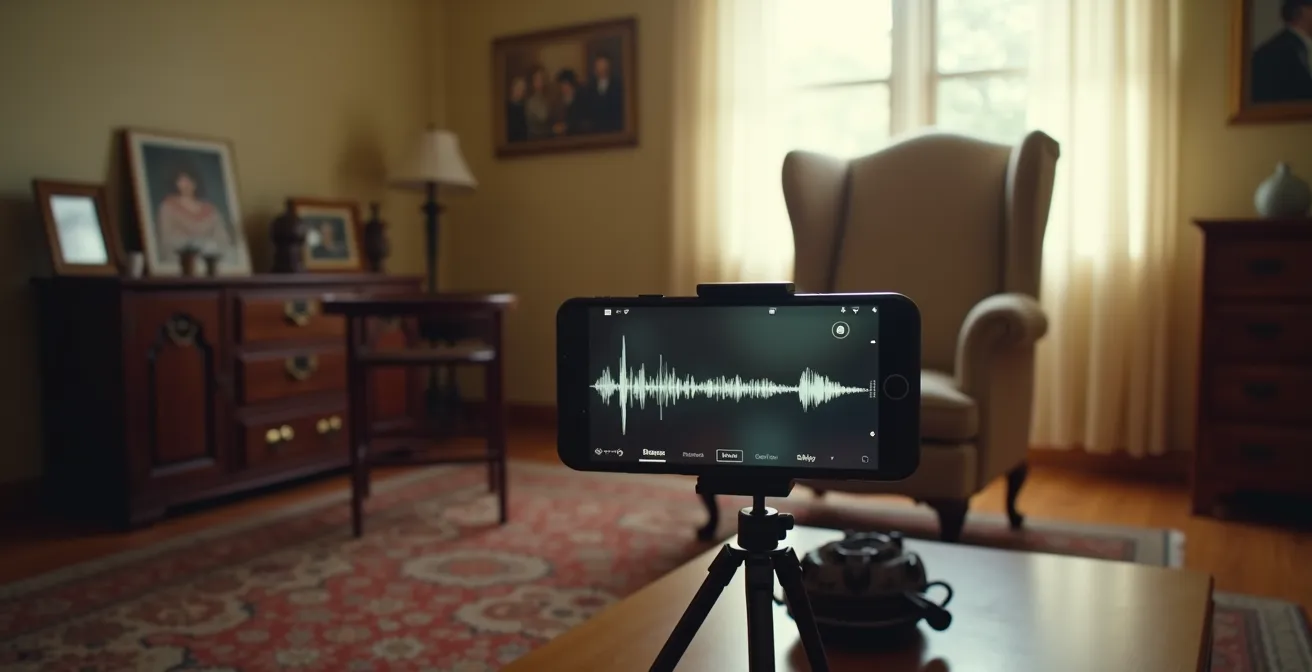
Remember, the goal is to make the technology invisible so the human connection can flourish. Simple preparations, like enabling airplane mode to block calls and notifications, ensure the flow of memory is unbroken. This is the archival mindset in practice: anticipating and neutralizing threats to the integrity of the record. Naming the file immediately with a consistent format (Date-Name-Topic) is the final, crucial step. It transforms a random audio file into a cataloged piece of history, ready for the archive.
Your Audit Plan: Securing an Oral History Legacy
- Points of Contact: Identify every medium where family stories exist—photo albums, letters, recipes, and most urgently, the living memory of your elders.
- Collection: Inventory existing materials. What have you already digitized? What recordings exist? List the specific stories or eras you need to capture (e.g., “Grandma’s immigration story,” “Grandpa’s war letters”).
- Coherence: Confront the collected stories with your family’s core values. Does the narrative you’re building feel authentic? Identify any conflicting accounts as areas for gentle further inquiry.
- Memorability & Emotion: Distinguish the unique, emotionally resonant details from generic anecdotes. What specific smells, sounds, or feelings are mentioned? These are the heart of the archive.
- Integration Plan: Prioritize the most vulnerable sources first (the oldest relatives). Create a schedule for recording sessions and scanning days to fill the gaps in your collection.
The Scanner Settings That Preserve Old Photos Best
After voices, photographs are the most powerful anchors to our past. But a quick photo of a photo or a low-resolution scan is a ghost of the original. To truly preserve these images, you must think like a conservator. The goal is not to create a convenient digital copy, but a digital master file—a foundational version so rich in detail that it can serve every future need, from a small web image to a large-format print. This is where technical specifications become acts of preservation. Using an uncompressed TIFF format is non-negotiable for a master file. It is the digital equivalent of an acid-free archival box.
The resolution, measured in Dots Per Inch (DPI), determines the level of detail you capture. Scanning a small, wallet-sized photo at a low resolution is like trying to read a book from across the room. As a rule, the smaller the original, the higher the DPI needs to be to capture its hidden information. This isn’t about creating unnecessarily large files; it’s about ensuring that you are capturing every possible grain of silver halide, every subtle texture of the paper, for future generations to explore.
Case Study: The Abraham Lincoln Presidential Library’s Archival Shift
The evolution of professional standards highlights this urgency. As shown in the practices of The Papers of Abraham Lincoln archives, archivists are moving to ever-higher standards. They recently upgraded their process to digitize correspondence at 600 DPI in uncompressed TIFF format, a significant increase from their old 300 DPI standard. This decision reflects a core archival principle: plan for technologies that don’t yet exist. By creating a rich master file, they ensure the material will be usable for future research and display methods we can’t even imagine today.
This table provides a clear, professional baseline for creating your own digital master files. Adhering to these standards is how you transition from a casual picture-saver to a dedicated family archivist. Each setting is a choice to prioritize permanence over convenience.
| Photo Type | Minimum DPI | Recommended DPI | File Format | Bit Depth |
|---|---|---|---|---|
| 4×6 Snapshots | 300 DPI | 400 DPI | TIFF (master) | 24-bit color |
| 8×10 Prints | 400 DPI | 600 DPI | TIFF (master) | 24-bit color |
| Photo Slides | 1400 DPI | 1500 DPI | TIFF (master) | 48-bit color |
| Negatives | 1500 DPI | 2000 DPI | TIFF (master) | 48-bit color |
| Wallet Size | 600 DPI | 800 DPI | TIFF (master) | 24-bit color |
Grants and Funds: How to Finance Local Heritage Projects?
The weight of this work can feel immense, not just emotionally but financially. Professional equipment, archival storage, and transcription services can be costly. While a personal family project may be self-funded, the archival mindset encourages us to think bigger. What if your family’s story is part of a larger community narrative? Framing your work not just as a personal endeavor but as a local heritage project can open doors to unexpected support systems that move beyond traditional grant applications.
Institutions like libraries, historical societies, and universities are often seeking meaningful community engagement. They may offer not money, but something even more valuable: in-kind support. This could be free access to high-end scanners, archival consulting from a professional, or even long-term digital storage space. By partnering with a local university’s history or journalism department, you might find students eager to help with transcription as part of an internship program, providing them with real-world experience and you with an invaluable resource.
The key is to shift your pitch. Instead of focusing on preservation for its own sake, frame the project’s urgency around its social value: fostering intergenerational connection, healing community wounds, or capturing a disappearing way of life. A five-minute, well-edited audio story—a “proof-of-concept”—can be far more powerful to a potential partner than a dry, text-based proposal. It makes the stakes real and the value of your work undeniable.
Case Study: The StoryCorps Community Partnership Model
The national oral history project StoryCorps provides a powerful model for this approach. Since 2003, StoryCorps has built the largest single collection of human voices ever gathered, archiving conversations from over 645,000 participants. Rather than relying solely on large national grants, their success is built on a network of local partnerships. They team up with public radio stations, cultural centers like the Atlanta History Center, and community organizations to fund and host their mobile and stationary recording booths. This demonstrates that heritage projects thrive when they become woven into the fabric of a community, leveraging shared resources for a common goal.
The Tourism Trap That Commodifies Sacred Rituals
As the keeper of your family’s stories, you have a profound responsibility. This is the heart of ethical guardianship. The stories you collect are not commodities. They are sacred, intimate, and belong first and foremost to the person who lived them. In our culture of constant sharing, there is a subtle pressure to perform our heritage for an audience—to package a grandparent’s painful immigration story into a neat, shareable social media post, or to simplify a complex family tradition into an easily digestible anecdote. This is the tourism trap, and it strips a story of its soul.
The moment a story is polished for public consumption, it risks losing its most important elements: the hesitations, the contradictions, the raw, unedited emotion. A sacred ritual, when performed for outsiders, can become hollow. The same is true for a family story. Its power lies in its authenticity, not its palatability. As an archivist, your primary duty is to preserve this authenticity, to protect the story’s contextual integrity.
This doesn’t mean stories should never be shared. But the decision of how, when, and with whom to share them must be made with intention and care. The first step is always preservation in its purest form. Create the master archive for the family, for the future. The question of a public-facing version is a separate and later consideration, one that should involve the storyteller if they are still with you. By separating the act of preserving from the act of publishing, you honor your role as a guardian, not a publicist. You ensure that the true record, in all its complexity, is safe.
Learning Forgotten Crafts: Why It Matters for Future Generations
Some of the most vital parts of our heritage are not spoken; they are held in the hands. The way your grandmother kneads dough, the specific motion your grandfather uses to tie a fishing knot—this is tacit knowledge, a form of memory that often defies words. Attempting to document these skills through a simple verbal interview can be frustrating for both of you. The knowledge is so deeply ingrained, so much a part of muscle memory, that it can be impossible to articulate. This is where the archivist must become an observer of action.
The process of documenting a craft is about capturing the “how” as much as the “what.” This involves what we can call tangible intangibility—giving stable form to an ephemeral action. Setting up a camera to record an elder while they are *doing* the craft can unlock a completely different layer of memory. The physical motions often trigger associated stories and details that a sit-down interview would never access. As they demonstrate a technique, they might recall who taught it to them, the mistakes they made as a child, or the specific context in which the craft was used.
Case Study: Unlocking Memories Through Action
A powerful example from a family history project revealed this phenomenon directly. When two siblings were shown old, unidentified photos, they struggled to recall details. But when the project shifted to having their mother demonstrate old family recipes on camera, the act of cooking unlocked a flood of memories. According to the project, demonstrating physical crafts triggered deeper stories that “pure verbal interviews couldn’t access,” especially as the elder showed hand movements and techniques passed down through generations. This is a critical insight: sometimes, the story isn’t in the head, it’s in the hands.
To do this effectively, a multi-angle approach is best. One camera can capture their facial expressions and verbal explanations, while a second device, perhaps your smartphone, can be positioned overhead to focus purely on the intricate hand movements. Close-up shots of tool handling and material manipulation are invaluable. These recordings, combined with photos of the finished product, create a holistic, multi-layered instructional document for future generations, preserving not just the result, but the precious, embodied process itself.
Why Saddle Stitching Lasts Longer Than Machine Sewing?
At first glance, the art of traditional leatherworking seems far removed from digital archiving. Yet, the principles behind a hand-sewn saddle stitch hold a profound metaphor for our work as memory keepers. A machine-sewn lock stitch uses two separate threads; if one stitch breaks, the entire seam can unravel. A saddle stitch, however, is made with a single thread and two needles. Each stitch passes through the leather and locks independently. If one stitch wears through after a century of use, the rest of the seam holds firm. It is a system built for resilience and repairability.
This philosophy is the bedrock of good archival practice, both physical and digital. When preserving a fragile, century-old family Bible or a faded photograph, a conservator’s first rule is to do no harm. As one expert from the Library of Congress notes about digital scanning, any edits—sharpening, color correction, cropping—should never be performed on the master file. Instead, you create a copy to work on. The “clean and pristine original” remains untouched, just as a saddle stitch allows for a single point of repair without compromising the whole.
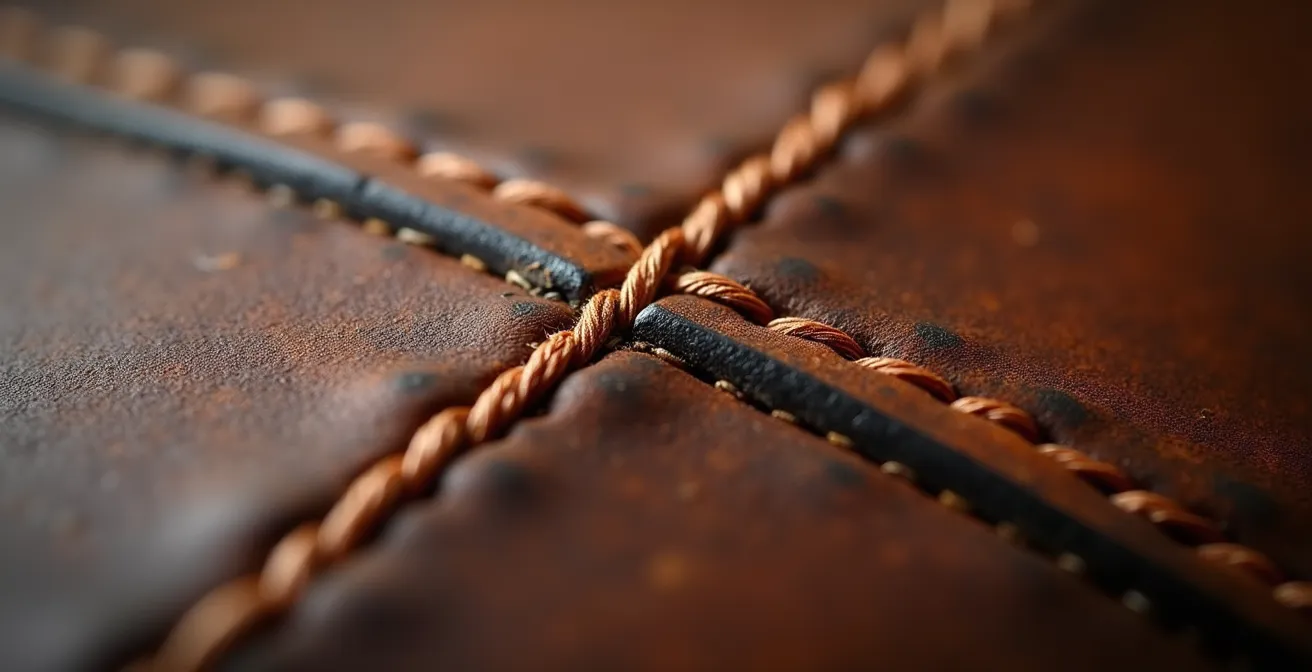
This is the “saddle stitch” philosophy of digital preservation. Your uncompressed TIFF scan is your master file. Your unedited WAV audio interview is your master file. These are the strong, independent stitches holding your archive together. You can create endless compressed JPEGs or MP3s for sharing, editing, and using in projects. But the master archive remains inviolate, a stable foundation from which all else is derived. This approach ensures that no matter how formats change or what future edits are desired, you can always return to the strong, original source.
Password Manager or Notebook: Which Is Actually Safer?
You have meticulously recorded the interviews, scanned the photos, and created a pristine digital archive. The work feels complete. But the most overlooked step in the entire process is the final one: ensuring its long-term survival and accessibility. An archive that cannot be opened is merely a collection of dead data. The question of how to secure your digital legacy—the keys to your cloud storage, the passwords to your accounts—is an urgent and final act of archival planning.
The debate between a digital password manager and a physical notebook is not just about security; it’s about heir accessibility. A high-quality password manager with an emergency access feature offers incredible security. It can generate and store complex, unique passwords for every account, protecting your archive from digital threats. However, its effectiveness in a legacy plan depends on your heirs being tech-savvy enough to navigate the recovery process. A forgotten master password could lock away your family’s history forever.
A physical notebook, stored in a secure location like a home safe and referenced in your will, offers a different kind of security. It is simple and universally understandable. Its risks, however, are physical: fire, flood, loss, or theft. It lacks the convenient, automated protection of a digital system. This is a choice without a perfect answer, and it depends entirely on your family’s specific circumstances and technical comfort level.
As a deep analysis of legacy access methods shows, for the most critical family archives, many experts recommend a hybrid system. This provides the highest level of both security and accessibility, creating redundancy that protects against a single point of failure.
| Method | Security Level | Heir Accessibility | Risk Factors | Best For |
|---|---|---|---|---|
| Password Manager with Emergency Access | Very High | Moderate (requires tech literacy) | Service discontinuation, forgotten master password | Tech-savvy families |
| Physical Notebook in Safe | Moderate | High (with will/estate planning) | Physical loss, damage, theft | Traditional estate planning |
| Hybrid System | Highest | Highest | Requires maintenance of both systems | Critical family archives |
Case Study: The Internet Archive’s “Hedging Your Bets” Strategy
The principle of redundancy is fundamental to digital preservation. As one family historian and podcaster documented in an account of his own oral history project, he doesn’t trust a single service. He uploads his final audio files to three separate locations: the original website (Storycorps.me), the non-profit Internet Archive (which promises free, perpetual storage), and a commercial cloud service (Amazon S3). By “hedging his bets,” he ensures that if one service fails, changes its policy, or goes offline, the precious record of his family’s voice will likely survive elsewhere.
Key Takeaways
- Adopt an Archivist’s Mindset: Treat family history not as a hobby, but as an urgent act of cultural preservation requiring rigor and a long-term view.
- Prioritize Quality Over Convenience: Use uncompressed formats (WAV for audio, TIFF for photos) to create high-quality “digital master files” that will serve future generations.
- Preserve, Then Share: Fulfill your role as an ethical guardian by first securing the authentic, unedited story before considering how to share it publicly.
How to Trace Your Family Tree Beyond Online Databases?
Online genealogy databases are incredible tools, but they represent only a fraction of the available historical record. Once you have gathered the stories and artifacts from your immediate family, the archival mindset pushes you to seek the surrounding context, to place your family’s narrative within the wider community they inhabited. The most powerful clues are often hidden in plain sight, in the records of the people who lived alongside your ancestors.
This is the foundation of the “FAN Club” research method: focusing on Friends, Associates, and Neighbors. Your ancestors did not live in a vacuum. Their lives were interwoven with a network of individuals who appear as witnesses on marriage certificates, godparents on baptismal records, or adjacent landowners on property deeds. These are not random names; they are a map of your ancestor’s social and economic world. Tracing these associated individuals can often break down brick walls where direct searches for an ancestor have failed.
Start by meticulously listing every name mentioned in the oral histories you’ve recorded. Who were their closest friends? Who did they work with? Who lived next door? Then, take those names and search for them in local records like city directories, church membership lists, and local newspapers. Finding a neighbor’s will might reveal that your great-great-grandfather was a witness and was referred to as “my trusted friend,” adding a rich, human layer to your family’s story that no census record ever could. This method transforms your research from a linear search for names into a three-dimensional reconstruction of a community.
Your Research Plan: The FAN Club Method
- Step 1: List all Friends, Associates, and Neighbors mentioned in family stories and documents.
- Step 2: Search for these individuals in local church records and city directories to establish a timeline of their presence.
- Step 3: Check property deeds and plat maps for adjacent landowners to your ancestors.
- Step 4: Review the names of witnesses on all marriage certificates, wills, and other legal documents.
- Step 5: Cross-reference your findings with cemetery records to identify family plot neighbors, which often indicate close relationships.
The time to act is now. Every day that passes, more of this irreplaceable history fades. By embracing these methods—by becoming the careful, dedicated archivist of your own family—you are doing more than saving memories. You are ensuring that the voices of your loved ones will continue to echo, offering wisdom, comfort, and a sense of belonging to the generations that follow.