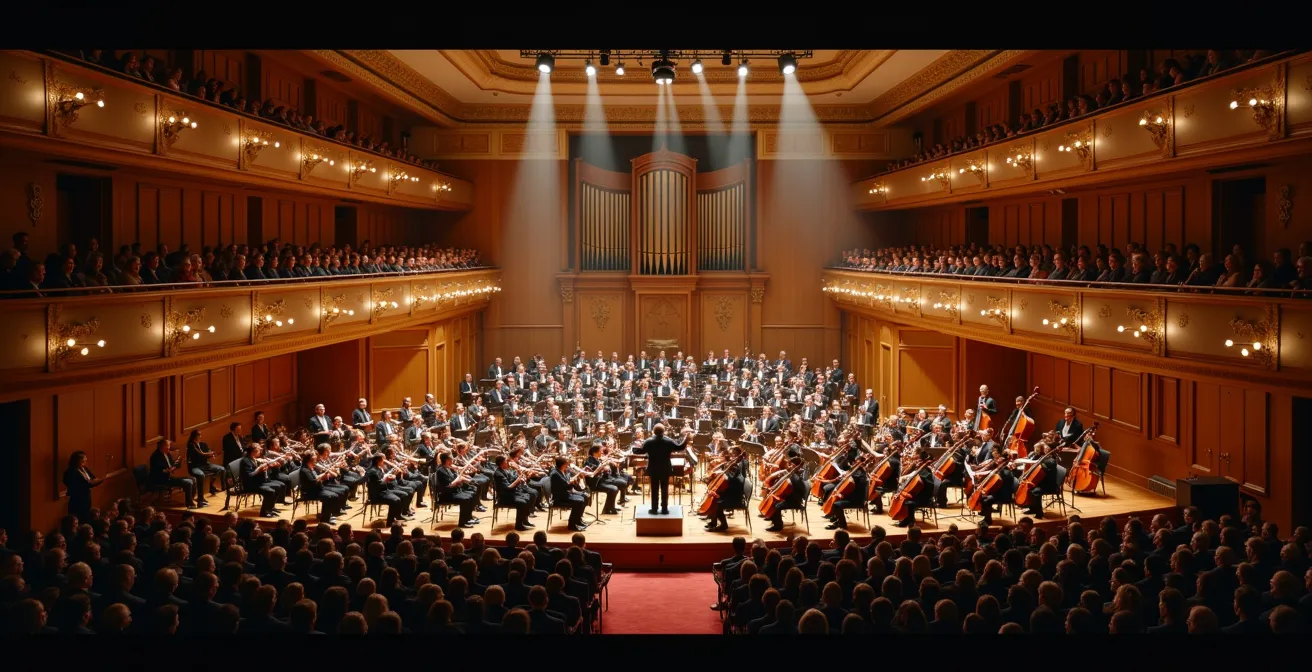
The superiority of live orchestral sound is not a matter of technology that headphones can eventually solve, but a fundamental issue of physics and psychoacoustics.
- Live sound provides physical, haptic feedback and exists within a unique “acoustic terroir” that headphones can only simulate.
- The collective experience relies on “biological latency”—instantaneous human interaction—and a prepared “sensory discipline” that home listening cannot replicate.
Recommendation: Instead of chasing the next technological upgrade, the true path to acoustic perfection for an audiophile is to invest in the live experience and train their ear to perceive these irreplaceable qualities.
For the discerning audiophile, the dilemma is perennial: invest in a new pair of flagship open-back headphones, promising an unparalleled soundstage and flawless frequency response, or purchase a front-row ticket to the symphony? The debate often circles around technical specifications—drivers, DACs, and digital signal processing. We are led to believe that with enough technological prowess, we can perfectly replicate the concert hall in the comfort of our living room. It’s a conversation focused on imitation, a race to create the most convincing illusion.
But this entire framework is flawed. The question is not whether technology can replicate the *sound*, but whether it can reproduce the *phenomenon*. The true difference between a live orchestra and the most sophisticated headphone setup lies beyond the realm of electronic components. It resides in the unalterable laws of physics, the intricate workings of human psychoacoustics, and the social ritual of shared listening. The superiority of the live experience is not found in the signal, but in the space it occupies and the biological network it connects.
This analysis moves beyond the spec sheet to explore the core principles that make live orchestral audio a fundamentally different, and ultimately superior, experience. We will dissect the very fabric of live sound—from the physical force of a brass section to the unique sonic signature, or “acoustic terroir,” of the hall itself. We will explore why the conductor’s real-time adjustments defy digital replication and how the shared, focused silence between movements is an integral part of the performance that headphones simply erase. This is not about choosing the right gear; it’s about understanding what you’re truly listening for.
This guide will deconstruct the layers of the live acoustic experience, providing a technical yet appreciative framework to understand its profound and irreplaceable value. By exploring the physical, psychological, and even social dimensions of sound, you will gain a new perspective on what constitutes true audio fidelity.
Summary: Deconstructing the Live Acoustic Experience
- Clapping Between Movements: The Social Faux Pas Explained
- What Does the Conductor Actually Do During the Performance?
- Symphony or Concerto: Which Style Suits a Beginner Ear?
- The Hearing Risk of sitting Too Close to the Brass Section
- Why the First Violin Gets Paid More Than the Tuba Player?
- Why Low Latency Is Critical for Remote Surgery and Gaming?
- Digital Stream vs Front Row: Is the Presence Worth the Cost?
- How to Taste Wine Like a Sommelier in 5 Steps?
Clapping Between Movements: The Social Faux Pas Explained
The quiet disapproval that follows applause between the movements of a symphony is more than just social etiquette; it’s a defense of a crucial acoustic and psychological component of the performance. This silence is not an absence of sound but a canvas upon which the hall’s character is painted. It is during these moments that the natural reverb—the sonic signature of the space—is allowed to fully decay, preparing the listener’s brain for the next sonic chapter. It’s an act of collective sensory discipline.
This shared experience is a core element that headphone listening, by its very nature, cannot reproduce. A case study of Vienna’s legendary Musikverein reveals how its unique acoustic properties contribute to what musicians describe as a “collective meditative state.” According to observations, the precise timing of silence allows for a shared reset, a moment where the entire audience and the orchestra breathe as one. This shared sensory discipline, where the audience actively participates in the acoustic event through focused listening, is entirely absent when the experience is solitary and isolated by transducers pressed against the ears.
Interrupting this decay with applause shatters the delicate acoustic architecture. It’s akin to turning on the lights in the middle of a film’s most suspenseful scene. The magic is not just in the notes played, but in the structured silence that connects them. Headphone listening replaces this dynamic, shared silence with an artificial, sterile void, severing the listener from the communal and architectural aspects of the music.
Ultimately, the “rule” against clapping is a tacit agreement to preserve the integrity of the acoustic environment and the collective psychological journey it enables.
What Does the Conductor Actually Do During the Performance?
To the uninitiated, the conductor’s frantic gestures can seem like mere pantomime. In reality, they are the central processing unit of a complex biological network, performing real-time audio engineering that no automated system can match. The conductor is not just keeping time; they are shaping the dynamic range, timbre, and spatial balance of over a hundred individual musicians. Their role is to translate a static score into a living, breathing sonic entity.
A key function is managing the orchestra’s immense dynamic range. A conductor can call for a surge in volume from the strings or a sudden hush from the brass with a flick of the wrist. These are not pre-programmed commands; they are live adjustments based on the feel of the room and the energy of the performance. For example, professional audio engineers note that conductor-led dynamic adjustments can create a 7dB reduction in treble peaks from the brass section, preventing harshness without sacrificing power—a subtle but critical act of live mixing.
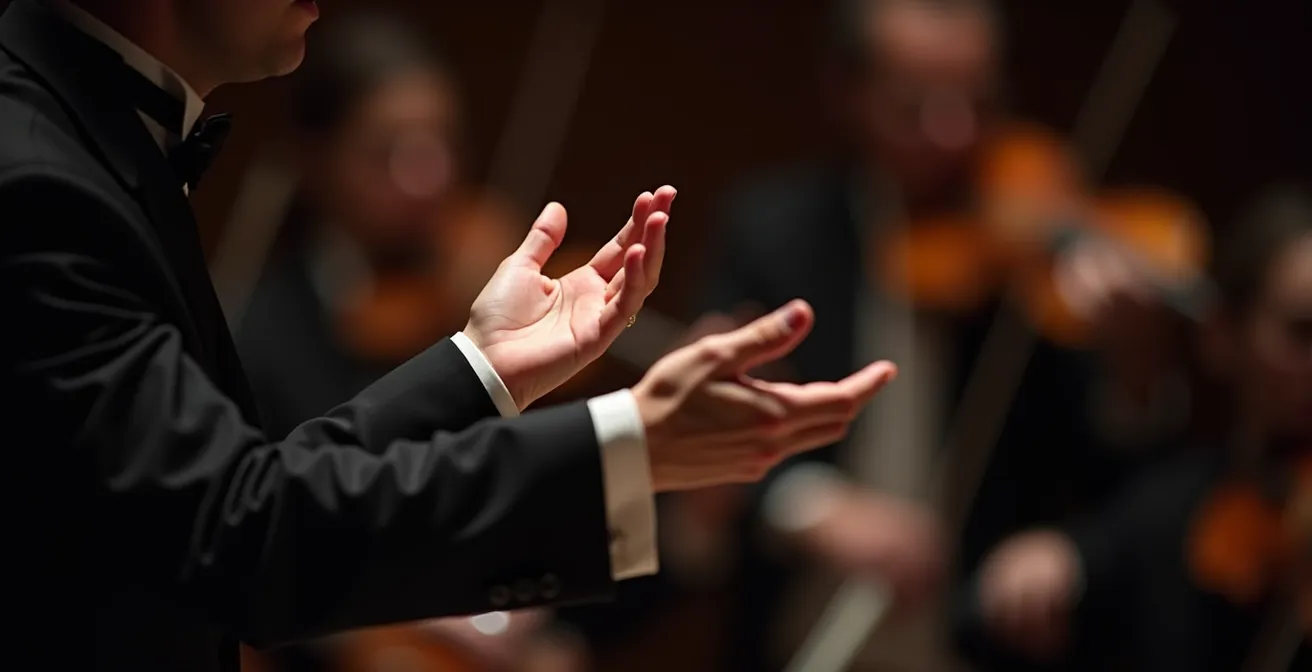
This live manipulation creates a sound field that is fundamentally different from a stereo recording. As the Chief Audio Engineer at Vienna Symphonic Library notes, with a live orchestra, the music appears to originate in front of you, with a tangible sense of depth and placement. This is because the conductor is physically balancing the sound in a three-dimensional space. Headphones, in contrast, deliver a signal directly into the ear canal, creating an “in-head” localization that, even with the best soundstage, remains an artificial construct. The conductor isn’t just leading musicians; they are sculpting the acoustic energy of the room itself.
This human element of interpretation and real-time adjustment is a critical layer of audio information that is lost in any recorded format, regardless of the quality of the playback equipment.
Symphony or Concerto: Which Style Suits a Beginner Ear?
Choosing a first orchestral experience can be daunting, and the choice between a symphony and a concerto often comes down to a listener’s acoustic preference. These two forms are not just compositionally different; they place entirely different demands on the listening environment and the listener’s ear. A symphony is an exercise in immersion and texture, while a concerto is a study in focus and dynamic contrast. For a beginner, understanding these differences is key to an enjoyable introduction.
A symphony aims to use the full orchestra as a single, cohesive instrument, creating a complex tapestry of sound. It requires a listening environment—the concert hall—that provides a sense of envelopment. Here, the hall’s unique sonic signature, its “acoustic terroir,” is paramount. The reflections and reverb blend the instrumental sections into a holistic, immersive wave of sound. A concerto, on the other hand, pits a solo instrument against the orchestra. The acoustic goal is different: the hall must provide enough clarity and separation to allow the soloist’s voice to cut through the orchestral texture while still maintaining a cohesive blend. This requires a space that balances reverberation with precision.
The following table breaks down the key acoustic differences and what they mean for a novice listener.
| Characteristic | Symphony | Concerto |
|---|---|---|
| Listening Focus | Diffuse, holistic appreciation | Single instrument tracking |
| Acoustic Complexity | Full orchestra immersion | Soloist vs orchestra dynamics |
| Spatial Requirements | Wide soundstage essential | Precise imaging crucial |
| Beginner Challenge | Processing multiple layers | Following melodic line |
| Hall Acoustics Role | Creates envelopment | Provides separation |
For a beginner, a concerto can be more accessible as it provides a clear melodic “protagonist” to follow. However, a symphony offers a more profound lesson in the power of the hall itself as an instrument, a foundational concept in appreciating live orchestral sound.
The Hearing Risk of sitting Too Close to the Brass Section
While the immersive power of a live orchestra is its greatest asset, it also carries a physical reality that headphones shield us from: raw, uncompressed acoustic energy. The concern about hearing damage in a concert hall, particularly near the brass or percussion sections, is valid. However, framing this purely as “risk” misses a crucial part of the live experience: the visceral, haptic sensation of sound. It is a thrilling “acoustic danger” that contributes to the excitement of the performance.
Headphone drivers are controlled transducers; they convert an electrical signal into sound waves with predictable, limited force. In contrast, a live trumpet or trombone produces a physical column of air, an uncompressed wave carrying not just sound but kinetic energy. As detailed in a study on the physical impact of live music, sitting near the brass section exposes listeners to this force. This isn’t just about volume (decibels); it’s about the haptic feedback from low-frequency waves that you feel in your chest. This physical sensation of power is a form of acoustic information that no headphone can ever deliver.

This physical dimension also includes a complex web of overtones and harmonics that are generated in the air itself. A headphone reproduces a curated signal, often with digital processing to smooth out peaks. A live instrument creates a raw, sometimes chaotic, but incredibly rich sonic texture. The “danger” of sitting too close is part of a trade-off: in exchange for exposure to high sound pressure levels, you receive the most direct, unfiltered, and physically engaging version of the performance. It’s an experience that is as much felt as it is heard.
While hearing protection is always wise for prolonged exposure, recognizing this physical dimension is crucial to understanding why the live experience feels so much more powerful and immediate than any recording.
Why the First Violin Gets Paid More Than the Tuba Player?
The orchestral hierarchy, often reflected in seating arrangements and even pay scales, is not arbitrary. While every instrument is essential, the first violin section, led by the concertmaster, bears a unique responsibility rooted in the concept of information density. From an acoustic engineering perspective, the strings, and particularly the first violins, are tasked with conveying the most complex and rapidly changing data set in the entire orchestra.
While it is true that the entire orchestra works to cover the full audible spectrum, the first violin section is almost constantly active, carrying the primary melodic lines, intricate counter-melodies, and fast-paced ornamental passages. Their parts often contain far more notes per minute than those of the lower brass or percussion. This requires immense technical precision to ensure every note is articulated clearly within the hall’s acoustic space. Their task is to accurately reproduce the full 20 Hz to 20 kHz frequency range not just as a spectrum, but as a dense stream of melodic and harmonic information.
The concertmaster, as the leader of this section, acts as a secondary conductor, translating the conductor’s grand gestures into precise bowing instructions for the entire string section. This ensures that the phrasing, articulation, and intonation of two dozen players are perfectly unified. This level of coordination is critical because any slight desynchronization in the high-frequency, information-rich violin parts would be immediately noticeable and jarring to the human ear. The tuba, while providing a vital and powerful foundation, typically has a less dense part, focused on harmonic support and rhythmic anchoring. The first violin’s role demands not only virtuosity but also a disproportionate share of the orchestra’s data transmission, justifying their prominent position.
Therefore, the first violin’s prominence is a direct reflection of their function as the primary communicators of the most intricate musical information.
Why Low Latency Is Critical for Remote Surgery and Gaming?
The term “latency” in the audiophile world refers to the delay introduced by digital processing. We celebrate headphones and systems that minimize this delay, chasing the dream of instantaneous signal transmission. While critical in applications like remote surgery or competitive gaming where milliseconds matter, this technological chase overlooks a fundamental truth: the live orchestra operates on a principle of “biological latency,” a near-instantaneous form of communication that digital systems can only approximate.
In a live performance, musicians are not just playing to a metronome; they are reacting to each other in a constant, subconscious feedback loop. A violinist adjusts their intonation based on the oboe’s pitch; the percussionist anticipates the conductor’s downbeat by watching their breath. As described in an analysis of the orchestra as a biological network, this is a zero-delay system where the only “latency” is the natural speed of sound through the air. The emotional intent of a performer is transmitted and received by other musicians and the audience in real-time, creating a shared, evolving experience.
Even the most advanced headphones, like the Focal Utopia mentioned in one study, introduce unavoidable processing delays. The signal must be read, converted from digital to analog (DAC), amplified, and then turned into sound by a transducer. While this delay may be imperceptible to the conscious mind, it creates a subtle but profound disconnect. The listener is no longer part of the real-time creation loop. They are receiving a delayed broadcast of a past event. This fractional-second delay is an unbridgeable gap that separates the listener from the immediate emotional and physical impact of the live performance, placing them outside the “biological network” of the concert hall.
The pursuit of low latency in headphones is a worthy engineering goal, but it is fundamentally an attempt to patch a disconnect that does not exist in a live acoustic setting.
Digital Stream vs Front Row: Is the Presence Worth the Cost?
This is the ultimate question for the audiophile: can a meticulously curated digital stream on a high-end system rival the experience of a front-row seat? From a purely technical standpoint, the cost of attempting to replicate the live experience at home is staggering. As many audiophiles report, approximating the sheer scale and acoustic complexity of a live orchestra hall requires a $50,000+ system required to even begin the conversation. Yet, even with such an investment, crucial elements remain forever out of reach.
The core, irreplaceable element is authentic spatial information. As one member of the Head-Fi audio community eloquently put it, the brain’s processing of real-world sound is a key differentiator.
Hearing sound in the same physical room it was created is irreplaceable. The brain subconsciously processes the authentic reverb and spatial cues, creating a sense of realism that binaural audio can only approximate.
– Head-Fi Forum Member, Head-Fi.org Community Discussion
Beyond the physics of sound, there is the psychoacoustic element of presence. Attending a concert is a ritual. The acts of traveling to the venue, dressing for the occasion, and disconnecting from digital devices all serve to prime the brain for a state of deep, focused listening. This “sensory discipline,” as observed in studies on concert attendance, creates a mental state of heightened awareness and receptivity. This prepared mindset is a stark contrast to casual home streaming, where music often becomes a backdrop to other activities. In a live setting, the act of attending itself becomes an integral part of the acoustic experience.
The cost of the ticket, therefore, is not just for the sound. It is for the irreplaceable combination of physical presence, authentic spatial acoustics, and the psychological readiness to receive the performance in its entirety.
Key Takeaways
- Live sound is a physical phenomenon with haptic feedback that headphones, as signal reproducers, cannot create.
- The concert hall itself acts as an instrument, providing a unique “acoustic terroir” that shapes the sound in a way a recording cannot capture.
- The live experience is a collective, real-time event operating on “biological latency,” a level of human connection that digital processing inherently breaks.
How to Listen to an Orchestra Like a Sommelier: A 5-Step Sonic Palate
The ultimate argument for the superiority of live orchestral sound is that it offers infinitely more information to a trained ear. Just as a sommelier tastes wine, an active listener can learn to deconstruct the complex layers of a live performance. This is not a passive activity; it is a skill. Developing your “sonic palate” transforms you from a mere consumer of sound into an active participant in the acoustic event. It is the final step in moving beyond the gear and focusing on the music itself.
This approach requires a shift in focus from the overall “impression” of the music to the specific qualities of its creation and propagation in a real, physical space. It involves listening for the texture of a bow on a string, the breath entering a flute, and the way sound blossoms and decays within the hall’s unique architecture. It is the practice of active sensory discipline. The goal is to train your ear to perceive the depth, texture, and space that a recording can only hint at.
The following plan provides a framework for developing this skill during a live performance.
Your Action Plan: Develop Your ‘Sonic Palate’ for the Orchestra
- Identify the ‘Attack’: Focus intently on how each note begins. Is it the sharp bite of a bow on a cello string, the soft breath entering a clarinet, or the explosive crack of a snare drum? Compare these real-world textures to their smoothed-over digital representations.
- Appreciate the ‘Body’: Close your eyes and listen for the harmonic richness and texture unique to each instrumental section. Can you distinguish the warm, woody resonance of the violas from the brighter, more focused tone of the violins? This is the core character of the sound.
- Follow the ‘Decay’: As a loud passage ends, do not wait for the next note. Instead, follow the sound of the final chord as it fades into silence. Track how long the sound hangs in the air and how its tonal character changes as it decays. This is the sound of the hall itself.
- Map the ‘Terroir’: Try to identify the unique acoustic signature of the venue. Is the hall bright and lively, with sharp reflections? Or is it warm and reverberant, blending sounds together? Recognize how this “acoustic terroir” colors the orchestra’s sound, making each performance unique to its location.
- Practice ‘Sensory Discipline’: Train your ear to perceive spatial depth and instrumental separation without the help of stereo panning. Can you pinpoint the location of the oboes versus the French horns? Can you sense the distance between the front-row violins and the back-row percussion? This is true, natural soundstaging.
The next logical step, therefore, is not to research the next pair of headphones. It is to book a concert ticket, sit down with intention, and begin the rewarding practice of truly listening.