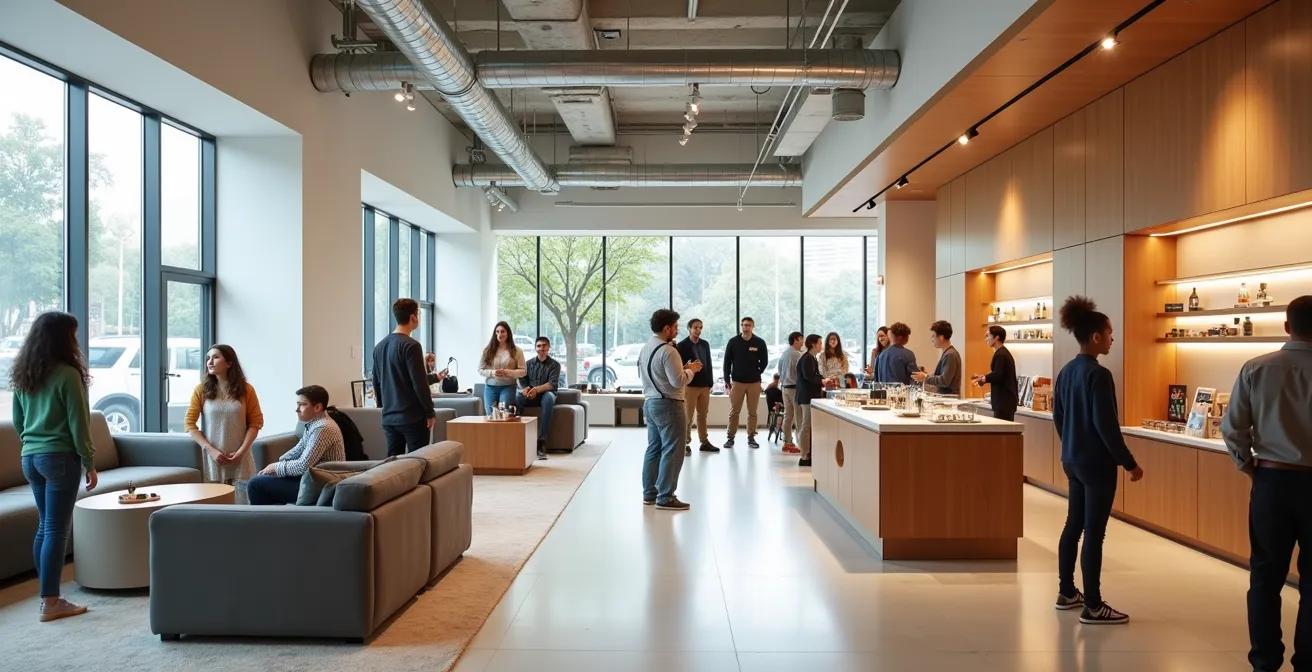
The evolution of stores into ‘experience hubs’ is not merely about adding cafes; it is a strategic recalibration to capture high-fidelity data and anchor a brand’s entire digital ecosystem.
- Physical stores now function as critical last-yard logistics centers, streamlining the supply chain and reducing e-commerce delivery costs.
- They operate as real-world testing labs, allowing customers to interact with products, which in turn improves online sales and significantly reduces return rates.
Recommendation: Retail leaders must view their physical footprint not as a post-pandemic liability, but as their most valuable asset for creating brand gravity and measuring the previously unmeasurable customer journey.
The narrative of the high street’s decline is a familiar one, often painting a picture of shuttered windows and the unstoppable rise of e-commerce. For any retail enthusiast, the contrast is stark: some malls feel like ghost towns, while others buzz with an energy that has little to do with traditional shopping. The common analysis suggests a simple fix: add events, install some engaging technology, or open a coffee shop. These are seen as defensive moves to lure customers away from their screens.
However, this perspective misses the profound strategic recalibration taking place. The most forward-thinking retailers aren’t just decorating their stores; they are fundamentally rewiring their purpose. The shift towards ‘experience hubs’ is less about competing with online shopping and more about creating a symbiotic relationship with it. What if the true value of a physical store is no longer just the transaction it processes, but the high-fidelity data it gathers and the brand gravity it creates?
This deeper transformation is about turning the store into a strategic asset that solves digital retail’s biggest challenges: logistics, returns, and the lack of tangible connection. It becomes a physical anchor in a digital world. This analysis will deconstruct this evolution, moving beyond the surface-level trends to explore the core functions that define the store of the future—from a logistical hub and a product laboratory to a center for radical authenticity.
This article explores the fundamental pillars of this retail recalibration. The following sections break down how physical stores are being repurposed as strategic assets that bridge the physical and digital worlds, creating a more resilient and profitable ecosystem.
Summary: The Strategic Functions of the Modern Retail Hub
- Why Click-and-Collect Is Safer Than Home Delivery?
- How to Use Physical Stores to Test Online Purchases?
- App Integration: Getting Personalized Discounts In-Store?
- The Privacy Risk of In-Store WiFi Tracking
- Future of Malls: Dining and Entertainment vs Shopping?
- Future of Shopping: The End of Standard Sizing?
- Human-Centric or Tech-Centric: Designing Future Neighborhoods
- Why Modern Aesthetics Are Shifting Towards Radical Authenticity?
Why Click-and-Collect Is Safer Than Home Delivery?
While convenience is a key driver, the strategic advantage of Buy Online, Pickup In-Store (BOPIS) models extends far beyond customer preference. For retailers, it represents a crucial move to control the “last yard” of the supply chain—the most complex and expensive part of e-commerce logistics. By routing online orders through their existing physical footprint, companies sidestep the volatility of third-party delivery services, reducing costs and mitigating risks like package theft and delivery errors. This logistical function is a primary reason for the model’s explosive growth, with recent consumer behavior data revealing that 97.2 million Americans now regularly use this service.
The model transforms the store from a simple point of sale into a distributed logistics hub. Major retailers have leveraged this to great effect. An analysis of the market shows how giants like Walmart and The Home Depot use click-and-collect as a core strategic tool. For these players, the model accounted for over half of their e-commerce growth during its initial surge, demonstrating its power in securing the final stage of delivery while building a more resilient and less dependent supply network.
This pivot makes the physical store an indispensable asset in the digital age. It’s not just an alternative to home delivery; it’s a more efficient, secure, and cost-effective solution that integrates seamlessly with online operations. By leveraging their brick-and-mortar locations, retailers gain a powerful competitive advantage that pure-play e-commerce companies cannot easily replicate.
How to Use Physical Stores to Test Online Purchases?
One of the largest hidden costs of e-commerce is the volume of returns, often driven by a mismatch between a customer’s digital expectation and the physical reality of a product. The experiential store directly addresses this by functioning as a high-fidelity “testing laboratory” before a final purchase is made or kept. By encouraging customers to see, touch, and try items, retailers can dramatically increase purchase confidence and reduce costly return rates. This isn’t just a defensive measure; it’s a revenue-generating opportunity. In fact, data on in-store behavior shows that 85% of US BOPIS shoppers have made an additional, unplanned purchase when visiting a store to collect their online order.
This “lab” concept goes beyond simply having products on a shelf. It involves creating dedicated environments and processes designed for testing and data collection. The return counter, once a point of friction, becomes a valuable source of customer insight. Staff can be trained to understand the “why” behind a return—was the fabric not as expected, the color different from the screen, the fit incorrect? This qualitative data is invaluable for informing future product design and online merchandising, creating a powerful feedback loop that digital-only channels lack.
By reframing the physical space as a hub for interaction and experimentation, retailers transform a major cost center into a strategic asset for both sales and product intelligence.
Action Plan: Turning a Store into a Testing Laboratory
- Implement Interactive Displays: Install interactive walls and virtual try-on stations to let customers test products in simulated real-world environments.
- Create ‘Try-On Lounges’: Design dedicated lounges with appointment booking systems, allowing customers to test a pre-selected cart of online items in a comfortable setting.
- Install Tech-Enabled Fitting Rooms: Equip fitting rooms with smart mirrors that can request different sizes, show styling options, or provide product details, turning a simple space into an interactive touchpoint.
- Analyze Return Data Deeply: Go beyond simple return metrics. Track qualitative feedback on fabric feel, color perception, and fit to inform and improve future product design.
- Empower Staff for Insight: Train employees to use return interactions as opportunities to understand customer needs, gather feedback, and guide them toward more suitable products.
App Integration: Getting Personalized Discounts In-Store?
The smartphone app is the digital thread that ties the entire phygital experience together. It’s the remote control for the physical store, transforming a passive browsing session into an interactive, personalized journey. When integrated correctly, an app can deliver location-based offers, provide detailed product information by scanning a barcode, and facilitate seamless checkout. This creates a powerful incentive for customers to identify themselves, turning anonymous foot traffic into known users. Consumer readiness for such enhancements is high, as research from Publicis Sapient reveals that 87% of consumers who have used generative AI are excited about the improvements it will bring to their shopping experience.
This paragraph introduces the concept of the mobile app as a central nervous system for the in-store experience. To understand this integration, it is useful to visualize how a customer interacts with their device within the retail environment.

As this image suggests, the experience is seamless and personal. The true strategic value, however, lies in measurement. The app allows retailers to connect the dots between a customer’s online behavior (browsing history, abandoned carts) and their in-store actions (dwell time in certain aisles, products scanned, final purchase). As Sara Alloy, a retail experience lead, notes, this connection is a game-changer. In her analysis for Publicis Sapient, she explains:
By tracking a user’s journey from online interaction to in-store visit and eventual purchase (online or offline), the app finally makes the impact of the physical experience measurable.
– Sara Alloy, Retail Experience Lead at Publicis Sapient
This ability to quantify the physical journey’s impact on overall sales elevates the store from a cost center to a provably valuable part of the marketing and sales funnel. It provides the hard data needed to justify investment in in-store experiences.
The Privacy Risk of In-Store WiFi Tracking
The same technologies that enable personalization—WiFi tracking, computer vision cameras, and Bluetooth beacons—also introduce significant privacy concerns. As stores become richer data-collection environments, they walk a fine line between creating a helpful, personalized experience and an intrusive, surveillance-like atmosphere. Customers are increasingly aware of how their data is being used, and a failure to be transparent can quickly erode trust. The deployment of technologies like heat mapping sensors for traffic analysis or RFID for interaction tracking must be handled with a clear ethical framework.
Simply hiding these tracking mechanisms is a losing strategy. The backlash from perceived spying far outweighs any short-term data-gathering benefits. The most forward-thinking approach is one of radical transparency, where the retailer proactively communicates what data is collected, why it is being collected, and what tangible value the customer receives in exchange. This value exchange is critical for gaining customer buy-in. According to retail design expert Kevin Ervin Kelley:
The winning strategy is not hiding tracking, but being proactively transparent about what data is collected, why it’s collected, and offering customers tangible value in exchange.
– Kevin Ervin Kelley, Principal and Co-Founder at Shook Kelley
This value could be in the form of hyper-personalized discounts, faster checkout, or a better-organized store layout based on real traffic patterns. By framing data collection as a tool for mutual benefit rather than a one-sided corporate activity, retailers can build a relationship based on trust. Offering customers clear opt-outs and “privacy zones” with limited tracking can further demonstrate a commitment to respecting their autonomy.
Future of Malls: Dining and Entertainment vs Shopping?
The traditional mall, a cathedral of consumption built around anchor department stores, is undergoing a fundamental identity crisis. Its future lies not in being a bigger place to shop, but in becoming a multi-purpose “community hub.” This model de-emphasizes transactional retail in favor of a diverse mix of uses, including dining, entertainment, wellness services, co-working spaces, and cultural events. The goal is to generate foot traffic through experiences, with retail becoming a secondary, albeit important, component. This shift is already well underway, as the latest Salesforce’s Connected Shoppers report shows that 59% of retailers now offer in-store services like customization and repairs, while 46% provide dedicated spaces for events.
This reimagined space functions as a town square, providing a physical anchor for community life. It becomes a place where people go to spend time, not just money. This vision of a dynamic, mixed-use environment is perfectly captured by the following photograph, which showcases a space designed for social interaction and activity rather than passive shopping.
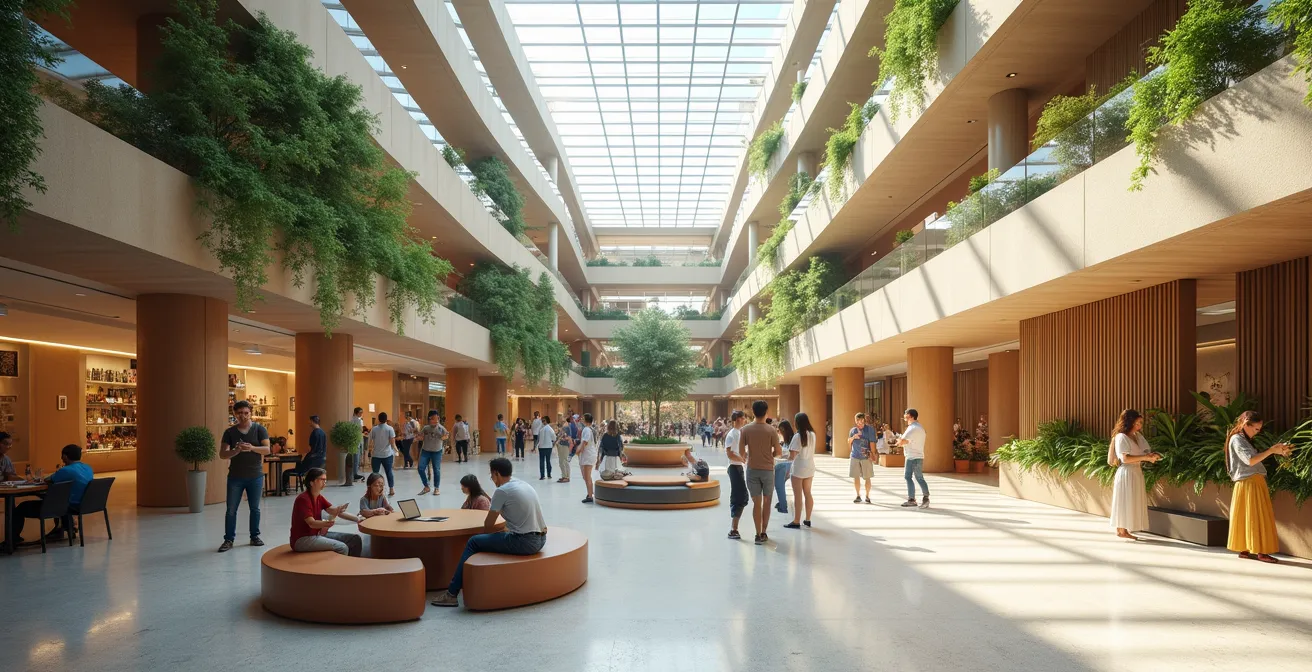
This architectural and strategic shift is about creating a destination that offers something a website cannot: a shared physical experience. It becomes a stage for pop-up shops from online brands, art installations, and local farmer’s markets. By focusing on experience-driven traffic, the mall provides a vibrant ecosystem where retail can thrive in a new context. It’s no longer about dedicating every square foot to selling goods, but about curating a compelling environment that makes people want to visit and stay.
Future of Shopping: The End of Standard Sizing?
For decades, the apparel industry has been built on the inefficiency of standardized sizing, a system that fits few people perfectly and generates massive volumes of returns. The convergence of in-store technology and data analytics is poised to dismantle this outdated model. The future is hyper-personalization, where clothing is made to a customer’s specific measurements, captured and refined through in-store interactions. This shift is being fueled by heavy investment, as industry analysis shows that retail is the third-largest industry investing in AI in 2024, allocating billions to technologies that enable this level of customization.
The physical store is the critical data-collection point for this revolution. Each time a customer tries on an item, it creates a valuable data point about fit and preference. Advanced retailers are already harnessing this information, turning the fitting room into a data lab. A prime example is Levi’s, which has armed its stylists with technology to create a comprehensive view of each customer.
Case Study: Levi’s Personalized Fitting Technology
Levi’s provides its stylists with ‘back pocket’ devices that grant them a 360° view of customers, including past orders and fit preferences. This technology enables staff to offer hyper-personalized service while collecting valuable fit profile data that could eventually eliminate the need for standard sizing. The system transforms each fitting interaction into a data point that helps predict future inventory needs and enables custom manufacturing on a mass scale.
This approach does more than just improve customer satisfaction. It fundamentally changes the business model from mass production to on-demand manufacturing. By producing only what is needed for a specific individual, retailers can drastically reduce waste, eliminate dead stock, and create a more sustainable and profitable supply chain. The end of standard sizing is not just a consumer benefit; it’s a strategic imperative for the future of apparel retail.
Human-Centric or Tech-Centric: Designing Future Neighborhoods
As retail spaces evolve, a central debate has emerged: should their design be driven by technological efficiency or by human connection? The tech-centric approach prioritizes automation, self-service kiosks, and frictionless transactions, optimizing for speed and low overhead. The human-centric approach, conversely, focuses on creating warm, inviting spaces that encourage community, personal interaction, and serendipitous discovery. While they seem to be in opposition, the most effective model for future retail neighborhoods is a hybrid that uses technology as an invisible scaffold to enhance, not replace, human connection.
This hybrid model, sometimes called “15-Minute Retail,” envisions a local ecosystem where technology handles transactional tasks, freeing up staff to act as brand ambassadors and expert consultants. The store becomes a community anchor, a place for both quick, efficient errands and longer, experience-driven visits. The following table breaks down these different approaches, highlighting the synthesis offered by the hybrid model.
| Aspect | Human-Centric Approach | Tech-Centric Approach | Hybrid ’15-Minute Retail’ Model |
|---|---|---|---|
| Primary Focus | Personal connections and community | Efficiency and automation | Tech as invisible scaffolding for human connection |
| Staff Role | Brand ambassadors sharing personal stories | Process facilitators | Empowered experts freed from transactional tasks |
| Store Design | Warm, tactile materials; gathering spaces | Clean, efficient layouts; self-service kiosks | Mixed-use spaces serving as community anchors |
| Customer Journey | Serendipitous discovery through browsing | Algorithm-driven recommendations | Phygital serendipity combining both approaches |
| Time Allocation | Extended dwell time for experiences | Quick, frictionless transactions | Flexible based on customer needs within 15-minute radius |
Ultimately, technology is a means, not an end. The goal of a well-designed retail space is to create a positive emotional experience that a purely digital interaction cannot replicate. As Kevin Ervin Kelley of Shook Kelley aptly stated at NRF 2024, there is a fundamental human element that e-commerce cannot capture.
Online shopping may have the monopoly on price, but it doesn’t have the monopoly on joy.
– Kevin Ervin Kelley, Principal and Co-Founder at Shook Kelley, NRF 2024
This “joy” is the ultimate objective. Technology should be deployed in service of creating it, by removing friction and empowering deeper, more meaningful human interactions.
Key Takeaways
- The modern store’s primary role is shifting from transaction processing to becoming a strategic asset for logistics, data collection, and brand building.
- Successful experiential retail uses technology not as the main attraction, but as an invisible layer to enhance personalization and measure the physical customer journey.
- Authenticity and human connection are the ultimate differentiators; physical spaces must offer a sensory, emotional anchor that digital channels cannot replicate.
Why Modern Aesthetics Are Shifting Towards Radical Authenticity?
In a world saturated with polished digital interfaces and algorithm-driven perfection, consumers are developing a hunger for the real, the imperfect, and the authentic. This is driving a significant aesthetic shift in retail design, away from sterile, minimalist spaces and towards environments that celebrate craftsmanship, transparency, and sensory engagement. This trend is particularly pronounced among younger consumers; generational shopping preferences reveal that Gen Z is three times more likely than baby boomers to value exclusive, authentic experiences over simple transactions. They don’t just want to buy a product; they want to connect with the story and the people behind it.
“Radical authenticity” is the design manifestation of this desire. It involves using raw, tactile materials, exposing a building’s structural elements, and even showcasing the production process itself. It is a direct counterpoint to the seamless, often impersonal, nature of online shopping. A brand that perfectly exemplifies this is Gibson, whose flagship store serves as a temple to the craft of guitar making.
Case Study: Gibson Garage Nashville’s Sensorial Experience
Gibson’s 8,000-square-foot flagship store in Nashville is a masterclass in radical authenticity. The space combines the raw energy of a live music venue with the open spontaneity of a bazaar. Visitors can freely test hundreds of guitars, watch live performances on an in-store stage, and even visit a custom shop to see luthiers at work. The environment’s use of exposed brick, raw wood, and visible craftsmanship areas creates a powerful sensory anchor that celebrates imperfection and human skill, a feeling a website can never convey.
This shift is the emotional core of the experiential hub. All the logistical efficiencies and data-gathering technologies are ultimately in service of creating a space where a brand can express its identity in a tangible, memorable, and authentic way. It’s about building a “brand gravity center” that grounds the brand’s digital presence in a real, physical place that people want to visit. This is the ultimate, non-replicable advantage of the physical store.
Frequently Asked Questions on The Future of Retail Stores
What types of tracking technologies are used in modern retail stores beyond WiFi?
Beyond WiFi, modern stores employ a range of technologies for analytics and personalization. These include computer vision cameras for sentiment and demographic analysis, BLE (Bluetooth Low Energy) beacons for proximity marketing to customers’ phones, RFID tags on products for real-time inventory and customer interaction tracking, and heat mapping sensors to analyze customer traffic flow and optimize store layouts.
How can customers protect their privacy while shopping in tech-enabled stores?
Customers can take several steps to manage their privacy. The most direct methods include turning off their smartphone’s WiFi and Bluetooth when not actively using them for a store service. Additionally, they can review and opt out of loyalty programs that require extensive personal data sharing, use privacy-focused mobile browsers or VPNs, and look for retailers who are transparent about their data policies and offer clear “privacy zones” with limited or no tracking.
What value do retailers provide in exchange for customer data collection?
In exchange for data, retailers aim to provide tangible benefits that improve the shopping experience. This value exchange includes offering personalized product recommendations and exclusive discounts based on past behavior, enabling faster, frictionless checkout processes, creating improved store layouts and product placements based on collective traffic patterns, and reducing wait times through predictive staffing models that anticipate peak hours.