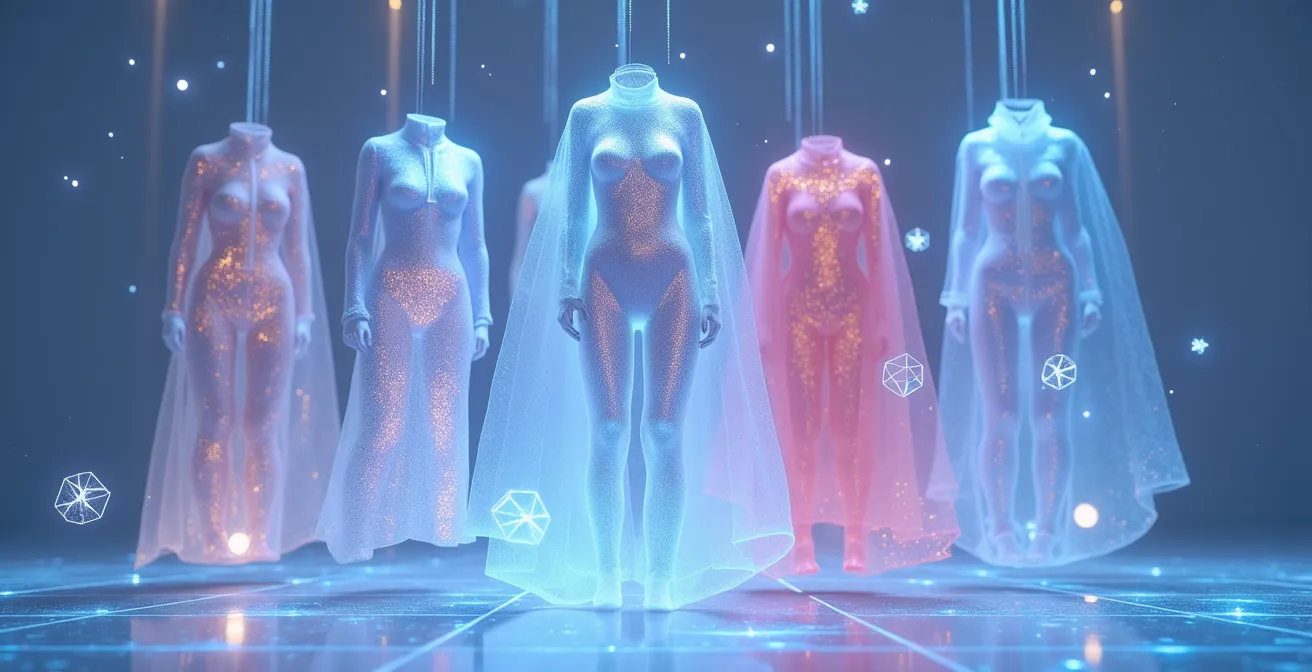
Virtual clothing’s value stems not from its code, but from its ability to function as a tool for digital identity, governed by the same principles of scarcity and status as physical luxury goods.
- Verifiable scarcity, enabled by blockchain technology, transforms infinitely replicable pixels into unique, ownable assets.
- In an avatar-first world, digital fashion is the primary vehicle for self-expression, social signaling, and community belonging.
Recommendation: View digital fashion not as a fleeting trend, but as the foundational layer of the emerging creator economy and our future digital lives.
It sounds like a paradox from a science fiction novel: paying hundreds, sometimes thousands, of real dollars for a piece of clothing you can never physically touch. For many, the idea of a digital-only wardrobe is baffling. Common explanations point to trends like video game skins or the complex, often misunderstood world of NFTs. These explanations are true, but they only skim the surface of a much deeper cultural and technological shift.
The conversation often gets stuck on the technology—blockchain, minting, gas fees—while missing the fundamental human driver. We are rapidly becoming a society where our digital presence is as significant as our physical one. This creates a new, urgent need for what can be called digital identity scaffolding—the virtual items, from profile pictures to avatar outfits, that we use to construct and signal who we are online. The value isn’t in the pixels themselves, but in their power to build this new dimension of self.
But what if the true key to understanding this new economy lies not in its futuristic technology, but in timeless principles of value? The revolution isn’t just that we can own a JPEG; it’s that we are applying age-old concepts of scarcity, provenance, and status to a realm that was once defined by infinite replication. This isn’t about buying files; it’s about claiming a unique space in the digital universe.
This article will deconstruct the virtual fashion economy, moving beyond the hype. We will explore the economic principles that give pixels a price tag, the practical ways this technology is being used to craft identity, the profound sustainability advantages, and the risks involved. Ultimately, we will see how this new market is not just a niche for gamers, but a blueprint for the future of branding, creativity, and ownership itself.
To navigate this emerging landscape, this article breaks down the core components shaping the digital fashion revolution. The following sections will guide you through the principles of value, practical applications, and future challenges of this new frontier.
Summary: Why Virtual Clothes Are Selling for Real Money?
- Why Digital Scarcity Creates Value for Virtual Items?
- How to Use Virtual Try-On Tech for Instagram Content?
- Digital Fashion vs Physical Samples: The Sustainability Win
- The Investment Risk of Volatile Digital Fashion Assets
- When Will Your Digital Wardrobe Work Across All Games?
- Trust Signals: Getting Your First 10 Reviews?
- Why a Canvas with a Red Dot Costs More Than Your Car?
- Launching a Niche E-commerce Brand with Minimal Capital
Why Digital Scarcity Creates Value for Virtual Items?
At its core, the digital world is a world of infinite abundance. Any file, image, or piece of code can be copied endlessly with zero loss of quality. This principle of zero-cost replication is what made the internet so powerful, but it also made true digital ownership impossible. Why pay for something you can right-click and save for free? The answer lies in a paradigm shift from replication to verifiable singularity. Blockchain technology, particularly through Non-Fungible Tokens (NFTs), introduced a mechanism for creating provable, unbreakable scarcity in the digital realm.
An NFT acts as a digital certificate of authenticity and ownership recorded on a public ledger. When a digital garment is “minted” as an NFT, it is assigned a unique token that cannot be duplicated or forged. This transforms it from an easily copied file into a one-of-a-kind (or limited edition) asset. Suddenly, owning the *original* digital piece is different from owning a copy, just as owning a Picasso painting is different from owning a poster of it. This verifiable scarcity is the foundational economic pillar upon which the entire digital fashion market is built, with some projecting the fashion NFT market to reach USD 20.87 billion by 2033.
However, scarcity alone isn’t enough. Value is a composite of scarcity, utility, and cultural significance. As one industry analysis notes, the equation is more complex. As stated in a report by Spotlight Shimaseiki, a leader in fashion technology, “The value isn’t in the ‘material’ (pixels) but in the artist’s reputation, the story behind the piece, and its cultural significance.” This is where provenance as pedigree comes into play. The blockchain provides an immutable history of an item’s creation and ownership, adding a layer of story and legitimacy that increases its desirability and, consequently, its price.
How to Use Virtual Try-On Tech for Instagram Content?
The most immediate and accessible application of digital fashion is in augmenting our digital identities on social media. For the avatar-first generation, a curated Instagram feed is as much a space for self-expression as a physical wardrobe. Virtual Try-On (VTO) technology, powered by Augmented Reality (AR), bridges the gap between abstract digital assets and personal expression, allowing users to “wear” digital clothes in their photos and videos.
The process is becoming increasingly streamlined. Platforms like DressX, The Fabricant, and dozens of independent creators on Instagram and Snapchat offer AR filters that overlay digital garments onto a user’s real-world image. This allows for the creation of surreal, futuristic, or simply impossible content without the need for a physical garment. A user can appear to be wearing a dress made of liquid chrome or a jacket wreathed in digital flames, creating a powerful visual statement that is designed to be seen, shared, and experienced purely in the digital sphere. This is the new frontier of the “fit pic.”

This form of digital identity scaffolding is not about utility in the traditional sense; it’s about communication. It allows individuals to experiment with aesthetics that are too expensive, impractical, or physically impossible in the real world. For content creators, it provides an endless stream of novel looks to engage their audience. For the average user, it’s a way to participate in high-fashion trends and artistic movements instantly and affordably. It detaches fashion from the body and reattaches it to the persona, making it a tool for storytelling above all else.
Digital Fashion vs Physical Samples: The Sustainability Win
Beyond identity and economics, one of the most compelling arguments for digital fashion is its potential to solve the physical fashion industry’s colossal sustainability problem. The traditional fashion lifecycle—from design and sampling to production, shipping, and eventual disposal—is notoriously wasteful and resource-intensive. The industry is responsible for a significant portion of global carbon emissions and water pollution. Digital fashion offers a radically different, near-zero-waste alternative.
Consider the design and sampling phase alone. Brands often create dozens of physical prototypes for a single garment, many of which are discarded after a single viewing. In a digital-first workflow, designers can create, iterate, and refine garments in 3D software, producing photorealistic renders for approval without a single scrap of fabric being cut. This not only saves immense resources but also dramatically shortens the time to market. Once a design is finalized, it can be sold as a digital-only item or produced on-demand, eliminating the need for speculative mass production and the resulting deadstock.
The environmental impact comparison is stark. Creating a digital garment consumes only the electricity required to power the designer’s computer, a fraction of the resources needed for its physical counterpart. This efficiency offers a powerful solution for an industry under increasing pressure to reform its practices.
The following table, based on consolidated industry data, highlights the profound environmental differences between the two models, demonstrating the transformative potential of a digital-first approach.
| Factor | Physical Fashion | Digital Fashion |
|---|---|---|
| Material Waste | 20% of textiles end up as waste | Zero material waste |
| Water Usage | 2,700 liters per t-shirt | None required |
| Carbon Footprint | 10% of global emissions | Energy for rendering only |
| Sample Production | Multiple physical prototypes | Unlimited digital iterations |
The Investment Risk of Volatile Digital Fashion Assets
While the creative and cultural potential of digital fashion is immense, it’s crucial to approach the market with a grounded perspective on its financial realities. The space is inextricably linked to the broader cryptocurrency and NFT markets, which are characterized by extreme volatility. The value of a digital asset can skyrocket overnight and plummet just as quickly, making it a high-risk environment for the uninitiated. This is not a traditional investment; it is speculation on an emerging technological and cultural frontier.
The hype cycle is a powerful force. High-profile sales, like Dolce & Gabbana’s $5.7 million “Collezione Genesi” auction, can create a gold-rush mentality, drawing in investors hoping for quick returns. Major brands are also seeing massive revenue; as one NASSCOM report highlights, Nike has profited more than $185 million on NFT sales, proving the market’s lucrative potential. However, for every success story, there are countless projects that fail to gain traction, leaving their collectors with effectively worthless assets. The value of most digital fashion pieces is currently tied to speculative demand rather than established utility.

Furthermore, the market is rife with challenges such as low liquidity (it can be hard to find a buyer for a niche item), the risk of scams, and the nascent state of the underlying technology. An investor must not only evaluate the artistic merit of a piece but also the long-term vision of the creator, the strength of its community, and the technological roadmap. Treating digital fashion as a pure financial instrument without appreciating its cultural context is a recipe for disappointment. The real “return on investment” for many early adopters is not monetary, but the cultural capital gained by participating in a new movement.
When Will Your Digital Wardrobe Work Across All Games?
The ultimate vision for many in the metaverse space is a truly interoperable digital identity—the ability to buy a virtual jacket in one game and wear it in another, or to showcase your entire digital wardrobe on any social platform. This is the holy grail of the open metaverse, where your assets are not trapped in the “walled gardens” of individual platforms. However, the current reality is far from this ideal. We are in the pre-iPhone era of the metaverse, a fragmented landscape of disconnected worlds.
The technical barriers are significant. Different platforms like Roblox, Fortnite, and Decentraland use proprietary 3D file formats, unique avatar “skeletons” (the underlying framework that allows an avatar to move), and vastly different artistic styles. A hyper-realistic digital Gucci bag designed for a photorealistic environment would look out of place and technically break in the blocky world of Roblox. Each platform is a distinct universe with its own physics of pixels, and making an asset work across them requires significant conversion work, if it’s possible at all.
Beyond the technical hurdles are the business incentives. Platforms have a strong financial interest in keeping users and their assets within their ecosystem to control the economy. Despite this, some brands are pioneering cross-platform initiatives. The Adidas “Into The Metaverse” project is a notable case study. By partnering with influential NFT collections like the Bored Ape Yacht Club, Adidas created a collection of virtual gear that holders could use across several affiliated platforms, demonstrating a viable, albeit limited, path toward interoperability.
Case Study: Adidas’s Virtual Gear Cross-Platform Initiative
Adidas launched its first NFT collection ‘Into The Metaverse’ in December 2021 with Bored Ape Yacht Club. Holders of specific NFTs (Bored Ape, Mutant Ape, etc.) were able to equip their avatars with exclusive digital gear. Furthermore, by acquiring digital land in platforms like The Sandbox, Adidas began building experiences where these assets could be used, creating a small, interconnected ecosystem and providing a glimpse into a more interoperable future.
Trust Signals: Getting Your First 10 Reviews?
In the decentralized and often anonymous world of digital fashion, trust is the most valuable currency. For a new creator or brand, breaking through the noise is not just about having a great design; it’s about convincing a skeptical audience that your project has legitimacy and longevity. In this space, traditional e-commerce metrics like “reviews” take on a new form. As one analyst aptly puts it, “In virtual fashion, ‘reviews’ aren’t star ratings; they are signals of legitimacy. The ‘first 10 reviews’ are the ‘first 10 collectors’ that validate a new creator.”
Getting those first believers is paramount. This requires a deliberate strategy focused on radical transparency and community building. A creator’s reputation is built not on a storefront, but on platforms like Discord and Twitter. Consistent engagement, sharing behind-the-scenes content of the creation process, and publishing a clear, public roadmap with achievable milestones are essential first steps. This builds a narrative and shows commitment beyond a quick cash grab.
Furthermore, trust can be bootstrapped through association. Collaborating with more established artists in the space lends credibility by proxy. Similarly, using the public nature of the blockchain is a powerful tool. By directing potential collectors to a block explorer like Etherscan, a creator can provide undeniable proof of an item’s provenance as pedigree, showing its origin and the smart contract’s integrity. These actions collectively serve as the foundational trust signals that encourage the first collectors to take a chance, transforming a new project from an unknown risk into a validated player.
Action Plan: Building Trust as a New Digital Fashion Creator
- Establish Presence: Create and maintain active, engaging communities on platforms like Discord and Twitter to foster direct communication.
- Publish a Roadmap: Develop and share a transparent project roadmap detailing clear milestones, future collections, and utility plans.
- Collaborate Strategically: Partner with established digital artists or brands to leverage their credibility and reach a wider, more trusting audience.
- Showcase Provenance: Guide potential buyers to use blockchain explorers (e.g., Etherscan) to verify the authenticity and ownership history of your items.
- Document Your Process: Share behind-the-scenes content, work-in-progress shots, and tutorials to demystify your creative process and build a human connection.
Why a Canvas with a Red Dot Costs More Than Your Car?
To truly understand why a digital file of a sneaker can sell for $25,000, it helps to look away from technology and toward the world of fine art. Why does a canvas with a single red dot by a famous artist command millions, while a technically identical canvas from an unknown artist is worthless? The answer is a mixture of provenance, brand, and social consensus. The value is not in the physical materials, but in the story, the artist’s legacy, and the collective agreement among a group of people that the object is significant.
Digital fashion operates on the exact same principles. A digital garment from a globally recognized luxury brand like Gucci carries with it a century of brand-building, design history, and perceived status. When Gucci sells a virtual item, the buyer is acquiring not just pixels, but a piece of that legacy—a status symbol for their digital identity. This dynamic is a key factor in a market that experts predict is rapidly expanding; for instance, the digital fashion and NFTs segment is projected to reach $38.2 billion by 2030.

The infamous sale of Gucci’s first NFT, a virtual sneaker, serves as a perfect case study. It demonstrated that the principles of luxury—exclusivity, brand power, and desirability—translate perfectly into the metaverse. People are willing to pay a premium for digital assets for the same reasons they pay for physical luxury goods: to signal taste, to belong to an exclusive club, and to own something beautiful and rare. The digital medium doesn’t diminish this desire; it simply provides a new, and arguably more visible, arena in which to express it.
Case Study: Gucci’s $25,000 Virtual Sneaker
In a landmark sale, Gucci’s early foray into NFTs included a virtual sneaker that sold for a price point rivaling many of its physical haute couture items. According to an analysis by ND Labs, Gucci’s early NFT sneaker sale for $25,000 set the stage for broader adoption of digital luxury. The sale was a watershed moment, proving that the perceived value of luxury brands could be successfully transposed into a purely digital format, commanding premium prices based on brand prestige and artificial scarcity alone.
Key Takeaways
- Value Decoded: The price of virtual clothes is determined by a combination of verifiable scarcity (via NFTs), brand provenance, and their function as tools for building digital identity.
- A Sustainable Shift: Digital fashion offers a near-zero-waste alternative to the traditional industry’s resource-intensive design and sampling processes.
- The Next Frontier is Interoperability: The greatest challenge and opportunity for the metaverse is creating standards that allow users to carry their digital wardrobe across different games and platforms.
Launching a Niche E-commerce Brand with Minimal Capital
Perhaps the most revolutionary aspect of the digital fashion movement is its power to democratize the entire industry. Launching a traditional fashion brand is a capital-intensive endeavor, requiring massive upfront investment in design, materials, manufacturing, inventory, and distribution. This creates a high barrier to entry that stifles independent creativity. The digital-first model shatters these barriers, enabling a new generation of creators to launch global brands from their laptops with minimal capital.
With a zero-inventory model, the financial risk plummets. A designer no longer needs to guess which sizes or colors will sell and invest thousands in stock that might never move. They can create a single digital master of a garment and sell it an infinite number of times as a virtual try-on item, or produce physical versions on-demand only after a sale has been made. The upfront cost shifts from manufacturing and logistics to software skills and community-building.
This new model fundamentally changes the economics of starting a fashion business. The initial investment can be orders of magnitude lower, and the time from concept to market can be reduced from months to weeks. This agility allows creators to be more experimental, respond to trends in real-time, and build niche communities around unique aesthetics without the pressure of a traditional business’s overheads. The RTFKT studio, which was acquired by Nike, is the poster child for this approach, building a multi-million dollar valuation on the back of digital sneakers and virtual collectibles before ever producing a large volume of physical goods.
The contrast with the traditional model is stark, as illustrated by a comparative analysis of startup costs. This data, based on a report from Global Growth Insights, shows how a digital-first approach drastically lowers the financial barriers to entry.
| Aspect | Traditional Fashion | Digital Fashion |
|---|---|---|
| Initial Investment | $50,000-$500,000 | $500-$5,000 |
| Inventory Costs | 30-50% of capital | Zero (digital only) |
| Manufacturing | MOQ requirements | Unlimited copies at no cost |
| Storage | Warehouse needed | Cloud storage only |
| Time to Market | 6-12 months | 2-4 weeks |
Frequently Asked Questions About Why Virtual Clothes Are Selling for Real Money?
Why can’t I use my Roblox outfit in Fortnite?
Currently, different platforms operate as “walled gardens” with incompatible technology. They use different 3D file formats, avatar skeletons, and art styles. Each platform also has a business incentive to keep users and their purchased assets within its own ecosystem to control monetization and user experience.
What technical barriers prevent cross-platform fashion?
The main barriers include varying 3D file formats (e.g., .FBX vs. .glTF), different avatar rigging systems that dictate how clothing moves, disparate rendering engines that affect how materials look, and intentional platform restrictions designed to maintain closed economies.
When will true interoperability happen?
While progress is being made, most industry experts predict that widespread, seamless interoperability is still 5 to 10 years away. Its arrival depends on the broad adoption of open standards, such as those being developed by organizations like the Metaverse Standards Forum, and a shift in business strategy from platforms toward embracing an open ecosystem.