
For a major home renovation, the choice is not between wired and wireless technology; it is between installing permanent, architectural infrastructure and relying on disposable consumer gadgets.
- Wired systems like KNX offer unparalleled reliability and longevity, functioning as a core utility like plumbing or electrical.
- While initial costs are higher, the 10-year Total Cost of Ownership (TCO) for a wired system is often comparable or lower than wireless due to eliminating replacement cycles and subscription fees.
Recommendation: Prioritize a professionally designed, wired digital foundation to ensure your smart home remains a valuable, functional asset for decades, not a source of recurring frustration and expense.
A major renovation presents a rare and valuable opportunity. With walls open and infrastructure exposed, you have the chance to lay a foundation that will serve your home for decades. When it comes to smart technology, the common discourse often revolves around the convenience of wireless devices and the plethora of consumer-grade gadgets available. This approach, however, fundamentally misunderstands the nature of a truly smart, high-performance home. It frames the decision as a choice between competing products.
The correct perspective for a significant renovation is one of architectural planning. You are not simply choosing devices; you are designing a core utility. The critical question is not “wired or wireless?” but rather, “am I building a permanent digital foundation or just decorating with temporary electronics?” A professionally installed wired system is not merely a collection of features; it is integrated infrastructure, as essential and enduring as your home’s electrical and plumbing systems. It is engineered for performance, reliability, and longevity.
This article will deconstruct the debate by shifting the focus from short-term convenience to long-term value and architectural integrity. We will explore why a wired backbone is the superior choice for any serious renovation project, analyzing its reliability, long-term costs, and ability to create a truly seamless and future-proofed living environment. We will demonstrate that investing in infrastructure today is the only way to avoid the cycle of technological obsolescence and create a home that is genuinely, and reliably, smart.
To navigate this critical decision, this guide breaks down the essential architectural and technical considerations for implementing a professional-grade home control system. Explore the sections below to understand the long-term implications of your choice.
Summary: Wired vs Wireless Smart Home Systems for Renovations
- Why KNX Systems Are More Reliable Than WiFi Devices?
- How to Budget for a Smart Home Wiring Plan?
- Tablet or Switch: Designing Controls for Guests?
- The Obsolescence Risk of Proprietary Smart Home Hubs
- Server Closet Essentials: Cooling and Power Backup
- Why Matter Is the Protocol That Will Save Smart Homes?
- How to Calibrate Your Smart Thermostat for Real Savings?
- Connecting Disjointed Smart Devices Into One Ecosystem
Why KNX Systems Are More Reliable Than WiFi Devices?
The fundamental difference between a professional-grade system and consumer devices lies in the communication medium. Wireless smart devices, typically reliant on WiFi, compete for bandwidth on a network already crowded with laptops, streaming services, and mobile phones. This contention leads to latency, dropped commands, and unpredictable performance. When you press a button, you expect the lights to turn on instantly, every single time. WiFi, by its very nature as a shared, unlicensed spectrum, cannot guarantee this level of deterministic performance. It is a network of convenience, not of mission-critical reliability.
In contrast, a system like KNX operates on a dedicated, low-voltage bus cable. This is a private, high-speed highway built exclusively for your home’s core functions. It is not affected by your neighbor’s new router or the number of devices streaming video. This architectural separation is why professional integrators overwhelmingly prefer it; a recent industry survey found that KNX is included in smart home projects by 63% of all professionals, significantly more than WiFi. This is not a matter of preference, but of professional responsibility to deliver a system that works flawlessly.

The physical robustness of the KNX bus cable itself, as shown in the image, is a testament to its design as permanent infrastructure. It is engineered to last for the life of the building, not the 3-5 year lifespan of a consumer gadget. This reliability is the bedrock of a true smart home, and it’s why the global KNX home automation market is expected to reach USD 25.9 Billion by 2034, reflecting its status as the professional standard.
This commitment to a dedicated, robust physical layer is the primary reason why a wired system provides an entirely different class of performance and peace of mind.
How to Budget for a Smart Home Wiring Plan?
Addressing the budget for a professional smart home system requires a shift in perspective from a one-time purchase to a long-term capital investment. The initial outlay for a wired system is undeniably higher than buying a few wireless devices off the shelf. A comprehensive wiring plan, professional installation, and higher-grade components contribute to this upfront cost. For reference, professional installations for luxury, fully connected homes can run from $10,000 to $150,000, depending on the scale and complexity.
However, focusing solely on this initial figure is misleading. The true financial picture emerges when analyzing the Total Cost of Ownership (TCO) over a decade or more. Wireless systems, with their lower barrier to entry, introduce a continuous cycle of hidden costs: device replacements due to failure or planned obsolescence, compounding subscription fees for cloud services, and the cost of troubleshooting an inherently less stable network.
A wired system, by contrast, is built on longevity. The core infrastructure—the wiring—has a lifespan measured in decades. While a keypad or sensor may eventually be updated, the foundational system remains. This dramatically reduces replacement costs and eliminates the dependency on third-party cloud services and their associated fees. The table below illustrates a typical 10-year TCO comparison.
| Cost Factor | Wired System | Wireless System |
|---|---|---|
| Initial Installation | $10,000-$15,000 | $2,000-$5,000 |
| Device Replacement (10 years) | $0-$500 | $3,000-$6,000 |
| Subscription Fees | $0 | $1,200-$3,600 |
| Maintenance/Support | $1,000 | $2,000-$3,000 |
| 10-Year TCO | $11,500-$16,500 | $8,200-$17,600 |
As the data shows, the TCO for a wired system is often comparable, and in many cases superior, to a wireless equivalent over a ten-year period, while delivering an exponentially better user experience and greater home equity value.
Tablet or Switch: Designing Controls for Guests?
A hallmark of a professionally designed smart home is its intuitive operation for everyone, not just the tech-savvy homeowner. A common pitfall of DIY systems is an over-reliance on a smartphone app or a single tablet as the primary control interface. This creates a significant usability barrier for guests, children, or anyone unfamiliar with the system. True architectural integration means embedding control so seamlessly into the home that it feels natural and requires no instruction.
The solution is a layered control strategy that prioritizes physical, tactile interfaces for core functions. Relying on a wall-mounted tablet to turn on the main lights is a design failure. The goal is to enhance, not replace, fundamental usability. A well-conceived system follows a clear hierarchy of control that ensures reliability and accessibility for all users.
This approach blends the power of automation with the simple, universal language of a light switch. Custom-engraved keypads can consolidate control for complex “scenes” (e.g., ‘Movie,’ ‘Entertain,’ ‘Goodnight’) into a single button press, reducing wall clutter while maintaining an intuitive physical interface. Digital interfaces like tablets and apps then become the powerful “Level 3” tool for granular adjustments, scheduling, and remote access, reserved for the power user, rather than being a bottleneck for everyday functions.
Ultimately, the most sophisticated system is one that does not require a manual. By prioritizing physical switches for essential services, you ensure your home remains welcoming and functional for every person who walks through the door.
The Obsolescence Risk of Proprietary Smart Home Hubs
One of the most significant, yet often overlooked, risks in home automation is technological obsolescence. The consumer electronics market is defined by rapid product cycles and fierce competition. A proprietary wireless hub from a startup, or even a major tech giant, may be discontinued in 3-5 years, leaving an entire ecosystem of connected devices without a functioning brain. The home is suddenly littered with “smart” devices that have become dumb, requiring a complete and costly replacement.
This is the fundamental flaw of building a home’s core systems on a proprietary, closed platform. You are tying the long-term functionality of your house to the business success and product strategy of a single company. An architectural approach demands a solution built on an open, universally adopted standard. This is where a protocol like KNX provides unparalleled long-term security. For 35 years, it has been a global standard for building automation, supported by a consortium of over 500 manufacturers.
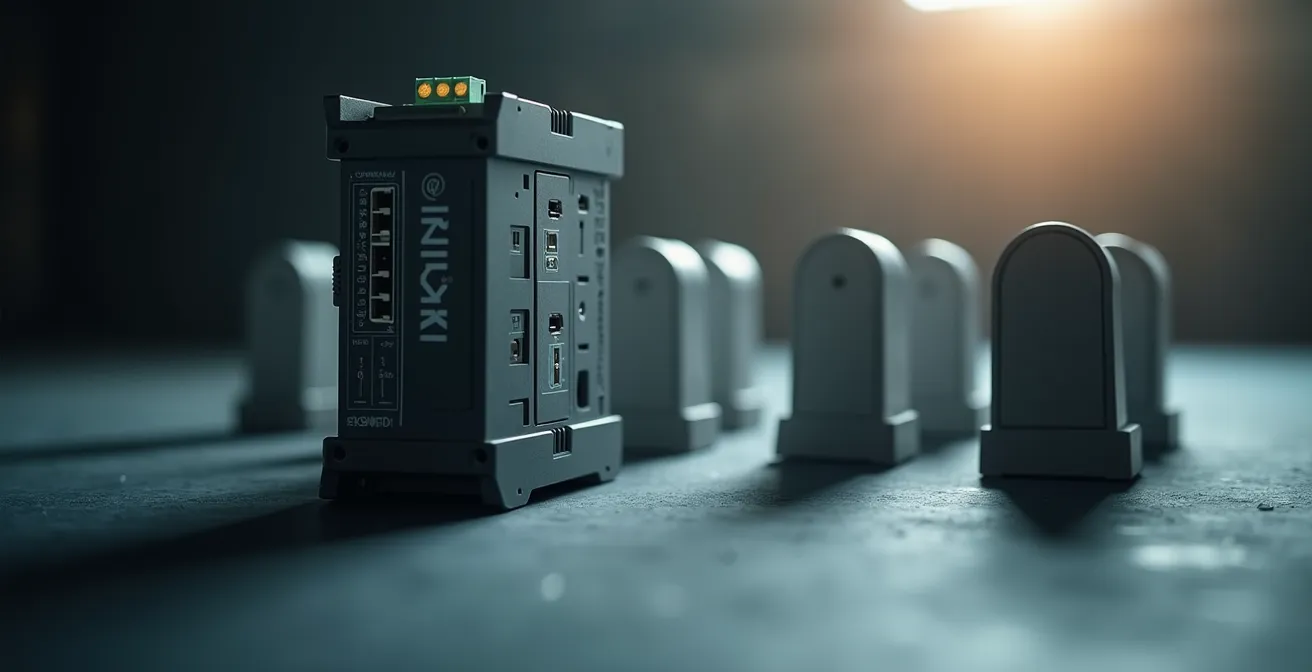
This open standard creates a competitive marketplace for devices, ensuring you are never locked into a single vendor. More importantly, it guarantees backward and forward compatibility. This robustness means that many 20-year-old KNX installations are still running perfectly today and can integrate with the latest devices. This is the definition of a future-proof investment. It transforms your smart home from a depreciating electronic liability into a permanent, value-enhancing asset of the property itself.
Choosing an open, wired protocol is the single most important decision you can make to protect your investment and ensure the intelligence of your home endures for decades.
Server Closet Essentials: Cooling and Power Backup
The digital foundation of a professional-grade smart home resides in a centralized equipment rack, often housed in a dedicated closet or utility room. This is the nerve center of the entire system, containing the processors, network switches, and power supplies that orchestrate every function in the home. Treating this space as an afterthought is a critical mistake. Just like any high-performance system, it requires a carefully controlled environment to ensure reliability and longevity.
The two most critical elements of this environment are cooling and power backup. Electronic components generate significant heat, and a sealed closet can quickly reach temperatures that cause equipment to malfunction or fail prematurely. A dedicated ventilation or active cooling solution is not a luxury; it is a requirement. Equally important is protecting the system from power fluctuations and outages. A simple power strip is inadequate. A rack-mounted Uninterruptible Power Supply (UPS) is essential to filter power and provide a seamless transition to backup power, preventing system crashes and data corruption during brief outages.
For true resilience, this UPS should be complemented by a connection to a whole-home generator for extended outages. This ensures that your home’s core systems—including lighting, security, and climate control—remain operational no matter the external conditions. Proper planning of this space from an architectural standpoint, with adequate clearance and cable management, is just as important as the technology it houses.
Action Plan: Professional Server Room Infrastructure
- Install thermostat-controlled exhaust fans with intake/outtake configuration for consistent airflow at a 65-75°F target temperature.
- Deploy a rack-mounted UPS system sized for 20-30 minutes of runtime, covering all critical infrastructure.
- Connect the server room circuit to a whole-home generator transfer switch for extended outage protection.
- Implement proper cable management with labeled patch panels and color-coded cabling from day one.
- Ensure front and rear rack access with a minimum of 36 inches of clearance for maintenance.
By engineering the “heart” of your smart home with the same rigor as the rest of the building’s utilities, you guarantee the stability and performance of the entire ecosystem.
Why Matter Is the Protocol That Will Save Smart Homes?
The conversation around smart homes is increasingly dominated by Matter, a new connectivity standard designed to improve interoperability between devices from different brands. There is a common misconception that Matter will replace existing protocols like KNX or that one should wait for Matter to mature before investing in a smart home. This misunderstands Matter’s purpose and its place within a professionally designed system architecture.
Matter is not a replacement for a robust, wired backbone. Instead, it is best understood as a powerful application layer protocol. Its primary strength is in simplifying the setup and control of accessory-level wireless devices like smart plugs, decorative lamps, and standalone sensors. It aims to solve the problem of having dozens of different apps for dozens of different gadgets. It does not, however, address the core requirements of mission-critical infrastructure like primary lighting circuits, HVAC systems, or motorized shades, which demand the deterministic reliability that only a wired system can provide.
The ideal architectural approach is not “KNX *or* Matter,” but “KNX *and* Matter.” A robust, wired KNX system serves as the home’s foundational layer for all critical functions. A Matter-compatible bridge or gateway is then used to integrate and unify the non-critical, wireless accessory devices. This creates a tiered system that leverages the strengths of each technology.
| System Layer | Recommended Protocol | Purpose |
|---|---|---|
| Core Infrastructure | KNX/Control4 (Wired) | Lighting, HVAC, Shades – Mission Critical |
| Bridge/Gateway | Matter-compatible Hub | Protocol Translation & Integration |
| Accessory Devices | Matter/Zigbee/Z-Wave | Smart Plugs, Bulbs, Sensors – Non-critical |
| User Interface | Unified App/Keypad | Single Control Point for All Layers |
By leveraging a wired backbone for reliability and Matter for accessory flexibility, you create a comprehensive and truly future-proof ecosystem that offers the best of both worlds.
How to Calibrate Your Smart Thermostat for Real Savings?
One of the most compelling promises of a smart home is energy efficiency, yet many consumer-grade smart thermostats fail to deliver substantial savings. This is because they operate on a simplistic logic: turn the HVAC system on when the temperature crosses a threshold, and turn it off when the setpoint is reached. This can lead to frequent cycling, temperature overshoots, and inefficient operation. A professionally integrated climate control system operates on a far more sophisticated level, achieving significant energy reductions through advanced calibration.
At the core of these systems are advanced algorithms, such as Proportional-Integral-Derivative (PID) control. Instead of a simple on/off switch, a PID algorithm learns the unique thermal properties of your home—how quickly it heats up and cools down. It can then modulate the HVAC system precisely to maintain a stable temperature without the inefficient peaks and valleys of basic thermostats. This intelligent control is a primary driver of efficiency, with professionally managed systems demonstrating substantial results. Comprehensive KNX-based automation can lower annual building energy use by up to 60% through this type of intelligent management.
This calibration is further enhanced by integrating data from multiple sources. A single thermostat in a hallway cannot make intelligent decisions for an entire home. A professional system uses an array of discreet room sensors, outdoor weather data, and even the position of automated shades to make holistic climate decisions. It can pre-cool a room before the afternoon sun hits it or use stored thermal mass to coast through peak energy pricing periods. This level of calibration moves beyond simple scheduling to true environmental management, delivering both superior comfort and tangible financial savings.
This intelligent, multi-faceted approach to climate control is a clear example of how a deeply integrated system delivers value that standalone wireless devices simply cannot match.
Key Takeaways
- A wired smart home is permanent infrastructure, not a collection of disposable gadgets.
- The Total Cost of Ownership for a wired system is often superior to wireless over 10 years due to reliability and zero subscription fees.
- Open standards like KNX offer true future-proofing against the risk of proprietary product discontinuation.
Connecting Disjointed Smart Devices Into One Ecosystem
The ultimate goal of a smart home is to create a seamless, cohesive environment where all systems work in concert. The common experience with DIY wireless solutions is the exact opposite: a fragmented collection of disparate devices, each with its own app and its own quirks, that never truly communicate. This “digital clutter” creates complexity and frustration, defeating the very purpose of home automation. The power of a wired, infrastructure-first approach is its ability to serve as a universal translator, unifying all elements of the home into a single, intelligent ecosystem.
This unification is possible because an open protocol like KNX is supported by a vast and mature ecosystem. With more than 8,000 certified KNX devices available from hundreds of manufacturers, there is a professionally-vetted solution for virtually any need, from lighting and HVAC to security and AV control. This guarantees interoperability at a deep, fundamental level. A lighting keypad from one brand can flawlessly control a shade motor from another because they speak the same core language. This is a stark contrast to the often-brittle integrations of the wireless world, which rely on cloud-to-cloud connections that can break at any time.
This commitment to a robust, open standard is what allows for the creation of truly sophisticated and personalized home automation scenes. As noted professional engineer Simon Buddle states, the success of these systems comes from “technically nailing it, job after job, house after house.”
Advertising, evangelising, demonstrating, but more than anything, technically nailing it, job after job, house after house, development after development, and that is what is driving the success of KNX.
– Simon Buddle CEng MIET, KNX Annual Review 2024
By investing in a wired backbone during your renovation, you are not just buying individual functions; you are creating the integrated platform upon which a truly intelligent, responsive, and effortless living experience can be built.
Frequently Asked Questions on Professional-Grade Smart Home Systems
What is PID loop calibration in professional systems?
PID (Proportional-Integral-Derivative) algorithms learn your home’s thermal properties over time, preventing temperature overshoots and undershoots for greater efficiency than simple on/off thermostats.
How do multiple sensors improve calibration accuracy?
Professional systems integrate room sensors, outdoor weather stations, and smart shade positions to make holistic climate decisions rather than relying on a single thermostat reading.
Can smart thermostats integrate with utility pricing?
Advanced systems can pre-cool or pre-heat during off-peak hours based on real-time utility pricing data, optimizing both comfort and energy costs.